


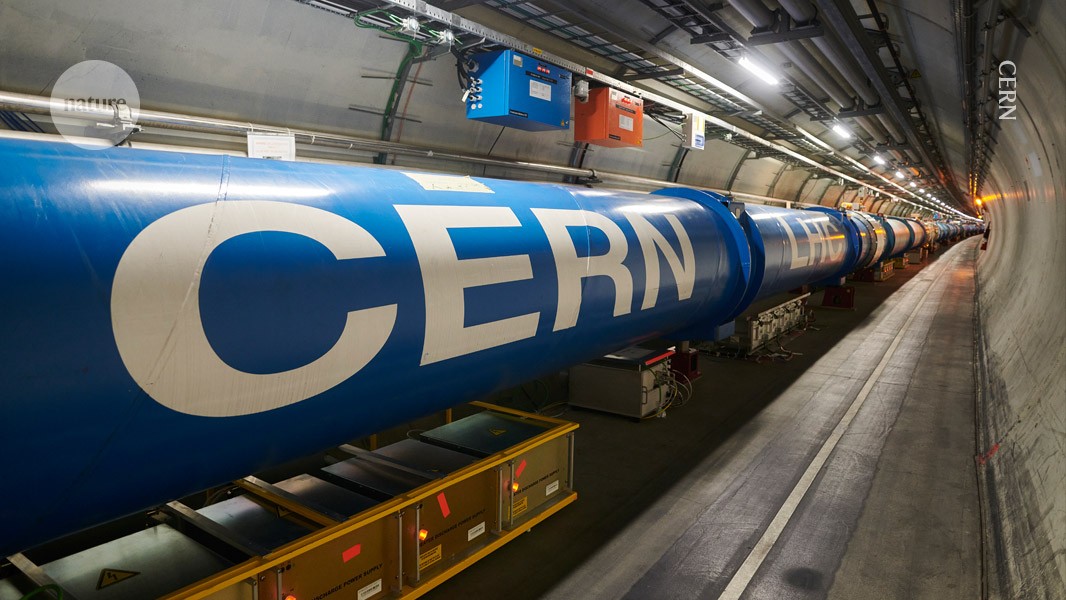

Funding reforms could impact UK physicists’ collaborations at CERN, Europe’s particle-physics laboratory.Credit: CERN
The United Kingdom’s researchers are an under-used asset “that we need to sweat” to boost economic growth, according to the head of the country’s largest funding agency.
Speaking at a parliamentary committee hearing in London on Tuesday, Ian Chapman, a physicist who leads UK Research and Innovation (UKRI), said that the high quality of the United Kingdom’s research and innovation base is its only competitive advantage over rival nations.
UKRI is the United Kingdom’s national funding agency for research and innovation, and has distributed about £9 billion (US$12 billion) of public money in the current financial year. Chapman said that UKRI needs major reform to convert expertise into ideas and companies that could create jobs and money for the UK economy. “It is latent at the moment. I think it’s under-exploited.”
However, media reports suggest that the reforms could drain university science of funds and put the nation’s participation in major international science projects in jeopardy, and have provoked concern and anxiety among researchers.
“This will hurt the UK research community very badly,” says Lucien Heurtier, a postdoctoral researcher in physics at King’s College London. He is organizing an open letter from postdocs and postgraduate students to make that point to Chapman, which he expects to publish later this week.
The reforms could leave large-scale physics infrastructure projects facing funding uncertainty. Those projects include an experiment called the LHCb, run using the Large Hadron Collider (LHC) at CERN, Europe’s particle-physics laboratory near Geneva in Switzerland.
“If the UK pulls out of these massive projects, it’s not clear that they will go ahead. It will have an international impact,” agrees Maggie Lieu, an astrophysicist at the University of Nottingham, UK.
Funding crisis
Three actions taken by UKRI have caused particular concern. First, of the nine research councils and other bodies that make up UKRI, three — the major funders of work in the medical, biological and physical sciences — have announced that they are temporarily blocking some grant applications. Second, another of the nine, the Science and Technology Facilities Council (STFC), has said it will cease or reduce investments in existing physics and astronomy projects. And third, researchers expecting money directly from the UKRI infrastructure fund have been told they have been de-prioritized.
Chapman said that the blocks on applications to the Medical Research Council (MRC) and the Biotechnology and Biological Sciences Research Council (BBSRC) are short-term measures. The BBSRC will reopen grant applications in a few weeks, and the pause at the MRC will last only until the summer, as it reassesses priorities.

UK university departments on the brink as higher-education funding crisis deepens
The situation at the STFC, which supports both university-led research and elements of the United Kingdom’s involvement in major international collaborations, is the result of a funding crunch. The UKRI leadership has asked the STFC to find about £60m in savings in what Chapman says are not budget cuts but “cost reduction against forecast costs”.
Although UKRI says no decisions have yet been made, physicists and astronomers are worried.
“Cuts of this scale are a devastating blow for the foundations of UK physics,” says Paul Howarth, president-elect of the UK Institute of Physics. “The government has promised boosts for areas like quantum, green tech and AI, and all of this is welcome, but the reality on the ground is hundreds of scientists being told their research is being slashed, jobs under threat, and no sign of the funding we’re told will replace it.”
Lieu fears her department will lose its remaining information technology support worker. “How do you do science without these resources? It’s massively concerning,” she says. “Astronomy degrees are what turn out the data scientists, or the machine-learning engineers.”
The STFC cost reductions could also threaten the United Kingdom’s continued participation in international projects such as the Vera C. Rubin Observatory in Chile — which, its team says, has the largest digital camera ever built.

