


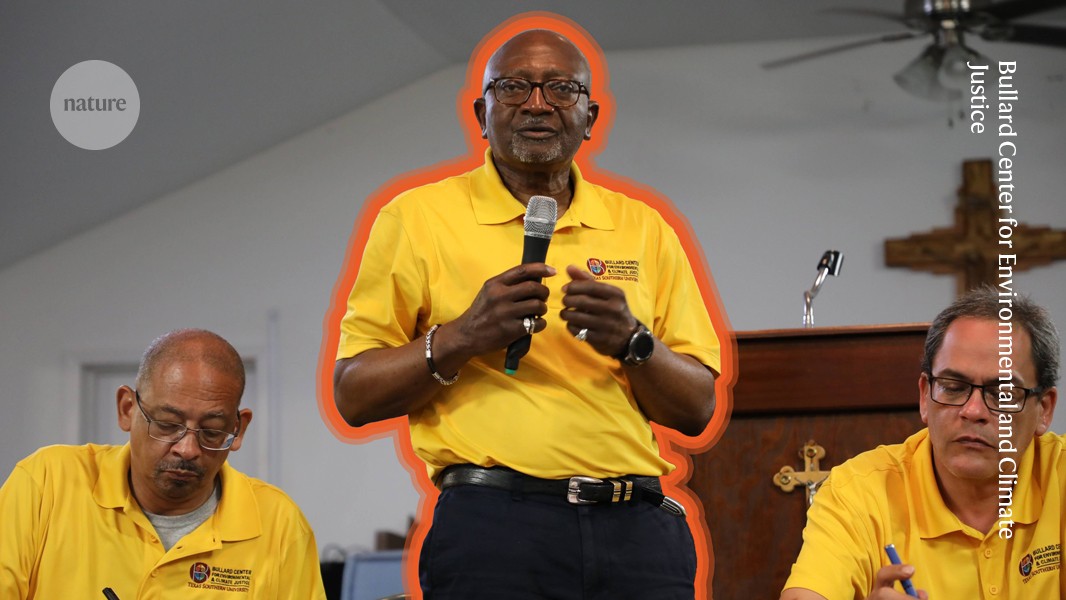
In the 1990s, Robert Bullard championed the then-emerging field of environmental justice. The field embraces the principle that all people and communities have a right to equal protection and equal enforcement of their environmental, health, housing, employment, energy, transportation and civil-rights laws and regulations. His first community-led research project, in the late 1970s, documented that solid-waste landfill sites in Houston, Texas, were more likely to be found in neighbourhoods that are predominantly Black. His data have bolstered lawsuits and policy changes to challenge the placing of landfill sites near predominantly Black schools.
Bullard has written 18 books, including Dumping in Dixie (1990), which is about the actions taken by five predominantly Black communities in the southern United States to protect the health of their residents from deadly pollution. The book has become a standard classroom textbook in the environmental justice field. In 2013, he co-convened the first Historically Black Colleges and Universities (HBCU) Climate Change Conference, which takes place each year in New Orleans, Louisiana. Bullard, who is the founding director of the Bullard Center for Environmental and Climate Justice at Texas Southern University in Houston, spoke to Nature’s careers team about his long career focusing on turning science into action.
What passions have driven you as a scientist?
The environmental justice movement brings together science, data, research and facts. But they are not enough to produce transformative change. When people talk about trying to achieve environmental, economic, climate and racial justice, they are referring to marrying all of those data with action, for example, through lawsuits or pressure to change public policies. That’s the movement. Forty years ago, there was no name for it. It is now called community-based, participatory research — converting research into action. That’s what I’ve tried to do. That’s my passion. I might have written 18 books over the past four decades, but it’s really all just one book on fairness, justice and equity.
Is there one thing from your career that you wish that you could have done differently?
I wish I had been able to reach out to more people before there was a body of knowledge or protocols for doing this research. Environmental sociology and urban sociology existed but they didn’t fit what I was doing, which is to say, my research considered that the environment includes everything — where we live, work, learn, play and worship. It’s the physical and natural world. I wish I had been able to convince people in various disciplines, such as health, ethics, demography and history, about the urgency of these environmental issues.

Robert Bullard inspects flood damage near Elba, Alabama.Credit: Bullard Center for Environmental and Climate Justice
In a lot of cases, researchers in my field worked with communities that had a lot of knowledge, but they didn’t know how to package their concerns in a way that would be respected by government officials. The burden of proof was not on the government agency or industry officials, but on the community. This type of research has to be driven from the bottom up, from communities that want to partner with academic researchers to ask these questions. It’s no surprise that the first universities to start doing this work in the 1990s were HBCUs, because they are often situated in the communities that are facing the biggest environmental challenges. Five HBCU-based centres — including the Environmental Justice Resource Center at Clark Atlanta University in Georgia and the Deep South Center for Environmental Justice at Xavier University of Louisiana in New Orleans — have provided the research foundation and theoretical framework underpinning the entire environmental justice movement.
Who was your biggest influence and why?
W. E. B. Du Bois, a leading figure in the US civil-rights movement, was an icon who crafted the framework for kick-ass sociology. He started the sociology department at Atlanta University in Georgia (now Clark Atlanta University), at which most of his research and writing was conducted. He did not shy away from criticising the US government and its policies that resulted in a lack of opportunity and equal treatment of Black people. He co-founded the National Association for the Advancement of Colored People (now known as the NAACP). He showed that you can do research and be objective, but you can also do research to effect policy. And you can speak out — and you can do that at a Black university.
When did you realize that you wanted to study issues tied to equity and racism?
I went to an all-Black elementary, middle and high school in Alabama in the 1950s and 60s. Everything was segregated: the schools, the swimming pool, the cemetery, the library. I couldn’t even go into the library when I was child. I don’t know if any of my books are in that library now.
Seeding opportunities for Black atmospheric scientists
But my grandmother believed in education. Together, we read about all sorts of Black leaders who overcame the odds to do great things for their communities — from Du Bois to George Washington Carver, a Black scientist and inventor. These were our heroes. After I finished my degree at Alabama Agricultural and Mechanical College in Huntsville, and spent two years in the US Marine Corps, I knew I wanted to get a master’s degree in the sociology department founded by Du Bois. After that I went on to earn a PhD in sociology at Iowa State University in Ames in 1976.
How have you dealt with racism and discrimination in your professional life?
It’s important for readers to understand that race is still a very potent factor in our society. Discrimination is hurtful. But when you experience discrimination, you can’t let it pull you under or freeze you in the moment.
To dismantle the power of racism in society, people have to have a strong will. They have to be laser-focused in their work. So, I don’t strive to be equal. I strive to work to the best of my abilities. Let your academic record speak for you. I’ll put my CV up against anyone else’s. Having that kind of track record requires less conversation about whether or not you are qualified for a position. That’s how I deal with it.

