




Artemis II science team members Jacob Richardson (left) and Kiarre Dumes react to the astronauts’ observations during the Moon fly-by.Credit: NASA/Luna Posadas Nava
Johnson Space Center, Houston, Texas
On Monday this week, as four humans flew around the far side of the Moon, I entered the heart of the Artemis II mission’s science operations.
Historic Artemis II Moon fly-by: Nature’s live coverage as it happened
The door creaked open, and I slipped into a mesh office chair by the wall. I watched the faces of researchers I knew well: lunar scientists I’d talked to at conferences, met on field trips or followed during the days when Twitter existed. Many were women; many were early in their careers.
Now they were focusing on Marie Henderson, NASA’s deputy lunar-science lead for Artemis II. She stood at the front of the room, beneath a row of display screens that showed a countdown clock and the astronauts inside the spacecraft they had named Integrity, a view of the Moon growing larger in their window. The lunar fly-by — a nearly seven-hour period when the astronauts would observe the Moon as they travelled past it — was about to start.
One by one, Henderson polled the scientists for their ‘go’ or ’no go’ signal. After she’d collected them all, she reached her decision: “We are go for lunar fly-by.” The tension in the room ratcheted up a little bit more.
Lunar rhapsody
In the end, those hours went swimmingly. The Artemis II astronauts — Reid Wiseman, Victor Glover, Christina Koch and Jeremy Hansen — pulled off a nearly flawless sequence of lunar observations. Drawing on their pre-mission training in geology and imaging, they described, photographed and marvelled at the Moon, observing parts of its far side that no human had seen in sunlight before.
After a few hours, I was gently hustled out of the science-evaluation room to make space for others. So I didn’t see the scientists’ faces when the astronauts reported seeing green and brown hues on the lunar surface, rather than just greys, or when Glover rhapsodized about the shadows along the ‘terminator’, the boundary between day and night on the Moon.
Marie Henderson, another leader of the Artemis II science team, smiles as the astronauts express their awe of the Moon.Credit: NASA/Luna Posadas Nava
A later news conference revealed that there were “audible screams of delight” in the room when Wiseman reported that the astronauts had seen multiple ‘impact flashes’, created when tiny meteorites pelted the lunar surface.
More observations flooded in during the remainder of the fly-by. The Artemis II crew saw mountains and cliffs. They saw features shaped like human hand prints and dinosaur footprints. Towards the end of the passage, they witnessed a total solar eclipse for nearly an hour. “There’s absolutely no words to describe what we are looking at out this window,” Wiseman said.
The rush of imagery
As the fly-by drew to a close, we journalists waited not-so-patiently to see the images the astronauts had recorded. We would have to hang on until morning. They were transmitted overnight Houston time, and NASA’s image-processing wizards worked their magic in the wee hours of Tuesday to get them ready for public viewing. I talked to David Hollibaugh Baker, a NASA planetary geologist who helps to lead the archiving of the mission’s data. He had been on a sleep shift for the first part of the night, and arrived at the space centre after the first images were up on the computer displays. “I opened up the door, and there was the Moon,” he said. “My heart was racing … I never felt that kind of rush before.”
The image that hit him on entering the room showed the Moon eclipsing the Sun, with an ethereal glow radiating into space from around the darkened lunar disk. Planets from Mercury to Neptune studded the surrounding blackness of space like a line of diamond chips.

Artemis II scientists work in the mission’s scientific nerve centre, a room where live data and observations flow from the astronauts back to Earth.Credit: NASA/Bill Stafford
And that was it. By Tuesday afternoon, with the fly-by over and the data now in hand, the scientists were ready to get to work.
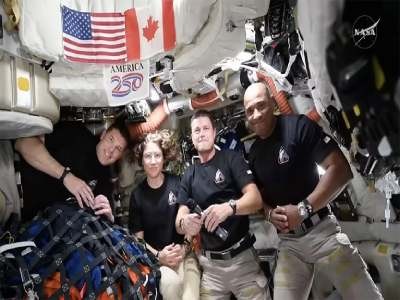
I sat in the room once more, this time to observe a meeting between the astronauts and the scientists. The researchers had a precious 20 minutes to ask the Artemis II crew follow-up questions about their lunar observations, before the astronauts’ memories faded. “This is going to be tightly choreographed,” said Jacob Richardson, NASA’s deputy lunar-science lead who was now in charge.
Capturing memories
The questions flowed into space, relayed by the mission lunar-science lead, NASA geologist Kelsey Young. Had the astronauts really seen impact flashes, or could the bursts of light in their vision have been caused by cosmic rays? No, the astronauts said. They knew what cosmic-ray flashes looked like. “I definitely see a dozen or two every night when I’m going to sleep,” one of them said. “The impact flashes were absolutely different.”

