


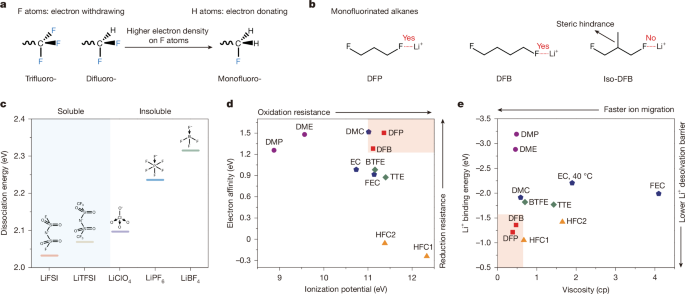
Lu, D. et al. Ligand-channel-enabled ultrafast Li-ion conduction. Nature 627, 101–107 (2024).
Fan, X. & Wang, C. High-voltage liquid electrolytes for Li batteries: progress and perspectives. Chem. Soc. Rev. 50, 10486–10566 (2021).
Jie, Y. et al. Towards long-life 500 Wh kg−1 lithium metal pouch cells via compact ion-pair aggregate electrolytes. Nat. Energy 9, 987–998 (2024).
Shen, L. et al. Creating lithium-ion electrolytes with biomimetic ionic channels in metal–organic frameworks. Adv. Mater. 30, 1707476 (2018).
Song, X. et al. Practical lithium-sulfur batteries: beyond the conventional electrolyte concentration. ACS Energy Lett. 9, 5576–5586 (2024).
Holoubek, J. et al. Tailoring electrolyte solvation for Li metal batteries cycled at ultra-low temperature. Nat. Energy 6, 303–313 (2021).
Piao, N. et al. Designing temperature-insensitive solvated electrolytes for low-temperature lithium metal batteries. J. Am. Chem. Soc. 146, 18281–18291 (2024).
Shi, J. et al. An amphiphilic molecule-regulated core-shell-solvation electrolyte for Li-metal batteries at ultra-low temperature. Angew. Chem. Int. Ed. 135, e202218151 (2023).
Chen, Y. et al. Steric effect tuned solvation enabling stable cycling of high-voltage lithium metal battery. J. Am. Chem. Soc. 143, 18703–18713 (2021).
Zhang, J. et al. Lithium metal anodes with nonaqueous electrolytes. Chem. Rev. 120, 13312–13348 (2020).
Xu, K. Nonaqueous liquid electrolytes for lithium-based rechargeable batteries. Chem. Rev. 104, 4303–4418 (2004).
Yu, Z. et al. Rational solvent molecule tuning for high-performance lithium metal battery electrolytes. Nat. Energy 7, 94–106 (2022).
Amanchukwu, C. V. et al. A new class of ionically conducting fluorinated ether electrolytes with high electrochemical stability. J. Am. Chem. Soc. 142, 7393–7403 (2020).
Ma, P. et al. Effect of building block connectivity and ion solvation on electrochemical stability and ionic conductivity in novel fluoroether electrolytes. ACS Cent. Sci. 7, 1232–1244 (2021).
Zhang, S. et al. Oscillatory solvation chemistry for a 500 Wh kg−1 Li metal pouch cell. Nat. Energy 9, 1285–1296 (2024).
Yin, Y. et al. Fire-extinguishing, recyclable liquefied gas electrolytes for temperature-resilient lithium-metal batteries. Nat. Energy 7, 548–559 (2022).
Wu, Z. et al. Deciphering and modulating energies of solvation structure of solvation structure enables aggressive high-voltage chemistry of Li metal batteries. Chem 9, 656–664 (2023).
Rustomji, C. S. et al. Liquefied gas electrolytes for electrochemical energy storage devices. Science 356, eaal4263 (2017).
Staley, R. H. et al. Intrinsic acid-base properties of molecules. Binding energies of lithium(1+) ion to .pi.- and n-donor bases. J. Am. Chem. Soc. 97, 5920–5921 (1975).
Li, Z. et al. Non-polar ether-based electrolyte solutions for stable high-voltage non-aqueous lithium metal batteries. Nat. Commun. 14, 868 (2023).
Yang, S. et al. Regulating the electrochemical reduction kinetics by the steric hindrance effect for a robust Zn metal anode. Energy Environ. Sci. 17, 1095–1106 (2024).
Crabb, E. et al. Electrolyte dependence of Li+ transport mechanisms in small molecule solvents from classical molecular dynamics. J. Phys. Chem. B 128, 3427–3441 (2024).
Son, C. Y. et al. Ion transport in small-molecule and polymer electrolytes. J. Chem. Phys. 153, 100903 (2020).
Efaw, C. M. et al. Localized high-concentration electrolytes get more localized through micelle-like structures. Nat. Mater. 22, 1531–1539 (2023).
Cao, X. et al. Optimization of fluorinated orthoformate based electrolytes for practical high-voltage lithium metal batteries. Energy Storage Mater. 34, 76–84 (2021).
Park, E. et al. Exploiting the steric effect and low dielectric constant of 1,2-dimethoxypropane for 4.3 V lithium metal batteries. ACS Energy Lett. 8, 179–188 (2023).
Zhang, G. et al. A monofluoride ether-based electrolyte solution for fast-charging and low temperature non-aqueous lithium metal batteries. Nat. Commun. 14, 1081 (2023).
Xu, J. et al. Revealing the anion–solvent interaction for ultralow temperature lithium metal batteries. Adv. Mater. 36, 2306462 (2024).
Li, T. et al. Stable anion-derived solid electrolyte interphase in lithium metal batteries. Angew. Chem. Int. Ed. 133, 22865–22869 (2021).
Wu, Q. et al. Effect of the electric double layer (EDL) in multicomponent electrolyte reduction and solid electrolyte interphase (SEI) formation in lithium batteries. J. Am. Chem. Soc. 145, 2473–2484 (2023).
Kim, S. C. et al. Potentiometric measurement to probe solvation energy and its correlation to lithium battery cyclability. J. Am. Chem. Soc. 143, 10301–10308 (2021).
Tang, T. Long-lifespan 522 Wh kg−1 lithium metal pouch cell enabled by compound additives engineering. Angew. Chem. Int. Ed. 64, e202417471 (2025).
Qiao, R. et al. Non-fluorinated electrolytes with micelle-like solvation for ultra-high-energy density lithium metal batteries. Chem 11, 102306 (2025).
Ji, H. et al. Liquid–liquid interfacial tension stabilized Li-metal batteries. Nature 643, 1255–1262 (2025).
Troup, R. I. et al. Skipped fluorination motifs, synthesis of building blocks and comparison of lipophilicity trends with vicinal and isolated fluorinated motifs. J. Org. Chem. 86, 1882–1900 (2021).
Frisch, M. et al. Gaussian 16 Rev. C.01. Gaussian Inc. (2016).
Weigend, F. et al. Balanced basis sets of split valence, triple zeta valence and quadruple zeta valence quality for H to Rn: design and assessment of accuracy. Phys. Chem. Chem. Phys. 7, 3297–3305 (2005).
Kresse, G. et al. Efficient iterative schemes for ab initio total-energy calculations using a plane-wave basis set. Phys. Rev. B 54, 11169–11186 (1996).
Perdew, J. P. et al. Generalized gradient approximation made simple. Phys. Rev. Lett. 77, 3865–3868 (1996).
Berendsen, H. J. C. et al. GROMACS: a message-passing parallel molecular dynamics implementation. Comput. Phys. Commun. 91, 43–56 (1995).
Wang, J. et al. Development and testing of a general amber force field. J. Comput. Chem. 25, 1157–1174 (2004).
Singh, U. C. et al. An approach to computing electrostatic charges for molecules. J. Comput. Chem. 5, 129–145 (1984).
Ravikumar, B. et al. Molecular dynamics investigation of electric field altered behavior of lithium ion battery electrolytes. J. Mol. Liq. 300, 112252 (2020).
Kühne, T. D. et al. CP2K: an electronic structure and molecular dynamics software package – Quickstep: efficient and accurate electronic structure calculations. J. Chem. Phys. 152, 194103 (2020).

