


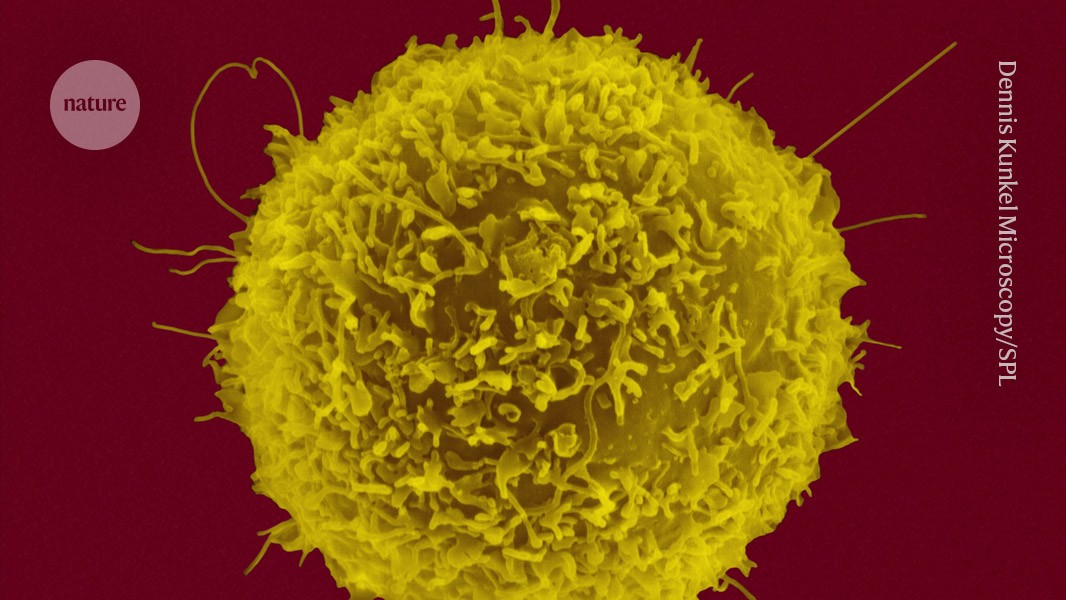

Immune cells called T cells help the body to fight off infection.Credit: Dennis Kunkel Microscopy/SPL
A cellular atlas that characterizes the functions of immune cells in more than 400 Chinese individuals has revealed key differences in the biology of people from different populations.
The study, published today in Science1, compiles a ‘multi-omic’ atlas of immune cells in the blood. It draws together data on genes, proteins, RNA and the epigenome to study how this group of cells works. Dubbed the Chinese Immune Multi-Omics Atlas (CIMA), the atlas finds important variation in immune-cell functions compared with those charted in similar data sets from European and Japanese cohorts.
“By providing a data set that complements other Asian cohorts like the Japanese ImmuNexUT project, we have created a resource that allows for the discovery of biological mechanisms and genetic associations that would likely be missed in European-centric studies,” write the authors in a joint statement to Nature.
Diverse data sets
Researchers have created multi-omic atlases for several cell types, using them to tackle specific questions relating to the brain, Alzheimer’s disease and the immune system. But these atlases often rely mainly on data from people of European origin. This means that medicines designed on the basis of cell characteristics in these atlases might not be effective in individuals who have other ancestries.
Cellular atlases are unlocking the mysteries of the human body
To address this gap, Jianhua Yin at the Shanxi Medical University–BGI Collaborative Center for Future Medicine in Taiyuan, China, and his colleagues analysed more than 10 million immune cells in blood samples from 428 healthy Chinese adults at multi-omics levels.
The atlas provides biomolecular indicators for each individual, including metabolite profiles, blood biochemical markers, chromatin accessibility data and differences in gene expression across cell populations.
The researchers compared their data set to results from the OneK1K project, which analysed people with northern European ancestry2 , and the Japanese ImmuNexUT project3. They found that core immune pathways and cell types are the same in the different populations.
But there were differences in genetic regulation and in immune-cell states between the atlases. When it came to looking for variations near specific genes that influence how active a gene is, for example, the researchers found that more than 93% of these targets in the CIMA data overlapped with those in the Japanese cohort, but only about 44% of them overlapped with the European group.
One example of divergence is the rs11886530 gene variant, which is common in East Asian populations but rare in Europeans. In the CIMA data, this allele was found to regulate the circadian-clock genes NPAS2 and NR1D1 in immune cells called T cells. According to the authors, this mechanism has never been observed before in immune cells.
“I think the atlas is a really clinically important resource,” says Kay Chung, an immunologist at the University of North Carolina School of Medicine in Chapel Hill. “This could be useful for personalized medicine and also to check on drug interactions that might be specific to a certain population.”
Age and sex differences
The group of people the authors studied were aged between 20 and 77 years and contained 189 men and 239 women, so there were enough participants to tease out variations in immune-cell behaviour related to age and sex.
They found that increased age was associated with having more white blood cells that drive inflammation, and with altered gene expression in dendritic cells, which act as messengers in the immune system.

