


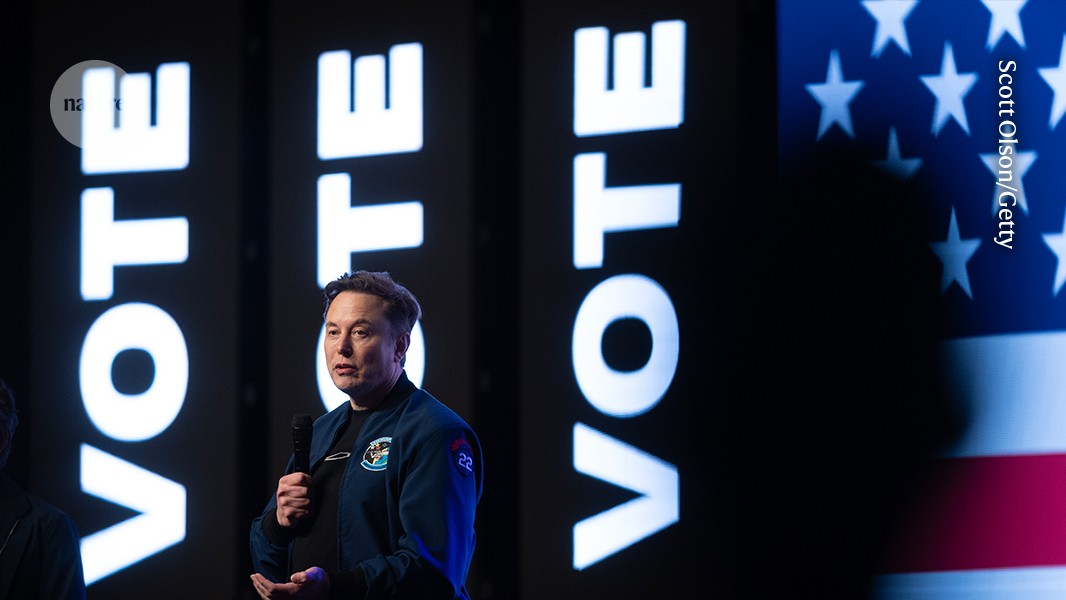

Business chief executives, including Elon Musk, have become increasingly involved in US elections.Credit: Scott Olson/Getty
Gilded Rage: Elon Musk and the Radicalization of Silicon Valley Jacob Silverman Bloomsbury Continuum (2025)
Over the past 20 years, big technology companies in the United States have exerted an outsized influence on the country’s politics. Initially, it was through conventional lobbying. Google, for instance, was one of the most influential lobbying organizations in Washington DC during the administration of former president Barack Obama. But the methods of big-tech executives have become much more direct and, today, are often highly disruptive.

How to end outrage and detoxify politics: share stories, not statistics
In Gilded Rage, journalist Jacob Silverman describes how some of the United States’ wealthiest men, who have enriched themselves during the technology boom of the past 20 years, are recasting themselves as ideological ‘rage pundits’.
In this guided tour of the origins and ascent of “America’s self-designated innovator class”, Silverman traces how people once seen as outliers in President Donald Trump’s orbit — including space mogul Elon Musk and Palantir Technologies co-founder Peter Thiel — became messianic ideologues. Their wealth, software platforms and online networks now have begun to influence democratic elections in the United States and around the world.
What is the message or world view these individuals promote? According to Silverman, it is one in which ordinary people have little power or hope, democratic agency is hollowed out and political life bends to the will of a self-appointed group of wealthy individuals.
Tech oligarchy
Although the United States has previously seen periods of close alignment between industry and government, Silverman argues that the present moment marks a qualitative break, even compared with Trump’s first administration.

The dangerous fantasies driving the quest for super-intelligent AI
What distinguishes this era, he suggests, is not merely the technology sector’s deference to presidential power, but also its increasingly open advocacy for many of the current president’s most controversial policies. This is a matter of deep concern, because California’s Silicon Valley is more powerful than ever.
Tech companies are dominant actors across entire parts of the economy and social life. They structure markets, shape public discourse and operate vast systems of data extraction — using and surveilling personal information at a planetary scale, often with limited transparency.
The spectacle of tech executives ‘bending the knee’ after Trump’s decisive 2024 presidential victory is unsurprising. What feels new, however, is the ideological fervour radiating from parts of Silicon Valley.

Several tech entrepreneurs attended Donald Trump’s presidential inauguration in 2025.Credit: AP Photo/Julia Demaree Nikhinson/Newscom/Alamy
Consider Musk, whose increasingly reactionary and combative online persona has blurred the line between chief executive and political agitator. Several media outlets credit him with having a direct role in shaping the electoral climate that returned Trump to office. Meanwhile, people such as Thiel and crypto-currency investor David Sacks now speak with greater confidence and visibility and consider themselves ideological visionaries in a post-liberal age.
Thiel, Musk, the venture capitalist Marc Andreessen and others have also amplified the voices of ‘dark enlightenment’ thinkers, including philosopher Nick Land and far-right writer Curtis Yarvin, whose work openly derides democracy and who express admiration for rule by chief executives or a dictator.
All of this prompts a deeper question: why are some of the most powerful individuals in the planet’s history so pessimistic about democracy and humanity’s future? Could they not direct their wealth and influence towards addressing the crises — including climate change, polarization and economic inequality — that the digital age has, in part, intensified?

