


You have full access to this article via your institution.
Hello Nature readers, would you like to get this Briefing in your inbox free every day? Sign up here.
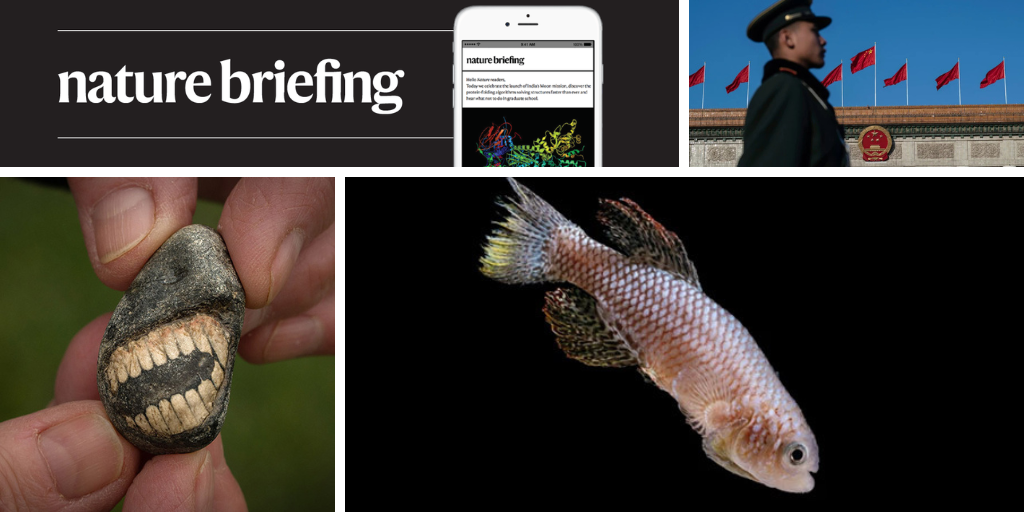
You snooze, you lose: young killifish (Nothobranchius furzeri) that take daytime naps have relatively short lives. Credit: Andrew Brodhead/Stanford Univ.
The sleep patterns and activity levels of African turquoise killifish (Nothobranchius furzeri) can be used to predict how long the fish will live. Researchers studied a group of killifish from adolescence to death and found that young fish that spent more of their waking hours being active tended to live longer than did more-sluggish fish. Young fish that only slept during evening hours also reached a riper age than did those that snoozed during the day. The findings hint that even early-adulthood behaviour can predict future lifespan, says neuroscientist Agustín Ibáñez.
The voracious demand for high-speed random access memory (RAM) chips for use in artificial-intelligence systems has driven a global shortage — making it more difficult for some researchers to get their hands on them. This ‘RAMmageddon’ has caused the prices of such chips to soar, pricing out laboratories that are already struggling with tight budgets. The shortage could also push researchers to develop more efficient algorithms and hardware that need less memory. It could take manufacturers 18 months or more to ramp up chip supply, experts say.
China is pledging to use ‘extraordinary measures’ to support the country’s bid to become a global leader in artificial intelligence, quantum technology and other cutting-edge technological fields, according to its latest five-year plan. The plan also doubles down on the government’s long-term goal of becoming more self-sufficient by making technologies, such as advanced semiconductor chips, domestically. The confident tone of the plan marks a shift in sentiment among Chinese science policymakers, who five years ago viewed the country as in need of catching up to the United States rather than leading it, says information scientist Meicen Sun.
Features & opinion
Canada’s government has invested Can$1 billion (US$734 million) to attract 100 leading international researchers to the country, particularly US researchers looking to flee north of the border. But the rush to recruit these Canada Impact+ Research Chairs is turning into “a competitive scramble with little regard for downstream effects”, argue ecologist Amanda Bates and mathematician Marni Mishna. Best hiring practices — including equity, diversity and inclusion protocols — are being put aside in favour of blunt indicators of prestige, informal networks and word of mouth. Meanwhile, up-and-coming Canadian talent is being neglected, Bates and Mishna write.
Image of the week

Credit: Tony Jolliffe/BBC
This grinning stone is actually a fossilized ancient organism: the teeth-like ‘beads’ are parts of the stem of a marine animal called a crinoid. Crinoids are part of the phylum Echinodermata, which includes sea urchins and sea cucumbers. Crinoids first appeared about 500 million years ago, and versions of them still exist today. This one was spotted by fossil-hunter Christine Clark on Holy Island in the United Kingdom.
See more of the month’s sharpest science shots, selected by Nature’s photo team. (Tony Jolliffe/BBC)
On Friday, Leif Penguinson was hiding among the wildlife of Browns Canyon National Monument in Colorado. Did you find the penguin? When you’re ready, here’s the answer.
Thanks for reading,
Flora Graham, senior editor, Nature Briefing
With contributions by Jacob Smith
• Nature Briefing: Careers — insights, advice and award-winning journalism to help you optimize your working life
• Nature Briefing: Microbiology — the most abundant living entities on our planet — microorganisms — and the role they play in health, the environment and food systems
• Nature Briefing: Anthropocene — climate change, biodiversity, sustainability and geoengineering
• Nature Briefing: AI & Robotics — 100% written by humans, of course
• Nature Briefing: Cancer — a weekly newsletter written with cancer researchers in mind
• Nature Briefing: Translational Research — covers biotechnology, drug discovery and pharma


