


You have full access to this article via your institution.
Hello Nature readers, would you like to get this Briefing in your inbox free every day? Sign up here.

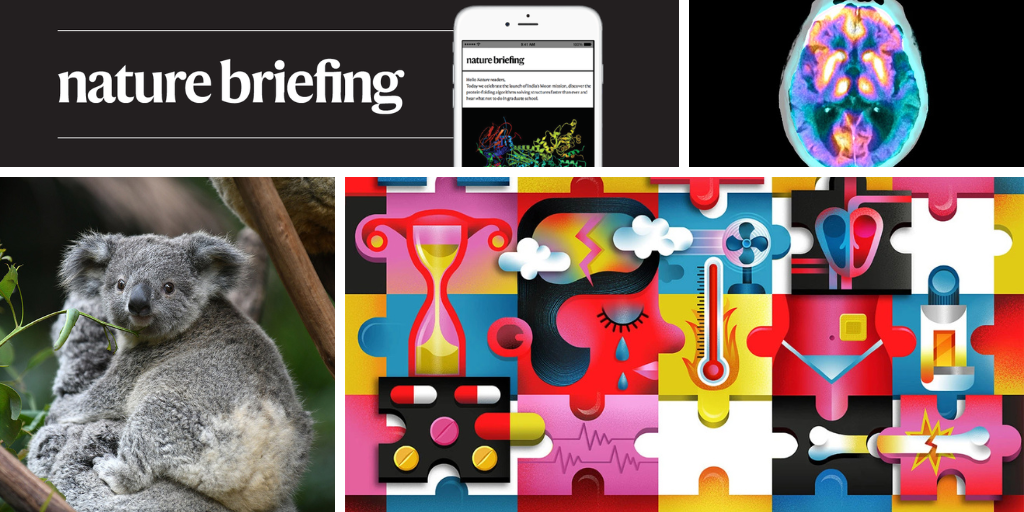
In some parts of Australia, koalas were hunted nearly to extinction by the early twentieth century.Credit: VCG via Getty
Koalas (Phascolarctos cinereus) in Victoria, Australia recovered from a severe genetic bottleneck through an increase in recombination — a process in which the DNA from two parents gets shuffled to form new sequences in their offspring — during a rapid population expansion. Researchers found that the number of individuals that breed and contribute to the next generation’s gene pool has jumped substantially in the past few decades, despite previously collapsing by more than 90%. The findings suggest that even species pushed to the brink of extinction can recover lost genetic diversity.
Tanycytes — specialized cells that clear toxic proteins from the brain — malfunction in people with Alzheimer’s disease, which leads to the build-up of abnormal tau proteins that characterizes the condition. From samples of blood and cerebrospinal fluid (CSF), researchers found that less tau had moved from the CSF to the bloodstream in people with Alzheimer’s compared with people who did not have the disease, which suggested that tanycytes weren’t working properly. They then looked at post-mortem tissue samples and found that tanycytes were destroyed or fragmented in people with Alzheimer’s.
Reference: Cell Press Blue paper
Chemists have synthesized a new type of carbon-based molecule with an unprecedented twist in its structure. The team calls the looped molecule a ‘half-Möbius’, inspired by the Möbius strip — a twisted loop with one continuous surface. In the half-Möbius molecule, the chain of atoms is twisted by 90° to make the loop, instead of the full 180º seen in a standard Möbius strip. The molecule can exist in two versions depending on whether it twists left or right. The versions differ in chirality, meaning that they are mirror images of each other.
Features & opinion
Mathematician Rafael Prieto-Curiel and his colleagues have created a mathematical model that revealed Mexico’s powerful drug cartels are the country’s fifth-largest employer. The model suggests that the government’s current strategy could lead to more casualties, more incarceration — and bigger cartels. “That result is one of the darkest results I have ever had in my research career,” says Prieto-Curiel. But finding ways of preventing people from joining organized crime groups could cut casualties and reduce cartel size — if they can be successfully implemented in the real world.
A dedicated scientist must follow the call of the wild in the latest short story for Nature’s Futures series.
Andrew Robinson’s pick of the top five science books to read this week includes a campaigning guide to alternative meats, a history of the groundbreaking Montreal Neurological Institute and a stimulating analysis of the many paradoxes that are raised by the development of AI tools.
In today’s penguin-search puzzle, Leif Penguinson is exploring the exposed bed of the Mayo-Louti river in Cameroon during a dry spell. Can you find the penguin?
The answer will be in Monday’s e-mail, all thanks to Briefing photo editor and penguin wrangler Tom Houghton.
This newsletter is always evolving — tell us what you think! Please send your feedback to [email protected].
Thanks for reading,
Flora Graham, senior editor, Nature Briefing
With contributions by Jacob Smith
• Nature Briefing: Careers — insights, advice and award-winning journalism to help you optimize your working life
• Nature Briefing: Microbiology — the most abundant living entities on our planet — microorganisms — and the role they play in health, the environment and food systems
• Nature Briefing: Anthropocene — climate change, biodiversity, sustainability and geoengineering
• Nature Briefing: AI & Robotics — 100% written by humans, of course
• Nature Briefing: Cancer — a weekly newsletter written with cancer researchers in mind
• Nature Briefing: Translational Research — covers biotechnology, drug discovery and pharma


