


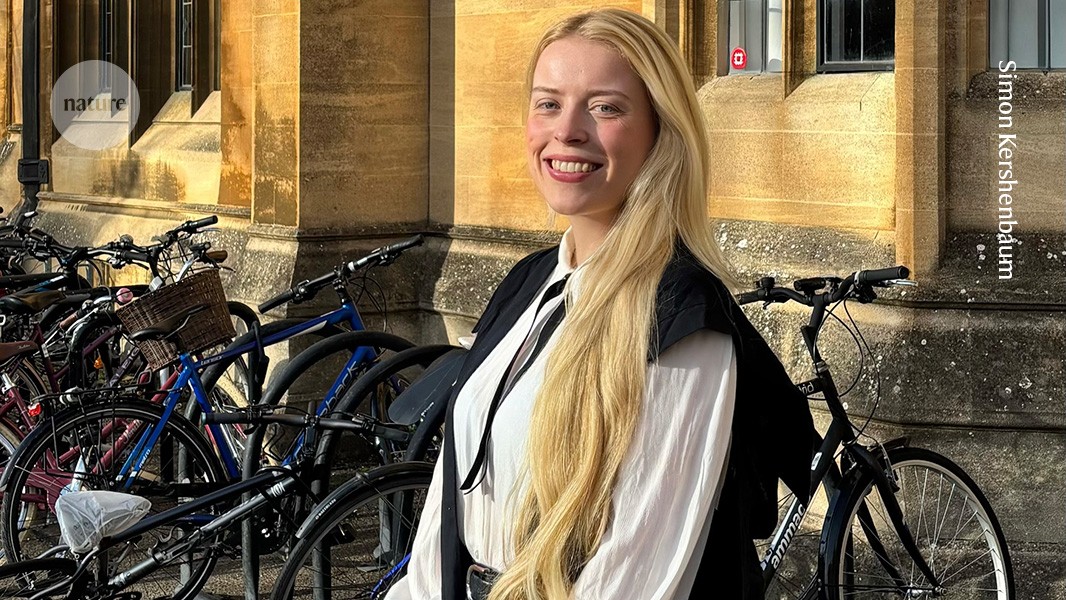

Juliet Turner was harassed on social media after posting about the successful completion of her PhD.Credit: Simon Kershenbaum
After devoting nearly four years to my PhD research on how insects cooperate and divide labour, I thought nothing of posting a photo on social media to celebrate passing the final oral examination of my degree. I wore a traditional academic gown, smiling in front of the golden limestone walls of New College at the University of Oxford, UK. “You can call me Doctor,” I wrote, punctuated with a sunglasses emoji. Maybe a bit cheeky, but harmless. Or so I thought.
In just a few hours, a screenshot of my post had been circulated widely on the social-media platform X, accompanied by comments questioning my competence and the wisdom of my life choices, rating my physical appearance and speculating about my fertility. One read, “they just handing doctorates out to anyone now” and another suggested that I would have spent my time better by having four babies instead of studying. One such post now has more than 21 million views.
I’d seen this kind of hostility before: a year earlier, an academic at the University of Cambridge, UK, had posted about her thesis on the politics of smell and was subjected to similar derision. Naively, I assumed that by working in a scientific field, I was safe. It quickly became clear that the common denominator between people targeted for ‘daring’ to post about their academic accomplishments was not their discipline, but their gender.
Meeting misogyny head-on
When the backlash escalated, I had three options: stay silent, delete the post or confront the comments. I decided on the last, mostly because these comments and beliefs just seemed so bizarre and entertaining to me that I felt I should share them with the world. It was so difficult to take them seriously that I started finding them funny.
I began reposting the best examples with commentary. Here are some highlights.
“I’m sure [your thesis] keeps you warm at night while your eggs shrivel and die.”
“If you follow an academic career, you will be unlikely to ever have or raise children — thus billions of years of evolution and suffering ends with you and your thesis.”
“Congrats on successfully becoming a biologist, but failing at biology. You are 30 years old with no husband or kids — a genetic dead end in an unbroken line of succession from your ancestors since the beginning of time. But hey, at least you have your cats to keep you company!”

Is the Internet bad for you? Huge study reveals surprise effect on well-being
For the record, not that it really matters, I am 27, live with my partner and am the product of an academic family. The idea that earning a doctorate means resigning yourself to a life of loneliness and ‘evolutionary failure’ felt wildly disconnected from reality. The commenters were correct that I do have a cat, and he is good company; he even got an official acknowledgement on my thesis.
These personal circumstances made it easier to be resilient and sometimes laugh in the face of the vitriol. However, I kept thinking about how it might feel to receive comments like this as an undergraduate, as someone who is still uncertain about their life choices, or perhaps as someone simply having a bad day. That made me feel like I had a responsibility to push back, publicly and visibly, and to expose the absurdity of these narratives.
I sifted through sprawling threads of comments in which men (it was only men) speculated about my life choices, and selected the most revealing examples of misogynistic posts to highlight. In my responses, I alternated between humorous commentary and genuine explanations of my research.
Redirecting attention to my research
Because countless eyes were suddenly on my profile, I used the attention to introduce people to my work in the field of social evolution, including the insights that it can provide about the development of multicellularity. As one of my supervisors said, “get them in with the rage baiting, then give them biology.” Later that week, ‘rage bait’ became the Oxford University Press word of the year for 2025.
I took the opportunity to share one of my papers, which was published in Nature Ecology & Evolution in 2024. In it, my co-authors and I showed that larger colony sizes in ants enabled the evolution of a greater number of specialized worker castes1. This is part of my laboratory’s research into evolutionary patterns. The findings offer insights into how biological systems divide labour by delegating it to different groups of specialized cells — a process that made it possible for single cells to evolve into complex multicellular organisms.
Sharing our work with my newly engaged audience was met with enthusiasm and curiosity, and even some previously hostile commenters had to admit that this work was pretty cool. This inspired me to keep going, so I also shared a paper that my colleagues and I published this year in Evolution, which tackled similar ideas2.

Juliet Turner completed a PhD focused on cooperative insects and how they distribute labour.Credit: Juliet Turner
I posted my thesis title page too, and then my abstract, and I watched in disbelief as they were circulated around the Internet by haters and supporters alike. I wondered if I could send over my CV for worldwide distribution, too.

