


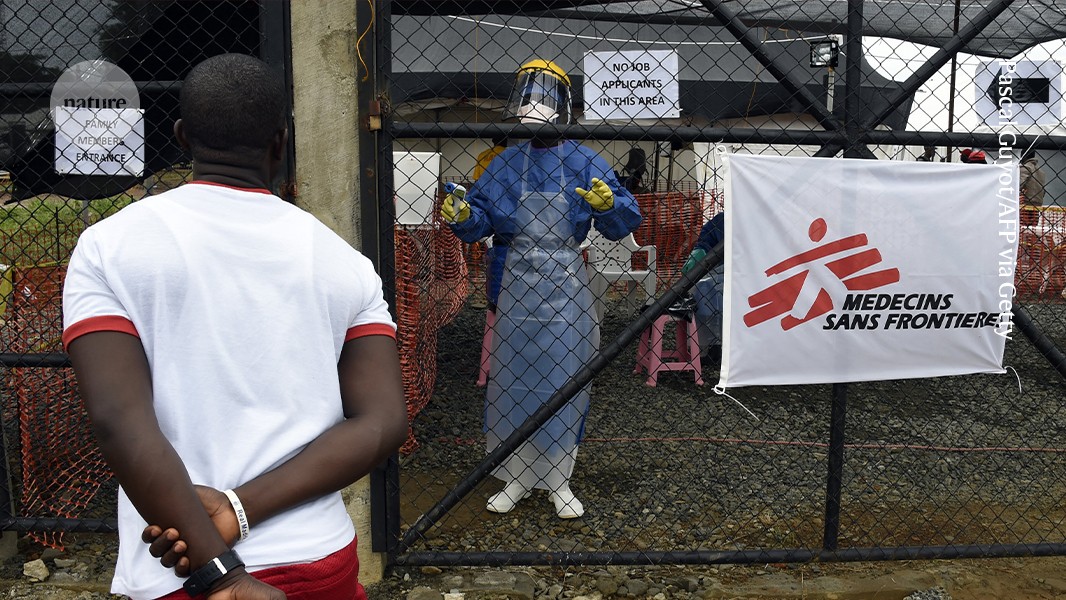

A Médecins Sans Frontières treatment centre in Monrovia, Liberia, in 2014 during the Ebola outbreak.Credit: Pascal Guyot/AFP via Getty
With degrees in nursing, public policy and social anthropology, Beverley Stringer has worked in various sectors in her career, but has returned again and again to the humanitarian organization Médecins Sans Frontières (MSF, also known as Doctors Without Borders).
MSF is a non-profit body that has won the Nobel Peace Prize and provides medical assistance to people during emergencies, such as conflicts, disasters and epidemics. Although the bulk of its work involves direct care in crisis settings, MSF also conducts research and training and organizes conferences.
When she first joined MSF in 1992, Stringer held short-term contracts, first using her nursing training to help set up a field hospital in Somalia. Stringer is now the deputy director of the Manson Unit, a medical support team in MSF UK. In this role, she works alongside epidemiologists, social scientists and clinicians seeking to improve the take-up of research. MSF employs more than 67,000 people globally and had an income of €2.4 billion (US$2.8 billion) in 2024, almost entirely from private donations.
Stringer speaks about harnessing scientific principles in challenging public-health contexts.
What was your path to your current role?
I was working in a paediatric oncology unit early in my career. I found myself, as a young nurse, really struggling with the low survival rate of some groups of children. I think I was at the beginning of developing a personal sense of morality and ethics in health care.
I decided to apply that sensitivity to humanitarian work with MSF. There, I found myself faced with a different type of dilemma, which is also linked to people’s survival: you had limits around resources and structural inequities in the kinds of environment where I was working. These were essentially war zones, including in Colombia and Somalia.
In my current role, which I started in 2021 after about 20 years full-time at MSF, I support country-specific projects as well as sponsoring innovations in research, often by trying to understand the lives and culture of patients in crisis settings. This provides more context to our medical interventions.
How does MSF apply science and data to its work?
Looking at the way we do scientific research includes acknowledging power politics and social realities: it needs to be really pragmatic along with respecting the science. For example, during the Ebola epidemic in West Africa, which lasted from 2014 to 2016, there was no effective therapy, so government forces in the affected countries imposed some quarantine zones to control the spread of disease.
Being quarantined, however, can feel penalizing for people, especially if controlling the spread of disease means they’re not allowed to farm. Those control measures can be as bad as the fear of being exposed to the disease: it’s really hard being forced out of the patterns of daily life, especially if you need to farm to eat.
In the rural area of Tonkolili, Sierra Leone, my colleagues and I did research and worked out quickly that we needed to connect with traditional healers, families and others to see what was possible for community members to do themselves, without others imposing overly harsh controls on them.
The local first responders came up with alternative measures that were as effective as the gold-standard epidemiological controls. Community members would get involved in contact tracing and surveillance, and a gardener, for example, who did not have symptoms and needed to enter their garden could continue that activity without infection risk to themselves or anybody else. We, together with the communities, called these compassionate controls1.
There is an added technical value that an organization such as MSF or a national ministry of health can bring, but community groups also bring huge value. And if all of these bodies are not working together, it’s unlikely that the problem will be solved, because people will go into hiding or ignore the imposed regulations. That’s the value of social science in a health-care crisis.
What changes are you seeing in the nature of conflict worldwide?
It’s bleaker than ever, for various reasons. Shifts in global economic systems are deepening inequality and instability, and more governments are consolidating power and restricting freedoms. In countries such as South Sudan, Haiti and Nigeria, criminal organizations are increasingly influential. They control resources and territory, making it harder for humanitarian groups to work safely with local populations. In the Gaza Strip and Darfur in western Sudan, and previously during the civil war in Syria, violence is not just sporadic but built into systems — through blockades, sieges and deliberate targeting of civilians, health workers and health care. This is often sustained by powerful external actors, which makes resolution even more difficult.
How do emergencies challenge the way MSF operates?
We need to think on our feet and be ready to compromise. Darfur, for example, is dealing with not only the immediate impact of war, but also outbreaks of cholera and diphtheria, and very high malnutrition rates. What we’ve been working on with the emergency desk is partnering with local mutual aid and solidarity groups, for instance through cash transfers to emergency-response rooms.

