


You have full access to this article via your institution.
Hello Nature readers, would you like to get this Briefing in your inbox free every day? Sign up here.

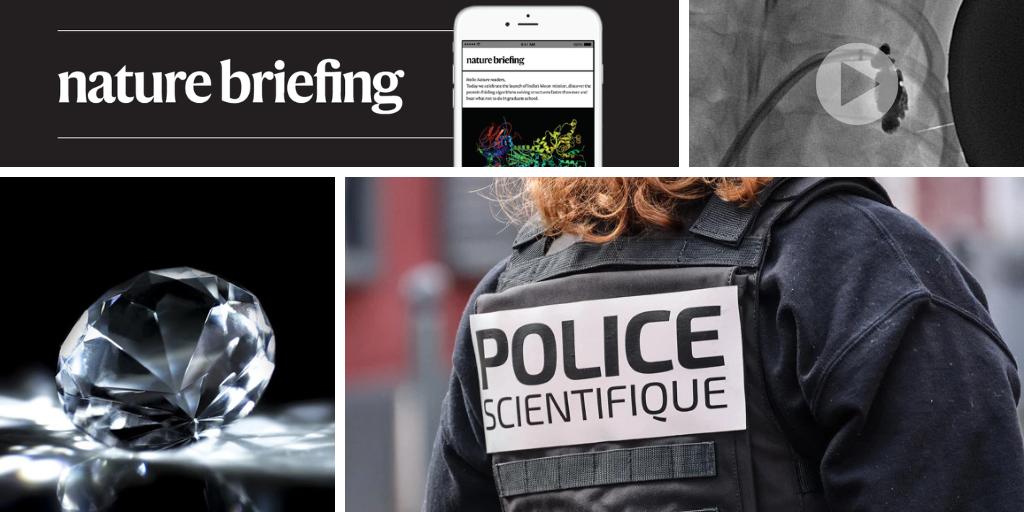
Conventional DNA testing failed to distinguish between twin brothers during a French criminal trial.Credit: Denis Charlet/AFP via Getty
In a court case in France last month, the DNA of twin brothers was found on a gun, but conventional DNA testing could not determine which of the brothers it belonged to. Standard methods analyse short sequences in regions of the genome where there is a lot of variation — except in identical siblings. More sophisticated techniques such as whole-genome sequencing, or looking for epigenetic changes that can be caused by behaviour or environment, can be used to tell twins apart, but require relatively large amounts of DNA that aren’t usually left at crime scenes, say experts.
Researchers in China have reported that they’ve synthesized hexagonal diamond — an unusual variant of the mineral that could be even harder than the conventional cubic form. The material has been sought for decades, but many previous claims to have synthesized or found it have been questioned. “This is the first very accurate characterization of this elusive material,” says mineralogical crystallographer Oliver Tschauner. The results come hot on the heels of a separate 2025 paper that also reports lab-synthesized hexagonal diamond.
Reference: Nature paper & Nature paper (from 2025)
An analysis of electronic health records from more than 600,000 US military veterans supports the idea that GLP-1 drugs — such as the diabetes drug Ozempic and the obesity medication Wegovy — can help to curb addiction, though it’s not clear how. “The consistency of effect across multiple substances, which have different mechanisms of action, was quite a revelation,” says clinical epidemiologist Ziyad Al-Aly, who co-authored the study. GLP-1 users with no history of addiction were also less likely to develop one, compared with a control group.
Features & opinion
A systemic failure of oversight allowed the sex offender Jeffrey Epstein to curry favour with academia, argues biomedical ethicist Arthur Caplan. “Researchers’ belated expressions of regret and claims of ‘nerd tunnel vision’ — that is, being too engrossed in research to notice warning signs — illustrate the hazards of allowing faculty members to manage donor relationships unchecked,” Caplan writes.
As climate change destabilizes global water systems, key treaties that govern how waters flow between billions of people are under strain, argues Ali Tauqeer Sheikh, a water- and climate-governance expert who has advised the Pakistan government. He points to The Indus Waters Treaty between India and Pakistan as a template for a path forward: “until its suspension last year, it sustained millions of people through several wars and military operations, as well as a 13% loss of glacier mass between 2000 and 2021,” he writes. He suggests that agreements should transition from a static process that aims to maintain historical river levels to a dynamic one that uses real-time monitoring.
Magnetic fluid injected into the heart that could help prevent strokes has been tested for the first time in a pig. The fluid seals off a section of the heart called the left atrial appendage, where clots can form in people whose hearts beat too quickly.
Today I’m basking in the beauty of radiolarians, a single-celled marine organism that is about the size of a grain of sand. Microscopist Eric Muzipov reveals the complex, stunning shapes of the creatures’ silica skeletons in a soothing YouTube video — with a fun coda showing off how his scanning electron microscope images are taken.
Help me zoom in on the best ways to improve this newsletter by letting me know your feedback. Your e-mails are always welcome at [email protected].
Thanks for reading,
Flora Graham, senior editor, Nature Briefing
With contributions by Jacob Smith
• Nature Briefing: Careers — insights, advice and award-winning journalism to help you optimize your working life
• Nature Briefing: Microbiology — the most abundant living entities on our planet — microorganisms — and the role they play in health, the environment and food systems
• Nature Briefing: Anthropocene — climate change, biodiversity, sustainability and geoengineering
• Nature Briefing: AI & Robotics — 100% written by humans, of course
• Nature Briefing: Cancer — a weekly newsletter written with cancer researchers in mind
• Nature Briefing: Translational Research — covers biotechnology, drug discovery and pharma

