


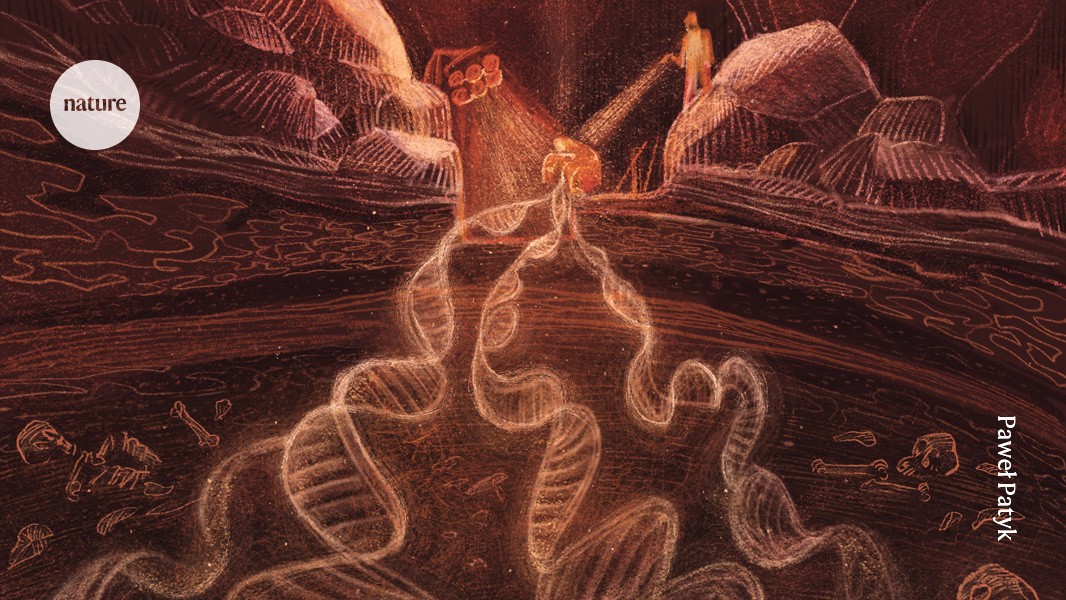
When he was a doctoral student at the University of Copenhagen, Eske Willerslev was a nobody. At least, that’s how it seemed to the budding evolutionary geneticist, who was unable to lay his hands on one of the few coveted fossils that might still contain traces of ancient DNA.
Who were the ancient Denisovans? Fossils reveal secrets about the mysterious humans
But frustration turned to inspiration one autumn day in 2000, when he saw a dog depositing its morning poo onto the ground. The droppings contain DNA, he thought, and perhaps, even after rain washes them away, some DNA might remain. And if it does stick around, the genetic material of long-dead animals might also persist in the environment. That would mean he could learn something about those creatures, even without getting access to priceless museum specimens.
Willerslev’s idea was ridiculed by his professors at the time. “I’ve never heard anything as stupid as this,” he recalls one of them remarking. But his hunch bore incredible fruit. In a 2003 paper in Science, he showed that plant and animal DNA could be recovered from a Siberian permafrost core that stretched back 400,000 years1.
Even in the warmer temperatures of a New Zealand cave, Willerslev identified DNA from the extinct emu-like moa (Euryapteryx curtus) in 600-year-old sediments. It was the first time that researchers had used sediment alone to identify long-dead complex organisms.
Two decades on, the study of ancient DNA from sediments has matured into one of the most exciting tools for studying the past, say researchers. Interest in soil DNA surged nearly ten years ago, when scientists found that human DNA could also be isolated from ancient sediments. Laboratories that had once focused on extracting genetic material from precious fossils are now turning their attention to dirt. Archaeologists, too, are re-examining soil collected decades ago, keen to discover more about the past using this modern technology.
The complex history archived in sediments is ripe for exploration, says Willerslev. And it is vast. In 2022, his team coaxed snippets of DNA from two-million-year-old permafrost sediments at the northern tip of Greenland, the oldest such genetic material so far2. “It is a huge new blue ocean” of possibilities, says Willerslev. “You have humans, you have animals, you have plants, you have the whole bloody ecosystem.”
“It’s really incredible how much molecular information you have in sediments,” says Matthias Meyer, a molecular biologist at the Max Planck Institute for Evolutionary Anthropology in Leipzig, Germany. “I think we’re really just sort of scratching the tip of the iceberg in terms of what’s possible,” he says.
According to Willerslev, whether a site has fossil remains could become irrelevant. “My expectation would be, we can almost drop the bones,” he says, “and just go to the dirt.”

Sediments in Denisova Cave have yielded fossil remains and DNA from ancient humans.Credit: Eddie Gerald/Alamy
Sedimentary DNA has been particularly influential in the study of ancient humans, revealing important clues about early members of our own species, as well as about Neanderthals (Homo neanderthalensis) and the mysterious Denisovans, of which very few bones have been found.
“Without sediment DNA,” says Pere Gelabert, a population geneticist at the University of Vienna, discovering those clues “would be impossible”.
But even as groundbreaking findings about this new type of evidence make headlines, some researchers are urging caution about whether enough care is being taken to ensure that the results are reliable.
Hitting paydirt
For 14 years, sedimentary ancient DNA — also known as sedaDNA — remained the preserve of palaeoecologists reconstructing what life on Earth looked like using lake cores and permafrost samples. But a watershed moment for the field came in 2017, when scientists successfully identified DNA belonging to ancient humans in ice age soils3.
“When you have a story about humans, this is where you get people [interested],” says Diyendo Massilani, a palaeogeneticist at the Yale School of Medicine in New Haven, Connecticut, who was not involved in the 2017 study. As soon as someone found human DNA, he says, “then everybody was like, ‘let’s do sediments for everything’”.
The problem is that ancient human DNA in soil is vanishingly rare compared with the DNA of soil microorganisms and other fauna. To improve their odds of finding human DNA in samples, researchers at the Max Planck Institute for Evolutionary Anthropology — including the Nobel-prizewinning founder of the palaeogenomics discipline, Svante Pääbo — developed probes that capture human sequences selectively3.
Siberia’s ancient ghost clan starts to surrender its secrets
The study found human DNA in places where human fossils have not been discovered. This has highlighted sedaDNA’s potential for extending the fossil record. At the Trou Al’Wesse cave in Belgium, for instance, sedaDNA results confirmed a long-held suspicion — based on characteristic stone tools — that Neanderthals had occupied the site. At Denisova Cave in Siberia, researchers found DNA from both Neanderthals and a sister lineage, the Denisovans, which was named after the cave.
Some of the DNA appeared in layers without fossils. In a more extensive study of roughly 700 permafrost sediment specimens from Denisova Cave, one sample from a deep layer indicated that Neanderthals had arrived at the site 170,000 years ago — 30,000 years earlier than fossil evidence suggested4. And even though no bones have been found so far, sedaDNA places early modern humans in the cave from around 45,000 years ago.
DNA also places Neanderthals in a layer that contains one type of stone tool, and Denisovans in a separate layer with another type, linking each to its potential maker. That connection is often difficult to establish otherwise. Meyer and others are optimistic that ancient DNA could one day identify the makers of tools at further sites, and even the artists responsible for cave paintings.
Sedimentary DNA has also helped to solve a mystery about a cave on the Tibetan Plateau, nearly 3,000 kilometres southeast of Denisova Cave. In 1980, a monk had discovered an ancient jawbone at this site — called the Baishiya Karst Cave. In 2019, Qiaomei Fu, a palaeogeneticist at the Institute of Vertebrate Paleontology and Paleoanthropology in Beijing, and her colleagues reported on the pioneering use of ancient proteins, revealing that the 160,000-year-old jawbone belonged to a Denisovan5.

At the Baishiya Karst Cave on the Tibetan Plateau, researchers identified DNA that confirmed Denisovans once lived in the region.Credit: HAN Yuanyuan
However, the approach was new and there were doubts about the jawbone’s provenance, because it had been removed from the cave so long ago. In 2020, Fu found Denisovan DNA in the cave sediments, confirming that these hominins had once occupied the site. It was the first incontrovertible evidence that the archaic people had lived outside Siberia6.
Going nuclear
Both Meyer and Fu used ‘molecular fish hooks’ designed to recover human DNA from mitochondria, the tiny power generators in cells. With thousands of copies per cell, mitochondrial DNA (mtDNA) is more abundant — and easier to find — than nuclear DNA is. However, the nuclear genome’s size — three billion letters versus just 16,000 for mtDNA — and its inheritance from both parents make it better for discerning how past human populations split and intermingled through history.
The information that nuclear DNA could provide intrigued population geneticist Benjamin Vernot, who is also at the Max Planck institute in Leipzig. He wondered whether he could fish nuclear DNA out of some of the samples that have yielded mtDNA.
To do this, Vernot designed a set of 1.6 million probes for sequences scattered across the human genome. These would bind to sequences from Neanderthals, Denisovans and early modern humans. They would also pick up the DNA of ancient humans whose genetics are unknown. “There’s always the possibility that there’s going to be Homo erectus DNA in your sample,” he says. “We wanted to be prepared just in case.”
The probes successfully pulled nuclear sequences from the dirt, but the greater challenge was gleaning meaning from the sparse data. “Our best sediment samples were still really, really shitty,” says Vernot. Of the 1.6 million genomic probes, good samples contained sequences for just 10,000.
It took Vernot some eight months to develop computational methods that could deal with such meagre data7. Using these methods, Vernot turned to sediments from Galería de las Estatuas, a cave in northern Spain where excavations had uncovered a single Neanderthal foot bone and characteristic stone tools, but no genetic information.
From the mtDNA data, Vernot could discern two distinct Neanderthal populations, with one fully replacing the other around 100,000 years ago. But from the nuclear DNA, he could tell which samples were from a single male or female, and which contained a mixture of DNA from several individuals.
Gelabert has coaxed nuclear sequences from cave sediments, too8. But instead of capturing human sequences with probes, he took a brute-force approach, using ‘shotgun’ sequencing to read through all of the DNA extracted from the soil.
Humanity’s oldest art is flaking away. Can scientists save it?
However, his latest work, presented in a preprint, suggests that this approach isn’t as useful for population genetics. In a head-to-head comparison, DNA capture using molecular probes yielded 32 times more sequences at informative genome locations than did the shotgun method9. For the shotgun sequencing in his comparison, he says, “the effort is insane”.
Gelabert says that the extra work required to obtain nuclear DNA from sediments means that the process will probably be reserved for special cases; for instance, if the sediments contain a lot of genetic material. In most cases, mtDNA will suffice, he says. With mtDNA, “we can already have ideas of how many different lineages are in our sample”, he says, and “we can even trace back differences of populations”.

