


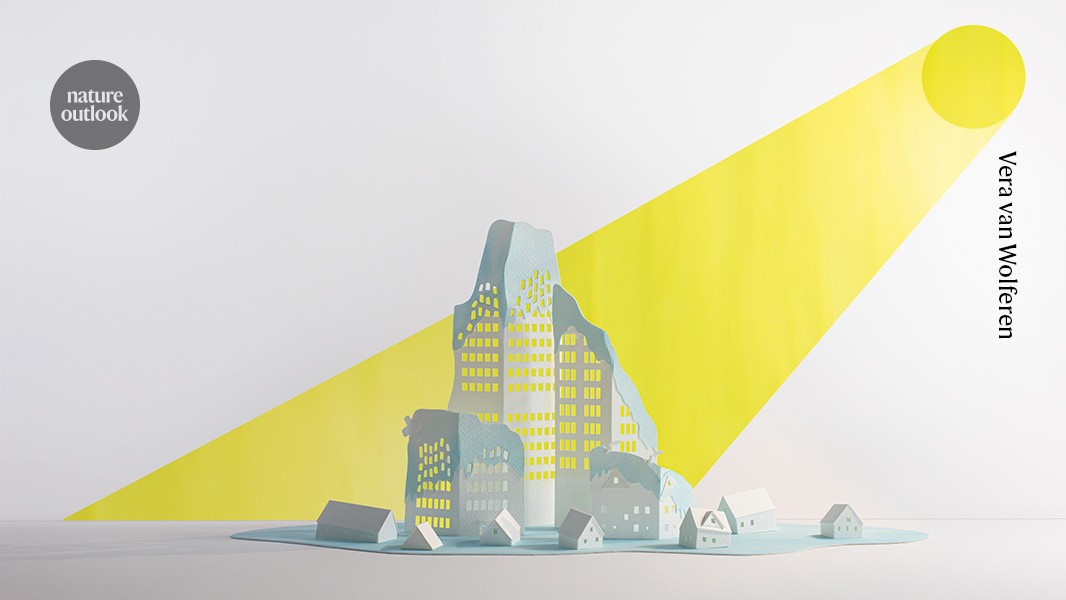
Record-breaking heat is now routine. The devastating heatwave that wracked southwestern Europe in 2003 and claimed more than 70,000 lives produced temperatures not experienced in the region since the sixteenth century. Subsequent summers have extended this trend. In 2024, the continent recorded its hottest summer on record.
In urban environments, where most of the world’s population lives, the problem is especially acute. “If you build a city, inevitably it will be hotter,” says Edward Ng, an architect at the Chinese University of Hong Kong. “This is just physics.” A 2021 study1 evaluated more than 13,000 cities around the world, and found that the extent to which city-dwellers were exposed to temperatures above 30 °C nearly tripled between 1983 and 2016. This problem will grow as the climate crisis worsens and cities expand.
Nature Outlook: Cities
Living with ever-intensifying heat could have huge economic and health consequences. “About 9% of the human population is living out of the so-called human niche, which means they are living at temperatures that we never had before,” says Matthaios Santamouris, a physicist at the University of New South Wales in Sydney, Australia. “This may increase up to 25% or 30% by 2050.” He points out that rising temperatures have been linked to increased hospitalization rates and mortality. Sweltering conditions also contribute to mental-health problems, including increased rates of suicide and violent behaviour. As usual, the danger is greatest for the poorest populations, including those in otherwise wealthy cities.
The solutions available range from simple urban-planning strategies, such as providing more shade, to sophisticated coatings for surfaces that reflect the Sun’s heat back into space. But effecting large-scale change in cities is difficult and requires careful analysis of the root causes of the problem. Deploying the wrong solution in a city could not only fail to mitigate the heat, but even exacerbate it, along with its associated health issues. “You have to implement a scientific approach,” says Santamouris. “It’s like in medical science — if you don’t scan the patient, you cannot offer the right medicine.”
Made in the shade
Hunkering down in air-conditioned comfort is not always an option. In many low- and middle-income countries especially, only a minority of the population has access to climate control. Even in countries such as India, where air conditioning is common, frequent blackouts during heatwaves limit its benefits.
In many places, class determines who will bear the brunt of soaring temperatures. David Sailor, an urban-climate researcher at Arizona State University in Tempe, notes that the United States’ history of systemic discrimination has stranded many racial minority communities in greenery-free environments with lots of concrete and asphalt, which typically trap and store the Sun’s heat, rather than reflect it away. For some groups, such as construction workers and children, staying cooped up all summer is problematic. “Certain people have to be outside to work, and many more benefit from outdoor activity,” says Jennifer Vanos, an environmental-health researcher also at Arizona State University.
Researchers have assembled a diverse toolbox to map the temperature landscape and reveal hidden urban hotspots (see ‘Taking the temperature’). Elie Bou-Zeid, a civil and environmental engineer at Princeton University in New Jersey, boils the problem of urban heat down to what he calls the three Fs: form, function and fabric. Form refers to the geometry of buildings, which can reduce airflow and trap radiation, Bou-Zeid explains, and function encompasses what cities do to create heat. These two aspects are difficult to alter in an urban environment that’s already been built, so most mitigation efforts focus on the third F, fabric. This relates to the properties of the materials that form the city’s surfaces.
One solution is to use vegetation to shield heat-amplifying surfaces. Even young children know they can escape the heat by moving into the shade of a tree. Extending the leafy canopy to cover more pavements and open spaces can alleviate the discomfort of being in direct sunlight for pedestrians and outdoor workers. “You feel 5–10 °C cooler,” says Scott Krayenhoff, an environmental scientist at the University of Guelph in Canada, “even though the air temperature might only be half a degree cooler in that street.” Well-watered trees can also cool the surrounding air, through a process called evapotranspiration, in which their leaves release moisture into the atmosphere. Heavily vegetated green roofs provide similar benefits, and also absorb less heat than do conventional roofing materials.
But expanding the urban tree canopies has hidden complexity. Cities need land that is suitable for planting, and the choice of appropriate trees can be difficult. In a city as arid as Phoenix, trees must be drought-tolerant to avoid using up limited water resources. Trees can also worsen the air quality in some situations, trapping pollution from motor vehicles when planted densely on narrow streets. Furthermore, trees under heat stress can release biogenic volatile organic compounds (BVOCs). Interactions between these molecules and other chemicals in the urban atmosphere can worsen pollution. Indeed, Santamouris says that the pollution-exacerbating effects of BVOCs can be several times more severe than the emissions from vehicle exhausts.

Healthy trees can cool the air around them as well as providing shade to pedestrians.Credit: James Andrews/Getty
The magnitude of this effect varies across tree species and environmental conditions, but one 2014 study2 found that planting one million trees that release high levels of these compounds could generate annual emissions equivalent to the pollution from 500,000 cars. Santamouris thinks that green infrastructure is part of the solution to urban heat, but warns that the species must be selected with care to avoid such unwanted effects. “If it is not planned using scientific approaches, you risk having a tremendous problem.”
Highly reflective materials that alleviate urban heat by sending sunlight back to where it came from are now common on the roofs and pavements of Phoenix and many other heat-stressed cities, says Vanos. They can be a cost-effective solution. A 2025 World Bank report3 found that Indian cities could save more than 50,000 lives a year by investing in measures including cool roofs, green infrastructure and heatwave early-warning systems, and that this would deliver net economic gains.
Such highly reflective coatings cannot be used on vertical surfaces or pavements, because they would be blindingly bright. Lower-reflectivity pavements could offer an alternative, but are best deployed in areas with low pedestrian traffic because they tend to amplify radiant heat during the day. Vanos also warns that cool roofs could backfire in cities such as Ottawa, Canada, and Chicago, Illinois, which also have cold winters. “The ice and snow won’t melt as fast — it could actually make it cooler,” she says.

Jennifer Vanos pulls a biometereological cart to take the street-level temperature in Phoenix.Credit: ASU/College of Global Futures
Cause for reflection
The armoury of coatings and surface materials for combating urban heat is expanding. For example, instead of conventional cool surfaces that reflect sunlight in all directions, one option is retroreflective surfaces. Often used for traffic signs and high-visibility safety garments, these materials incorporate tiny beads or prisms that reflect light directly back to its source: towards the Sun, in this case, rather than into the eyes of pedestrians or drivers.
A 2024 modelling study4 by Bou-Zeid and his colleagues predicted that treating walls and pavements with retroreflective coatings could lower the air temperature of the superheated urban canyons formed by tall buildings by up to 2.6 °C. “These are not expensive technologies,” Bou-Zeid says, but so far there have been no large-scale deployments of such materials.
There has also been considerable progress with passive radiative cooling materials. These are designed to reflect the Sun’s radiation while also emitting heat as mid-infrared radiation that can pass freely through the atmosphere. Surfaces coated with these materials “remain cooler than the air during all hours”, says Sailor, who is collaborating with global conglomerate 3M to test these ‘supercool coatings’ as commercial products. “As air flows over the surface, heat comes out of the air, goes to the surface, and the surface then radiates that heat to space.” This is more effective than conventional reflective surfaces, which reflect direct sunlight but do not eliminate accumulated heat.

A white radiative-cooling material applied to half of the roof of the Dubai Mall reduced the surface temperature by 17.5 °C.Credit: i2Cool Limited
Researchers led by Edwin Chi-Yan Tso, a materials scientist at the City University of Hong Kong, have developed a promising radiative-cooling material inspired by the whitest insects on Earth. After analysing the shells of Cyphochilus beetles, the team identified a distinctive porous structure that is highly effective at passive radiative cooling. They then emulated this structure in a synthetic ceramic5. “We found that this material can achieve the near-theoretical limit in terms of cooling power,” says Tso. He subsequently launched a company in Hong Kong called i2Cool to develop this material into a host of surface treatments. In one demonstration, the company applied its coating to the roof of the massive Dubai Mall. The surface temperature fell by 17.5 °C, which is equivalent to a reduction of 3–4 °C in air temperature, according to Tso, and reduced cooling costs by up to 20%.
The affordability and durability of such materials remain to be seen, although Tso says that lab tests predict a lifetime of 6–7 years for i2Cool’s current coatings. The materials also typically have a limited colour palette — anything other than white generally takes a big hit in cooling efficiency. This might not matter for roofs, but a wider colour palette could spur these materials’ use in more-visible locations. Santamouris and his colleagues achieved promising results in the scorching Australian desert with radiative-cooling materials incorporating red, yellow and green fluorescent dyes6. “The green fluorescent supercool material had exactly the same temperature as white supercool material,” he says.
Investing in protection
Ultimately, the effort to keep cities liveable as the world heats up will require a combination of measures. A 2024 study7 by Santamouris and his colleagues showed that broad deployment of several interventions, including cooling materials and green infrastructure such as trees and bushes, could lower daily summer air temperatures in Riyadh, Saudi Arabia, by an average of 4.2 °C and reduce buildings’ cooling requirements by 16%.
But the combination that works in one city might not be the answer in another. “Every strategy has pros and cons,” says Sailor, and there’s no simple rulebook for city leaders to follow. “You have to know your climate,” says Ng. In tropical cities with high humidity and heavy cloud cover, for example, shade and sunlight-reflecting materials are unlikely to perform well. “Humidity effects can be dealt with best by wind flow,” says Ng, and this requires careful urban planning or heavy reliance on electric fans.
Computational modelling can help to avoid ineffective or negative changes. Heat measurements from a city can be used not only to reconstruct the recent history of urban heat, with a resolution down to tens of metres, but also to forecast hotspots that are likely to emerge or be amplified by climate change. “The predictive models have become really good,” says Bou-Zeid. Models can then be used to test how different interventions might affect temperature. This requires substantial geographical climate data, however, and many of the less-wealthy cities at the greatest risk from extreme heat are relatively unmapped.
The changes required to cool down cities, such as phasing out old roofing materials or waiting for saplings to become stout trees, will take time to work. “It’s probably going to take us 10 or more years to see the full benefit of any strategy we’re modelling,” says Sailor. In the short term, cities can introduce targeted cooling solutions that focus on the highest-traffic pedestrian areas or that selectively protect those at greatest risk, such as older, impoverished and unhoused people.
Ng is working with the Hong Kong government to establish networks of cooling centres that provide refuge for the city’s older population, many of whom live in cramped and poorly climate-controlled apartments. Vanos points out that simple measures such as misting stations, shade and even cheap handheld battery-powered fans can make a big difference for people with poor access to air conditioning.
Given what researchers and city planners already know, there is no good reason not to act. “We know the solutions to keep pace, and to keep people cool,” says Vanos. “It’s making sure that the resources are distributed to those who need them the most that’s the problem.”

