


People spend most of their time in buildings, and these shelters are meant to support life. But how they are constructed and managed now means that the opposite is true — they emit carbon, pollute water bodies, create waste and spread toxic compounds that harm human health as well as the planet.
These problems reflect the increasing separation of societies from nature. Most economies function as though the living world is an externality — something distinct from people that can be plundered for resources and used as a dumping ground. In 2024–25, buildings accounted for one-third of global greenhouse-gas emissions and around one-third of total waste1.
But it doesn’t have to be that way. Over the past few decades, researchers, designers and companies have been developing strategies that go beyond conventional sustainability and into the realm of regenerative design, whereby buildings actively restore and revitalize ecological, water and energy systems. Many of the best solutions are inspired by nature itself.
For example, by mimicking the interconnected nature of ecosystems, buildings can operate in ways that produce little or no waste. By studying how materials and structures are assembled in living organisms, designers can learn how to make buildings in which nearly all the materials used are non-toxic, made with minimal energy and able to sequester carbon.
Here, I outline some of the areas in which biomimicry is influencing the built environment, and call on researchers, designers, urban planners and policymakers to rethink old, damaging practices so that buildings, cities and the use of materials are aligned with living processes on Earth.
Rethink cities as living systems
The first step in building a sustainable city or building is to look at how the natural world operates in that location. The nature-inspired consultancy Biomimicry 3.8 in Missoula, Montana, recommends that urban designers start a project by analysing how much oxygen is produced, water filtered, carbon sequestered, food grown and wildlife accommodated in a reference ecosystem at a particular location, for example.
Human constructions should match those performance criteria if they are to function sustainably there. For example, a city in a temperate climate might include swathes of forest planted with native trees and sustained by rainwater to sequester carbon, clean the air and support biodiversity in ways that mimic surrounding landscapes. Designers of a city in a hot, arid region might look instead to desert species for tips on how to harvest water or cool the air. The cactus Opuntia microdasys, for instance, which is found in Mexico’s Chihuahua Desert, uses clusters of very fine conical spines to suck moisture out of the air and funnel it into the body.
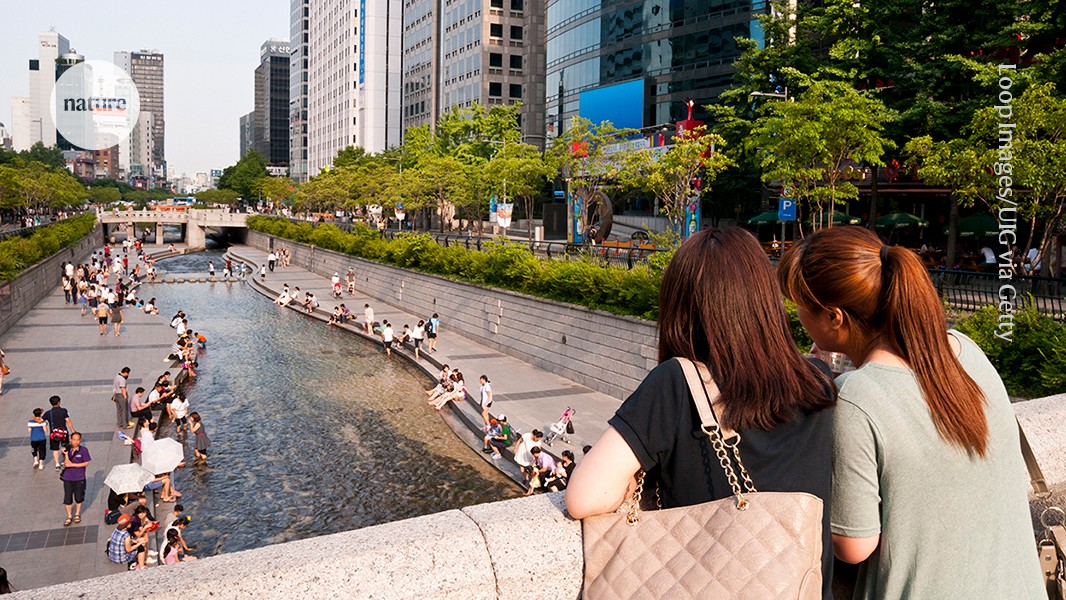
Combinations of naturally inspired approaches can be more effective than conventional engineered solutions. For example, as part of a restoration project of the Cheonggyecheon stream in Seoul, between 2003 and 2005, a six-lane elevated motorway was removed and the river underneath restored from a lifeless culvert to a lushly planted park. Confounding its critics, the scheme resulted in cooler summer temperatures and less congestion because more people chose to walk, cycle and use public transport instead of cars.

Energy-efficient design has been incorporated into buildings in Hammarby Sjöstad in Stockholm.Credit: Carlos Sanchez Pereyra/Getty
Similarly, China has moved towards ‘sponge city’ planning strategies and away from using concrete pipes and culverts to manage urban water flows. Such strategies draw on ancient Daoist philosophy principles of living in harmony with nature and natural solutions: retaining water at its source by reforesting upland areas, slowing its flow through re-naturalized riverbeds and establishing large areas of soft landscaping to absorb large influxes of water.
By increasing the capacity of built environments to retain water and restore biodiversity naturally, the worst impacts of droughts and floods can be avoided, while providing benefits to the people who live there. For example, sponge-city measures implemented in Wuhan, China, in 2015 cost US$600 million less than a heavy infrastructure approach would have, delivered large areas of green space for citizens and, by storing 70% of rainfall, saved $220,000 each year in irrigation costs during the first few years of operation2.
Flows of other resources should mirror those in ecosystems, too. Currently, industrial processes for water, energy and materials tend to be linear, disconnected, wasteful, extractive and engineered to maximize a single goal. Most energy generation is fossil-fuel dominated and disconnected from where food is grown, water is treated and building materials are processed.
Big opportunities exist in bringing these flows together in ways that mirror ecological principles, such as closed loop and densely interconnected flows of resources, use of symbiotic relationships, use of local materials, almost-exclusive use of solar energy and evolving systems as a whole. Some towns and cities are already using ecosystems as a model to deliver resource savings and regenerative benefits (see ‘Regenerative cities’).
Ways to improve industrial and urban systems can be identified using tools such as ecological network analysis, which is usually applied to food webs. For example, one analysis of eco-industrial parks found that the industrial networks tend to lack the equivalents of ‘detritivores’ — the organisms such as earthworms, fungi and bacteria that feed on dead organic matter3. By analogy, repair, recovery and recycling facilities should become a more important part of such economies to restore balance.
If waste is considered as a future nutrient or as an underutilized resource rather than worthless material, a different economic model can emerge — one in which wealth can be created by consuming less. This is in stark contrast with the current assumption that wealth is created by consuming more.
Natural and regenerative materials
The materials people use must also align better with life. Persistent toxic substances (such as chemical fire retardants, heavy metals and petrochemicals) must be designed out of environments because they are incompatible with living systems. Ecosystem models show that physical resources should be sourced locally and that industries need to reconsider how they make products so that all materials can be stewarded in closed-loop cycles.
The living world provides clues to how this can be done, starting with which elements should be used. Nature has evolved high-performance materials in a limited and safe subset of the periodic table4. Carbon, hydrogen, oxygen and nitrogen form 96% of all living matter and the remaining 4% is mainly calcium, chlorine, magnesium, phosphorus, potassium, sodium and sulfur.
Materials based on these elements have the potential to deliver higher levels of efficiency and performance, and be recyclable. With just proteins, polysaccharides and some salts (mostly of calcium), nature has formed materials that have many of the same properties as human-made ones — from polymers through to high-strength composites5.

A project in Kenya uses mycelium of mushrooms to make building materials.Credit: Kang-Chun Cheng for Nature
Production methods can also take inspiration from nature. Industrial processes often start with energy-intensive mining, crushing, smelting, refining and forming, followed by further treatments, protective coatings and adhesives. Although much of this still goes on, the shift towards more-sophisticated manufacturing, and increasing use of biomaterials, is gathering momentum.
Start-up companies are now producing insulation from plant waste and the mycelium of fungi, for example, as a much more benign alternative to petroleum-based insulation products. Mycelium insulation performs well thermally, is fire-resistant and, at the end of its life, can be fully reabsorbed into nature.
And for tasks for which people tend to use brute force, nature works at low energies. Compare spider silk with the nearest human-made equivalent, aramid fibre, for example. Manufacturing aramid fibre requires petroleum to be mixed with sulfuric acid and then heated to around 400 °C, producing large quantities of toxic waste. Yet, spiders manage to make their silk at ambient temperature and pressure with raw materials, such as dead flies and water.
Technologies such as 3D printing could allow designers and builders to make complex and effective structures but at a lower cost, and with less energy and waste than conventional technologies. As bioengineer Julian Vincent said in the book Bulletproof Feathers (2010): “in nature materials are expensive and shape is cheap”. Examples of using less material and more-complicated forms abound in fine structures such as bird skulls, water-lily leaves and bamboo stems.
Computer-aided design and manufacturing can facilitate the incorporation of even more subtle features of biology, such as interfaces and structures that improve fracture resistance in building materials. Researchers might take inspiration, for example, from the shells of the sea snail abalone (Haliotis spp.): at a chemical level the material is almost identical to blackboard chalk but flexible protein interfaces mean it is 3,000 times tougher.

