


You have full access to this article via your institution.
Hello Nature readers, would you like to get this Briefing in your inbox free every day? Sign up here.
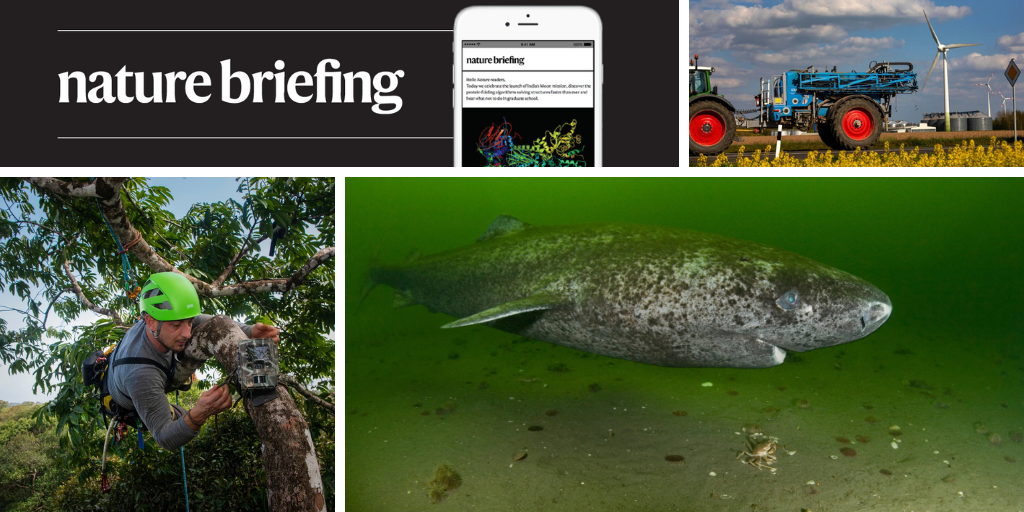
“We’re used to working with mouse eyeballs, which are the size of a papaya seed, so we had to figure out how to scale up to [the Greenland shark’s] baseball-sized eyeball,” says study co-author Emily Tom. (Doug Perrine/Alamy)
Greenland sharks (Somniosus microcephalus) can live to be up to 400 years old, making them the longest-lived vertebrate. They dwell in the almost-sunless waters of the Arctic deep sea, and are often infested with parasites that attach to their eyes, leading scientists to suppose that the animals might be functionally blind. But researchers who studied the sharks’ eyeball in the lab say that it’s quite the contrary: the sharks seem to maintain their vision over centuries with no signs of retinal degeneration — perhaps thanks to a DNA repair mechanism in the retina — and could offer clues to treating age-related vision loss in people.
Reference: Nature Communications paper
The US Congress has released a spending bill that backs the Trump administration’s plan to terminate the Mars Sample Return (MSR) programme — NASA’s plan to return rocks collected by its Perseverance rover on Mars to Earth. The bill allocates the space agency US$7.25 billion for the upcoming financial year — a cut of only 1% from the previous year’s allowance — but explicitly states that the funding does not support the MSR programme. The end of the MSR is “deeply disappointing”, says planetary scientist Victoria Hamilton. But it could free up funding for other NASA projects that have stalled in recent years, such as two missions bound for Venus.
Features & opinion
Artificial-intelligence and remote-monitoring technologies are allowing ecologists to do more and more research from the comfort of the lab. The shift lets researchers monitor ecosystems on a scale that was previously unimaginable, but comes at the cost of field experience, say some ecologists. They argue that this loss could lead to error, bias and oversimplification of results. “If it becomes a world where you don’t actually have to go out in order to become an ecologist, we kind of lose sight of what the actual world is like,” says conservation biologist Bill Sutherland.
It’s not enough to end the burning of fossil fuels, argues a Nature editorial — we must stop using coal, oil and gas as the raw material for a myriad of useful chemicals. Alternative sources of carbon are plentiful, but we have to be careful about how we make the change — converting cropland to biofuel production, for example, can drive up food prices, damage biodiversity and harm soil health. Instead, Europe should look to recycled plastic waste and captured carbon dioxide for sources of carbon that are going spare.
To celebrate its 10th anniversary, the editors of Nature Microbiology asked experts in the field: what’s next? Some answer that we’ve only scratched the surface of what artificial intelligence will bring to the table. Others have their eyes set on the vast number of species that we’ve yet to study deeply. Some are simply excited to build on the successes they’ve already achieved. The public “has a sense that we’ve sort of finished exploring most of the organisms on Earth”, says biologist Masaru Nobu. But when it comes to microorganisms, researchers are just getting started.
Nature Microbiology | 9 min read
Nature’s selection of nine books to help shape your science career in 2026 includes advice on how to navigate a pivot to a new discipline, top tips for overcoming the fear of public speaking and a how-to guide for international scientists looking to work in the United States.
Today I’m learning why mintiness makes us feel cooler. We can thank our skin’s TRPM8 receptors, writes sports scientist Christopher Stevens — menthol activates them, making us feel more chill even when we’re not. In 2015, Stevens and his colleagues found that a minty mouth rinse was even more effective than an icy slushie when it came to making athletes feel cooler and run faster in the heat. Just don’t follow it up with a glass of orange juice, as any mint-toothpaste user will tell you.
While I dream of warm slushie-weather, why not send me your feedback on this newsletter? Your e-mails are always welcome at [email protected].
Thanks for reading,
Flora Graham, senior editor, Nature Briefing
With contributions by Jacob Smith
• Nature Briefing: Careers — insights, advice and award-winning journalism to help you optimize your working life
• Nature Briefing: Microbiology — the most abundant living entities on our planet — microorganisms — and the role they play in health, the environment and food systems
• Nature Briefing: Anthropocene — climate change, biodiversity, sustainability and geoengineering
• Nature Briefing: AI & Robotics — 100% written by humans, of course
• Nature Briefing: Cancer — a weekly newsletter written with cancer researchers in mind
• Nature Briefing: Translational Research — covers biotechnology, drug discovery and pharma

