


At the fundamental level, the strong nuclear force between nucleons arises from quantum chromodynamics (QCD), a quantum field theory formulated in terms of their ‘colour-charged’ elementary constituents, the quarks and gluons. The interaction between these constituents is characterized by being weak at very high energies and short distances, a phenomenon known as asymptotic freedom5,6, whereas, in contrast to the other forces, it is so strong at nuclear distances that thinking of quarks and gluons as individual particles makes no sense at all. We speak of ‘confinement’: fundamental quarks and gluons cannot be directly observed, but instead, only composite ‘colour-neutral’ states, such as protons, neutrons or π-mesons, are observed in experiments. This fact poses several challenges, including the fundamental question of how to determine the strength of the interaction between quarks and gluons at high energy.
The quark–gluon coupling, αx(μ), depends on the energy scale, μ, of the interaction and also on its detailed definition, summarized as the ‘scheme’, x. Owing to confinement, we cannot collide quarks with quarks or gluons and determine αx(μ), directly in experiments. Instead, phenomenological estimates of the strong coupling are obtained by examining different processes, such as electron–positron or proton–proton collisions at various energy scales. After decades of theoretical and experimental efforts to parameterize the effects of confinement and to identify observables in which these effects are minimized, significant uncertainties persist. In particular, in determining a world average of αx(μ), notably by the Particle Data Group (PDG), different categories still exhibit uncertainties in the range of 1.5–3% (compare ref. 3 and Fig. 5). In fact, in most cases, these are not simply due to the limited precision of the experimental data, but include significant systematic uncertainties originating from the lack of an analytic understanding of confinement. In this situation, we cannot profit much from having more experimental data in reducing the uncertainty in αx(μ).
The inaccuracy of αx(μ) limits the potential of current experiments that test the fundamental laws of nature4. Even when all phenomenology extractions of the strong coupling are combined, they lead to an error of about 1%. This uncertainty propagates, for example, into a 2–4% uncertainty in the rate of production of Higgs particles by gluon fusion7 or its decay into gluons8. Furthermore, reducing the current uncertainty in the strong coupling by a factor of 2 turns out to be crucial9 for finding out whether the vacuum of the Standard Model is stable10 and to constrain extensions of the Standard Model, which cure the possible instability11,12.
A first-principles, robust, free of modelling uncertainties determination of the strong coupling avoids the limitations of extractions from experimental data and will affect ongoing searches for new physics.
Here we provide such a determination. We analyse the scale dependence of the strong coupling, as described by its β-function:
$$\mu \frac{{\rm{d}}}{{\rm{d}}\mu }{\alpha }_{{\rm{x}}}(\mu )={\beta }_{{\rm{x}}}({\alpha }_{{\rm{x}}}(\mu )),$$
(1)
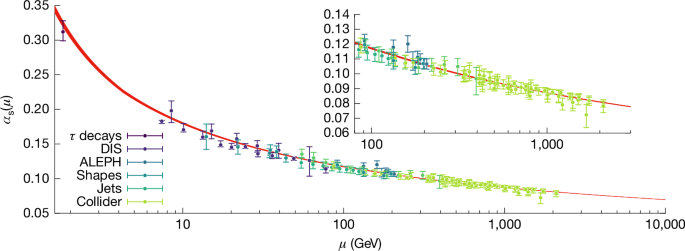
which has an expansion of the form \({\beta }_{{\rm{x}}}({\alpha }_{{\rm{x}}})=-{\beta }_{0}{\alpha }_{{\rm{x}}}^{2}-{\beta }_{1}{\alpha }_{{\rm{x}}}^{3}+{\rm{O}}({\alpha }_{{\rm{x}}}^{4})\), with leading positive coefficients β0, β1, which are independent of the scheme. This implies that αx(μ) runs with the scale μ, decreasing with increasing μ, with a leading behaviour proportional to 1/ln(μ/Λx), as shown in Fig. 1. This phenomenon, known as asymptotic freedom5,6, implies that perturbative series expansions in powers of the strong coupling become accurate at high energies, as shown by the β-function itself. The scheme independence of the leading coefficients, β0, β1, implies that the asymptotic scale dependence is universal, and the Λ-parameters of different schemes are simply related by exactly calculable constants. Conventionally, we use the modified minimal subtraction scheme13 (\(\overline{{\rm{M}}{\rm{S}}}\)) to quote the coupling \({\alpha }_{{\rm{s}}}\equiv {\alpha }_{\overline{{\rm{M}}{\rm{S}}}}\) and \({\Lambda }_{{\rm{Q}}{\rm{C}}{\rm{D}}}\equiv {\Lambda }_{\overline{{\rm{M}}{\rm{S}}}}\).

The strong coupling for a wide range of energy scales, as determined from our result for ΛQCD, is represented by the red band. The data points show the experimental determinations from various processes with their uncertainties as quoted by the PDG3.
Knowledge of ΛQCD and the β-function is equivalent to knowing the coupling at any given scale μ. In the \(\overline{{\rm{M}}{\rm{S}}}\) scheme, the expansion coefficients of \({\beta }_{\overline{{\rm{M}}{\rm{S}}}}\) are known up to high order, including β4, that is, five-loop order14,15,16,17,18, so that the scale dependence of \({\alpha }_{\overline{{\rm{M}}S}}(\mu )\) can be accurately predicted down to μ of the order of 1 GeV.
In this paper, we determine ΛQCD with two independent, dedicated strategies replacing the modelling of confinement by numerical simulations of lattice QCD. Our αs-uncertainty of about 0.5% is due to the finite computational resources and not due to our limited theoretical understanding. (The total cost of our αs-dedicated simulations is 400 million core hours). Combined with \({\beta }_{\overline{{\rm{M}}{\rm{S}}}}\), our determination of the coupling can be compared with experimental estimates at various energies, as shown by the data points in Fig. 1. The new, precise result also provides opportunities for better understanding of how confinement manifests itself in different processes and for extracting more detailed information from the experimental data.
The role of lattice QCD
The modelling of confinement is entirely by-passed in lattice QCD, a genuinely non-perturbative formulation of QCD on a (Euclidean) space–time lattice with spacing a. Quark and gluon fields are sampled on the lattice points and edges, respectively. If the space–time volume is finite, the number of QCD degrees of freedom is reduced to a finite albeit large number, enabling the numerical evaluation of observables by large-scale computer simulations. Predictions for hadronic observables, such as the mass of the proton, mp, or the leptonic decay width of π-mesons, can be obtained for a given choice of the Lagrangian parameters, the bare quark masses and bare coupling g0. To make contact with the natural world, we need to take the continuum limit, a → 0, based on numerical data for a range of a values. This is achieved by simulating lattices with decreasing values of the bare coupling, \({g}_{0}^{2}\to 0\) and thus a → 0, while the bare quark masses are tuned to match the physical values of the chosen experimental inputs.
In lattice QCD, confinement is a direct consequence of the simulated nonlinear dynamics of QCD, not of some model. Still, conventional lattice QCD determinations of the strong coupling are typically limited by systematic uncertainties. In a volume large enough to accommodate hadrons, the typical momentum cutoff π/a is 6−15 GeV. This is one order of magnitude below the universal large energy region, in which low-order perturbation theory is accurate. Together with the basic requirement that physical scales have to be well below the cutoff, μ ≪ π/a, a large-volume approach to determine the strong coupling would require lattices with significantly more than 100 million lattice points (the current state of the art), along with computational resources several orders of magnitude beyond what is presently available. Instead, most lattice QCD determinations of αx(μ) make compromises, performing the extraction at intermediate energies with estimates of what is the effect on αx(μ). Different strategies exist, as reported in the FLAG (Flavour Lattice Averaging Group) review19, with estimated precisions of 1–2%. Similar to the phenomenological situation, these uncertainties are not the result of the limited statistics in the computer simulation, but they are limited by our insufficient analytical control over QCD at low energies. A notable increase in precision can only be reached with a dedicated strategy reaching high energy non-perturbatively.
This strategy, known as step scaling, was suggested more than 30 years ago20. Then it was tested in a model with one space dimension. The distinguished idea is to use a scheme for the running coupling, in which the energy scale is given by the size of the simulated world, μ = 1/L. Small volumes probe the high-energy regime of QCD, whereas large volumes probe low-energy scales. The energy dependence of the coupling is obtained by simulating pairs of lattices with extents L/a and 2L/a, and a subsequent continuum extrapolation. This relates the values of the coupling separated by a factor of 2 in scale. By iterating this step scaling n times, a scale change of 2n is achieved. For QCD with Nf = 3 flavours, the method was developed and applied21,22,23,24 over many years. As of today, this result dominates the world average and is the only determination with negligible perturbative uncertainties.
Here, we use this step-scaling approach to not only reach a significant increase in precision but also have better control of the potential remaining systematic effects. We show that the continuum limit is approached smoothly and that the perturbative inclusion of dynamical charm and bottom quark effects is well under control.
But most crucially, we complement the step-scaling approach with the ‘decoupling technique’ described in refs. 25,26. In our previous implementation, we had discretization errors linear in amq removed only at one-loop order. In ref. 27, we determined the improvement coefficient non-perturbatively. With this knowledge, we now eliminate the so-far dominating systematic effect. The decoupling strategy is based on the observation that QCD with very heavy quarks can be expanded in the inverse quark mass, and the lowest-order term is the theory without quarks. This observation allows us to relate the QCD coupling and the coupling in a world without quarks.
Results from lattice simulations come in units of the lattice spacing a. To express them in physical (energy) units, the units of the lattice spacing a must be established through an experimental input, for example, \(a={\widehat{m}}_{{\rm{p}}}/{m}_{{\rm{p}}}^{\exp }\), where \({\widehat{m}}_{{\rm{p}}}\) is the dimensionless proton mass measured in lattice simulations, and \({m}_{{\rm{p}}}^{\exp }\) is the physical, experimentally measured, one. To minimize the uncertainty from the conversion between lattice and physical units, it is common19 to introduce an intermediate step, by first relating the experimental input to a technical, not experimentally accessible, (length-) scale, \(\sqrt{{t}_{0}}\), derived from the Yang–Mills gradient flow (GF)28. Nominally quite precise values \(\sqrt{{t}_{0}}\) are available from the literature29,30,31,32,33,34,35. They differ by the discretization of QCD, and some results include the heavier charm quark in the simulations. They also use various experimental inputs, from baryon octet masses, the Ω-baryon mass, to leptonic decay rates of pion and/or kaon19 for the overall scale, whereas the physical quark masses are set by the experimental masses of pions and kaons (Fig. 2, top box).

We have colour-coded experimental inputs in red and scale definitions in blue. The flowchart follows the energy scale from top to bottom, starting with hadron masses and meson decay constants as input used to set the scale by different collaborations29,30,31,32,33,34,35,43. This scale is used to reach an energy scale μdec. From there on two branches describe our two approaches (Nf = 3 running and decoupling), to obtain \({\Lambda }_{\overline{{\rm{M}}{\rm{S}}}}^{(3)}\). Our final value, a combination of the result obtained from the two computations and the values of the charm and bottom quark masses19, is then used to determine the strong coupling. Vertical, coloured arrows represent the non-perturbative running, characteristic of our strategy, in different finite-volume schemes. Perturbation theory is a key element in our computation, but it is only used at very high energies (above 70 GeV) or to include the effect of the missing charm and bottom quarks (which induces very small perturbative and non-perturbative uncertainties).
As discussed in more detail in the Supplementary information, the values of \(\sqrt{{t}_{0}}\) differ outside of the quoted error bars. A fit to a common value yields s ≡ χ2/dof = 2.8, where dof indicates the degree of freedom. In these situations, the standard PDG procedure stretches all errors by \(\sqrt{s}\). This yields \(\sqrt{{t}_{0}}=0.1434(7)\,\mathrm{fm}\). For a safe estimate, we enlarge the error further such that all precise central values are covered. This yields \(\sqrt{{t}_{0}}=0.1434{(7)}_{{\rm{s}}{\rm{t}}{\rm{a}}{\rm{t}}}{(17)}_{{\rm{r}}{\rm{o}}{\rm{b}}{\rm{u}}{\rm{s}}{\rm{t}}}{(18)}_{{\rm{t}}{\rm{o}}{\rm{t}}}\,\mathrm{fm}\) (see Extended Data Fig. 3 and the Supplementary information for details). The robust error originates from further enlarging the error from the PDG procedure. It contributes by far the largest systematic uncertainty to our result, but is expected to be reduced significantly by the ongoing simulations and analysis of the community4,19.
Apart from t0, we use other theory-defined scales to split up the computation in a way that yields a very precise result for αs(mZ). Their definition is based on a common principle. Generic running couplings decrease monotonically with the energy scale (Fig. 1); they are in one-to-one relation with the energy scale. Given a non-perturbatively defined coupling αx(μ), we can then define a scale μref by specifying a reference value for a coupling, \({\alpha }_{{\rm{x}}}({\mu }_{{\rm{r}}{\rm{e}}{\rm{f}}})\equiv {\alpha }_{{\rm{x}}}^{{\rm{r}}{\rm{e}}{\rm{f}}}\). For convenience, the used theory scales are shown in Fig. 2, which also serves as an orientation about our strategy. It shows how we reach higher and higher energy and finally determine the Λ-parameter.
The main split of our computation uses μdec in refs. 25,26:
$${\Lambda }_{{\rm{Q}}{\rm{C}}{\rm{D}}}\sqrt{{t}_{0}}={\mu }_{{\rm{d}}{\rm{e}}{\rm{c}}}\sqrt{{t}_{0}}\times \frac{{\Lambda }_{{\rm{Q}}{\rm{C}}{\rm{D}}}}{{\mu }_{{\rm{d}}{\rm{e}}{\rm{c}}}}\,.$$
(2)
Both dimensionless factors can be computed with high precision. However, the second factor presents a main challenge and dominates the error budget. Therefore, we computed it using two methods with very different systematics: the massless step scaling in Nf = 3 and the decoupling method.
Direct approach in N
f = 3 QCD
We implemented the step-scaling method using two different renormalization schemes for the coupling at low- and high-energy scales, respectively. In the region from hadronic μhad = 200 MeV to intermediate scales μ0 = 4.4 GeV, our finite-volume scheme is based on the Yang–Mills gradient flow21,28, and we indicate it with αGF(μ); it is closely related to the low-energy scale \(\sqrt{{t}_{0}}\) (for details see the Supplementary information). Altogether, our dataset includes 98 simulations at 10 different volumes L in the range 1/L ≈ 0.2–4.4 GeV. Compared with refs. 24,26, our new analysis includes a very fine lattice spacing, with a/L = 1/64. This allows us to improve the precision and perform crucial checks on the previous continuum extrapolation. We implicitly define an energy scale, μdec, by prescribing the value αGF(μdec) = 3.949/(4π). We then determine \({\mu }_{{\rm{d}}{\rm{e}}{\rm{c}}}\sqrt{{t}_{0}}=0.5831(71)\), which implies μdec = 803(14) MeV. For energies above μdec, we combine these results with our previous simulations of the high-energy regime in the SF scheme24. These include more than 40 simulations at eight values of the volume L, which cover energy scales 1/L ≈ 4−140 GeV non-perturbatively. An extensive analysis of the continuum limit together with a detailed exploration of the asymptotic high-energy regime22,36 leads to ΛQCD/μdec = 0.433(11), which translates to our final result for the direct method, ΛQCD = 347(11) MeV. Although a further error reduction, especially in the high-energy part, seems feasible, we decided to develop an alternative: the decoupling method. It is computationally more efficient and, even more importantly, affected by very different systematic uncertainties: discretization errors and perturbative errors are very different in Nf = 3 and the pure gauge theory.
The decoupling method
The idea is based on the following observation25. If we increase the masses of the quarks in a gedanken experiment, eventually the low-lying spectrum of QCD matches the spectrum of the pure gauge theory, in which quarks are absent; we say they are decoupled. In this way, QCD is connected with the pure gauge theory, the theory without any quarks. As the latter is easy to simulate, better precision can be achieved compared with QCD37. The exact connection requires the fundamental scale of the pure gauge theory, Λ(0), to be adjusted appropriately, \({\Lambda }_{\overline{{\rm{M}}{\rm{S}}}}^{(0)}=P(M/{\Lambda }_{\overline{{\rm{M}}{\rm{S}}}}^{(3)})\,{\Lambda }_{\overline{{\rm{M}}{\rm{S}}}}^{(3)}\), where in \({\Lambda }_{\overline{{\rm{M}}{\rm{S}}}}^{({N}_{{\rm{f}}})}\) the number of quarks, Nf, is indicated. Here and below, M refers to the renormalization group invariant mass of the Nf heavy quarks. The matching factor P is known perturbatively to four-loop order38 and is routinely being used to relate \({\Lambda }_{\overline{{\rm{M}}{\rm{S}}}}^{(3)}\to {\Lambda }_{\overline{{\rm{M}}{\rm{S}}}}^{(4)}\to {\Lambda }_{\overline{{\rm{M}}{\rm{S}}}}^{(5)}\), across the charm and bottom quark thresholds39.
Decoupling works up to O(1/M2) corrections. Detailed studies have shown38 that the corrections are small already at masses of the order of the charm quark mass (Mc ≈ 1.5 GeV). Here we use masses in the range z = M/μdec = 4−12, where μdec = 803(14) MeV, which translates to M ≈ 3−10 GeV, allowing us to explore the approach M → ∞ in detail and safely match QCD with the pure gauge theory. Again, we use the GF to define a coupling, now in QCD with three degenerate heavy quarks.
To illustrate the procedure, the running of this massive coupling αGF(μ, M) is shown schematically in Fig. 3 (for a more precise account, see Methods, ‘Decoupling of heavy quarks’). For energies well below their mass, the heavy quarks are decoupled, and αGF runs as in pure gauge theory (green line), whereas at μ far above their mass, the running is governed by the massless β-function; it is slowed down.

a, Illustration of the decoupling of three heavy quarks with large mass as described in the model of section 11.2 of the Supplementary information. For energies μ ≪ M, the massive coupling runs as the pure gauge coupling, whereas for μ ≫ M, the coupling runs as the massless three-flavour coupling. b, Continuum extrapolation of the massive coupling α(μ, M) for z = M/μdec = 4, 6, 8, 10, 12. The error bands for the different z values indicate which data points are included in the fit. Even with the conservative cutoff in the data (aM)2 < 0.16, the extrapolated continuum values are still very precise.
Our strategy now follows the magenta trajectory in Fig. 3a. Below μdec, we reuse the running in the massless theory. Then, at fixed μ = μdec, we increase the mass of all three quarks artificially to very high values, eventually to M ≈ 10 GeV, following the vertical part of the magenta trajectory. (Note that fixed μdec just means to keep both the bare coupling and the dimensionless aμdec fixed; that is, to work in a mass-independent renormalization scheme.) At the resulting value of the massive coupling, we switch to the pure gauge theory and run to large μ where \({\Lambda }_{{\rm{G}}{\rm{F}}}^{(0)}\) is obtained. Converted (exactly) to the \(\overline{{\rm{M}}{\rm{S}}}\) scheme, we then use the accurate high-order relation \(P(M/{\Lambda }_{\overline{{\rm{M}}{\rm{S}}}}^{(3)})\) between the Λ-parameters with and without quarks to revert to \({\Lambda }_{\overline{{\rm{M}}{\rm{S}}}}^{(3)}={\Lambda }_{{\rm{Q}}{\rm{C}}{\rm{D}}}\).
The main challenge is the continuum extrapolation of the massive coupling from our simulation results at finite a. On the one hand, the quark mass has to be large for the decoupling approximation to be as accurate as possible. On the other hand, the mass has to be below the momentum cutoff of π/a of the lattice. In other words, we need aM ≪ 1 and a good understanding of the asymptotic behaviour of discretization effects close to the continuum limit. To this end, we determined an improved discretization27 that allows us to completely cancel the dangerous terms linear in aM. Next, sufficiently small lattice spacings were simulated, and we performed a combined extrapolation of the results for different quark masses and different lattice spacings. Analysing the theory for discretization effects40 in an expansion in 1/M, we arrive at an asymptotic form of the discretization errors with only two free parameters. This form fits the data (Fig. 3b) remarkably well. The fit tells us that the coupling changes from αGF(μdec, M) = 0.4184(22) for z = M/μdec = 4 to αGF(μdec, M) = 0.4600(41) for z = 12 in continuum QCD.
We then matched to the pure gauge theory by equating αGF(μdec, M) with the Nf = 0 coupling. Using previous results in the pure gauge theory from ref. 37, we arrive at an estimate of ΛQCD/μdec at each value of the quark mass. These estimates should all agree up to the mentioned O(1/M2) corrections. The numbers are very close: for quark masses between 5 GeV and 10 GeV, ΛQCD/μdec varies by 5%. They also follow the expected c0 + c1M−2 behaviour. An extrapolation with this form thus yields our final number ΛQCD/μdec = 0.426(10) in the three-flavour theory from the decoupling strategy. Together with the value for μdec, we get ΛQCD = 342(10) MeV. The uncertainty covers the statistical errors and several variations of the functional form used in the continuum, a → 0, and decoupling, M → ∞, extrapolations. It also includes the uncertainty of the conversion from \({\Lambda }_{\overline{{\rm{M}}{\rm{S}}}}\) of the pure gauge theory to ΛQCD.
Final result and concluding remarks
Both the above methods to extract Λ have uncertainties dominated by statistics. Theoretical uncertainties, in particular those related to the use of perturbation theory, are subdominant. The systematics are also very different in both methods, and their agreement further corroborates the robustness of our methodology. An average is justified and leads to
$${\Lambda }_{{\rm{Q}}{\rm{C}}{\rm{D}}}=344.4(8.7)\,{\rm{M}}{\rm{e}}{\rm{V}}.$$
(3)
We still need to account for the missing charm and bottom quarks in our simulations. Their effect is known including high order in the perturbative expansion. A detailed study of both perturbative uncertainties and possible non-perturbative effects is discussed in the Supplementary information. These considerations lead to our final result
$${\alpha }_{{\rm{s}}}({m}_{Z})=0.11876(58),$$
(4)
where \({\alpha }_{{\rm{s}}}={\alpha }_{\overline{{\rm{M}}{\rm{S}}}}^{({N}_{{\rm{f}}}=5)}\).
The break-up of the variance, \({(\Delta {\alpha }_{{\rm{s}}})}^{2}\), of αs into different contributions is shown in Fig. 4. In both the direct Nf = 3 QCD and the decoupling approaches, statistical errors dominate by far. Small systematic errors originate from the models used to extrapolate the data to the continuum and a bound on residual linear \({\rm{O}}(a)\) effects (see Extended Data Table 4 and the Supplementary information for details). Perturbation theory enters our computation of Λ(3) as well as in including the effect of the charm and bottom quarks, but the effect due to the truncation of the series expansion affects our errors by 2% (Extended Data Table 4). This is a direct consequence of our strategy. Namely, we use perturbation theory at truly weak coupling only (extraction of Λ(3)) or to very high order combined with very good apparent convergence (charm and bottom thresholds). A special case is the ‘robust’ estimate of the uncertainty in t0, the only significant non-statistical source of uncertainty. It will be eliminated once scale determinations of different lattice computations agree more closely. It also has a small effect on our final number: dropping it (as in the standard PDG average) would decrease the error in αs(MZ) only by about 10%.

The figure splits the different errors in the three main components of our computation: a common component that connects hadronic physics with the intermediate decoupling scale μdec, the connection with large energies using Nf = 3 running and the connection with large energies using the decoupling strategy (see also Fig. 2).
Figure 5 shows our result compared with numbers from other strategies. In comparison with our result, most of them have uncertainties dominated by systematic effects associated with the use of perturbation theory and/or the continuum extrapolation, as quoted by the PDG for the phenomenology results3 and by FLAG for lattice results19.

The strong coupling constant αs can be determined from a variety of experimental processes, as reviewed by the PDG3, and from lattice QCD calculations, as reviewed by FLAG19. Our method achieves significantly better precision than the most accurate individual determinations, while maintaining well-controlled systematic uncertainties.
An important exception is the category labelled ‘Step scaling’, which uses the methods developed over the years by the ALPHA Collaboration. This result is dominated by our earlier computation24, the first robust sub-per cent determination of the strong coupling. Still, as emphasized by one of the PDG reviewers2, this computation was based on a single strategy and key systematics (the effect of the heavier charm and bottom quarks and the approach to the continuum limit) required confirmation24. Our present computation provides not only this confirmation by simulating finer lattice spacing and with a detailed study of the heavy quarks missing in our simulation, but also a complementary determination based on a new strategy (decoupling of heavy quarks), which also has negligible systematic uncertainties. Moreover, the precision is significantly better than our previous computation, and about two times more precise than all experimental estimates combined.
Beyond the precise number for the strong coupling, there is a qualitative lesson. Recall that QCD is a complicated nonlinear theory with the observed particles completely different from the fundamental quanta in the Lagrangian. Still, surprisingly, we can determine the intrinsic scale ΛQCD of the theory and, equivalently, the coupling between quarks and gluons. A conceptual achievement beyond the mere precision of αs is that it is determined with experimental low-energy input: the Ω baryon mass, together with π, K, D, B meson masses (and decay constants), which are all bound states of quarks and gluons. Figure 1 compares the resulting coupling with phenomenological determinations. Although the latter have some issues, the overall qualitative agreement confirms QCD as the single theory of the strong interactions at all energies, both small and large compared with ΛQCD. Thus, there is very little room for any modifications or additions to the theory of the strong interactions.
Our precise and first-principles determination of the strong coupling will be key in the quest for new physics at the energy frontier. The analysis of the Higgs boson production and decay at the LHC, the puzzle of the top quark mass or the analysis of the stability of the Standard Model vacuum will immediately and crucially benefit from the increase in precision4,7,8,9. Moreover, the low-energy experimental input used in our methods is uncorrelated with the experimental data of the LHC. Thus, our value for αs can be used as input to determine the hadronic parton distribution functions3,41,42 relevant for all LHC processes, without having to disentangle correlations between experimental processes and determination of αs. Being a prediction of QCD, matched to nature at low energy, our value cannot hide or mask new physics effects, a possibility always present when using experimental high-energy data as input.

