


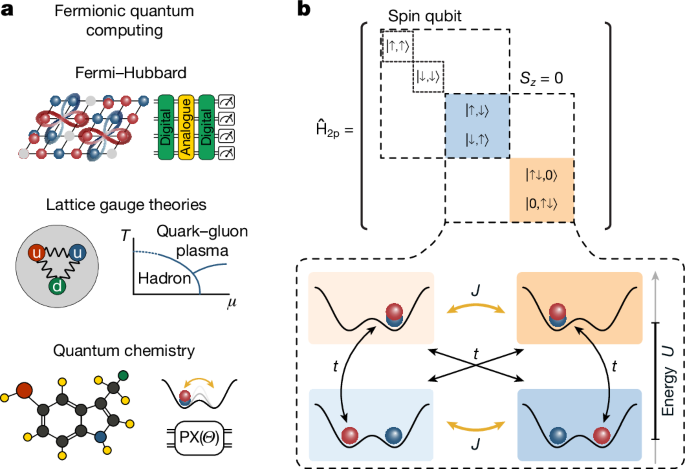
Experimental platform
In our experiment, we prepare a degenerate Fermi gas of 6Li atoms in a balanced mixture of the two lowest hyperfine states, which represent our two spin states. The atomic cloud is loaded into a single plane of a vertical lattice following our previous work41,51, with radial confinement provided by a blue-detuned box potential projected using a digital micromirror device (DMD)40,41.
From there, the atoms are loaded into a two-dimensional square optical lattice in the x–y plane with lattice constants ax,long = 2.28(2) μm and ay = 1.11(1) μm. A DMD pattern is chosen such that a flat central region of approximately 145 sites is surrounded by a low-density reservoir60. The chemical potential of the reservoir, tuned by the light intensity of the DMD, controls the particle density \(\langle \hatn\rangle \) at the centre. We realize a state with an average of nearly two particles per lattice site (close to a band insulator) at lattice depths of \(V_x^\rml\rmo\rmn\rmg=9.0\,E_\rmr^\rml\rmo\rmn\rmg\) and \(V_y=9.3\,E_\rmr^\rms\rmh\rmo\rmr\rmt\). Dynamics are frozen by ramping the lattice depths to \(V_x^\rml\rmo\rmn\rmg=35.5\,E_\rmr^\rml\rmo\rmn\rmg\) and \(V_y=45.0\,E_\rmr^\rms\rmh\rmo\rmr\rmt\), leaving isolated single-wells with mainly two particles per site. Subsequently, we ramp up a second, short-spaced lattice along x (ax,short = ax,long/2) over 25 ms, resulting in isolated, doubly occupied double-wells with total spin Sz = 0. In this experiment, the short lattices are generated by laser beams at blue-detuned 532-nm light incident at an angle of about 27°. The long lattice along the x-direction follows the same beam path, except that it is generated with red-detuned 1,064-nm light14.
In all figures, data points were collected in a randomized sequence to prevent systematic bias.
State preparation fidelity
The probability of realizing the desired state in the region of interest is approximately constant within a given dataset and mostly depends on the relative phase drift between the long and short lattices, as well as on the chosen atomic density. It is set largely by the fidelity of preparing an average occupancy close to two atoms of opposite spin per initial lattice site, which ranges from 60% to 85%. Deviations from the target state fall into two categories: (1) empty or singly occupied double-wells, which we remove by post-selection, and (2) double-wells containing three or more atoms, typically with population in higher lattice bands. Because these high-occupancy events can be mistaken for gate errors, we deliberately work at slightly lower atomic densities to suppress them, retaining between 45% and 65% of double-wells in analysis. Recent demonstrations of low-entropy band insulators in optical lattices suggest that considerably higher state preparation fidelity is attainable7,13,61. We note that the state preparation step does not affect the intrinsic performance of the individual gate operations.
Lattice depth calibration
Lattice depth calibration is performed by measuring single-particle oscillations in a double-well, from which we extract the calibration factor by fitting the observed tunnelling rates to theoretical predictions across a range of lattice depths. An initial state consisting of a single particle in a double-well is prepared by adjusting the atom density and tilting the double-well potentials during loading, similar to our previous work14. We then remove the potential offset δ, resulting in a symmetric double-well configuration at lattice depths of \(V_x^\rml\rmo\rmn\rmg=36.5\,E_\rmr^\rml\rmo\rmn\rmg\) and \((V_x^\rms\rmh\rmo\rmr\rmt,V_y)=(56,43)\,E_\rmr^\rms\rmh\rmo\rmr\rmt\). Quenching the short x lattice depth to a lower value initiates coherent oscillations of the population between the two sites in the double-well. In our analysis, we post-select double-wells containing exactly one atom.
In Extended Data Fig. 1a, we show an example calibration plot in which the calculated calibration curve aligns with the measured tunnelling frequencies with residuals less than 1.5% of \(V_x^\rmshort\). The tunnelling frequency of intra-double-well oscillations ft = 2t/h is extracted by fitting a resonant two-level oscillation [1 + cos(2πft × τh)]/2 to the population of one of the wells, which is then compared with the frequency expected from a band calculation (see our previous work14 for more details).
To cross-check the lattice depth calibration, we measure spin-exchange oscillation in the U/t ≫ 1 regime (J ≈ 4t2/U), in which virtual doublon-hole excitations are strongly suppressed (Extended Data Fig. 1b). We compare the frequency extracted from the fit to the oscillations (Extended Data Fig. 1b, upper row) with the calculated calibration curve (solid blue line) and find excellent agreement, consistent with the single-particle tunnelling calibration. The initial lattice depths in this case are \((V_x^\rms\rmh\rmo\rmr\rmt,V_y)=(56,45)\,E_\rmr^\rms\rmh\rmo\rmr\rmt\), \(V_x^\rml\rmo\rmn\rmg=39.5\,E_\rmr^\rml\rmo\rmn\rmg\) and the Feshbach magnetic field is set to 688.2 G to control the on-site interaction strength U through a Feshbach resonance. The long lattice depth \(V_x^\rmlong\) is independently calibrated using lattice modulation spectroscopy through band-excitation energies to an accuracy of 5%.
Experimental protocol
The spin-exchange process is initialized from the state |↑,↓⟩ (Fig. 3) by linearly lowering the intra-double-well barrier from \(54\,E_\rmr^\rms\rmh\rmo\rmr\rmt\) (t ≈ 0) to \(5.54\,E_\rmr^\rms\rmh\rmo\rmr\rmt\) (t = h × 2.9(1) kHz) in 500 μs, at on-site repulsive interactions U = h × 6.7(1) kHz corresponding to a ratio \(U/t\approx 4/\sqrt3\). After a variable holding time τh, the intra-double-well barrier is ramped back to its initial value in 500 μs. Coherent pair-tunnelling dynamics are induced under identical conditions and at the same ratio U/t, starting from the initial state |↑↓,0⟩.
The oscillation frequency and coherence shown in Fig. 3c,e are obtained by fitting the data patches in Fig. 3b,d individually with:
$$g(\tau _\rmh)=\frac12[1+A\cos (2\rm\pi f_J(\tau _\rmh-\tau _))].$$
(4)
Here A is the contrast, fJ = J/h is the frequency of exchange oscillations and τ0 is the phase offset. The decay of contrast A (shown in Fig. 3c,e) is in both cases compatible with a Gaussian decay \(\propto \rme^{-(\tau _\rmh/\tau _\rmex)^2}\) that originates from a spatial average over several sites with inhomogeneous oscillation frequencies62 (see the section ‘Effect of spatial averaging on collisional gates’).
The data in Fig. 4b,c use the quasi-adiabatic approach with Blackman pulses. The total pulse duration for the \(\sqrt\rmSWAP\) gate is tuned to 1.125 ms in Fig. 4b and 1.29 ms in Fig. 4c. The data in Fig. 4 are post-selected on having two-particles in a double-well and is not SPAM corrected. Experimental parameters are given in Extended Data Table 1.
Fermi–Hubbard double-well simulation
To accurately describe the continuous exchange dynamics (Fig. 3b,d), we simulate the Fermi–Hubbard Hamiltonian (equation (1)) by exact diagonalization for a double-well with two particles of opposite spin with the QuSpin library63. The calculation of the Hubbard parameters t and U from the depths of the optical lattices and the phase of the superlattice is explained in the supplemental material of ref. 14.
The two-particle exchange dynamics are well reproduced by a simulation based on the experimental parameters in Extended Data Table 1. Three empirical modifications are added to the bare simulation to fit the data. First, we fine-tune the depth of the long lattice by 0.3% (5%) for the spin-exchange (coherent pair-tunnelling) oscillations, relative to the value expected from lattice-shaking experiments. Second, we observe a small chirp in the exchange frequency during the 30 ms oscillation time, which we attribute to a small gradual change of the lattice depth owing to technical heating. To account for this effect, we apply a linear correction to Vshort when calculating U and t:
$$V^\mathrmshort(\tau _\rmh)=V_^\mathrmshort+\Delta V^\mathrmshort\tau _\rmh$$
(5)
The slope ΔVshort was found to be \(4(1)\times 1^-3\,E_\rmr^\rms\rmh\rmo\rmr\rmt\,\rms^-1\) for both the spin-exchange and the coherent pair-tunnelling dynamics. Finally, to account for dephasing effects, the simulation results were multiplied by a Gaussian envelope, with parameters extracted from the fits shown in Fig. 3c,e. Apart from these three adjustments, no free parameters were needed. Notably, key features such as the initial phase of the oscillations and deviations from pure sinusoidal oscillations arise intrinsically from the simulation of the double-well system.
We performed similar simulations for the different lattice ramps (Fig. 4a). In this case, the only free fitting parameter is the long lattice depth Vlong, adjusted by 0.3% in all three cases. Owing to the short duration of the pulses used in this experiment, thermal drifts and the associated frequency chirp can be safely neglected and were therefore not included in the simulation.
To reproduce the Ramsey oscillations of Fig. 5c in simulation, we increase the experimental long lattice depth by 12% to calibrate the Uint(π/2) pulses. Because the idealized simulation does not capture all residual inhomogeneities, we also reduce the simulated contrast by 8.7%, a value extracted from a sinusoidal fit to the data. The experimental parameters used for the pair-exchange gates in Fig. 5e are identical to those of Fig. 5c, except for the short-lattice depth during the 3π/2 pulse. This depth is reduced to \(3.3\,E_\rmr^\rms\rmh\rmo\rmr\rmt\), optimized so that the |↑,↓⟩ and |↓,↑⟩ initial states undergo the desired 3π/2 rotation. With only this modification compared with Fig. 5c, the resulting simulation reproduces the experimental data of Fig. 5e with good agreement. This comparison confirms that the reduced contrast is mainly caused by direct-exchange processes, which become prominent at the very low lattice depths used there and slightly modify the effective exchange coupling J in the spin and charge sectors. At higher lattice depths, in which direct exchange is negligible, these effects are suppressed, and uniformly high performance for all initial states is achievable.
Effect of spatial averaging on collisional gates
The decay of the global spin-exchange contrast (Fig. 3c,e) arises from inhomogeneous local oscillation frequencies, which lead to a Gaussian envelope when averaging over several sites62. This behaviour is further supported by comparing the experimental data with simulations that incorporate site-resolved distributions of spin-exchange frequencies. To capture the spatial inhomogeneity, the relative spin-exchange frequency map from Fig. 3c is fitted with a two-dimensional Gaussian profile (Extended Data Fig. 2a). Averaging over this fitted spatial distribution yields the contrast decay shown by the black curve shown in Extended Data Fig. 2b. The grey error band represents the range of simulated outcomes obtained by shifting the centre position (x0, y0) of the two-dimensional Gaussian fit within its 68% confidence interval. This result reproduces both the Gaussian form and the correct order of magnitude of the decay of contrast, confirming its consistency with inhomogeneous dephasing. Further sources of dephasing such as lattice disorder or temporal fluctuations are not included in the model and may further reduce contrast.
Two-qubit fidelity estimate
The fidelity \(F_\sqrt\rmSWAP\) of the entangling gate is estimated from an exponential decay fit \(P(N_\rmp)=p_(F_\sqrt\rmSWAP)^N_\rmp\) (Fig. 4c), in which p0 is the initial state population and Np is the number of applied pulses.
With our fully spin-resolved and charge-resolved imaging, the two-qubit gates errors depend on states kept in the analysis, that is, the chosen qubit basis. In a pure spin quantum computer, all measured states involving doublons or holes can be trivially ignored, whereas in a full fermionic quantum computer, all states are physically relevant and contribute to the error of the gate. Extended Data Fig. 3a shows how the fidelity estimation depends on this choice. In the most general case for two-particle states, we post-select on having two particles in one double-well potential (Extended Data Fig. 3a, light-blue circles and Fig. 4c). For a spin-qubit basis, the unphysical states are |↑↓,0⟩ and |0,↑↓⟩, but on the other hand, states |↑,↑⟩ and |↓,↓⟩ are not part of the Sz = 0 basis. Black circles correspond to post-selection of only |↑,↓⟩ and |↓,↑⟩ states. Extracted fidelities are shown in the legend and largely remain unaffected by post-selection.
The jump in the |↑,↓⟩ population after applying the first entangling pulse can be explained by a state preparation error that is not captured by the post-selection. During the initial preparation, which should lead to two particles with opposite spins per site, it can happen for two atoms with identical spin states to occupy the same lattice site, residing in different motional bands. Following spin-dependent splitting, which is used for initial-state preparation, such configurations (for example, |↑,↑⟩ or |↓,↓⟩) are distributed in the excited band (one well) and the ground band (the other well). After vertical spin-splitting, which is used for the final detection, these atoms are displaced in opposite directions as a result of their band-dependent motion, making them indistinguishable from the target state |↑,↓⟩. If a gate pulse is applied before vertical spin splitting, the atoms in higher bands tunnel out of the double-well and throughout the system and are wrongly detected as one of the unwanted two-particle states, which is removed by post-selection. This is clearly visible in Extended Data Fig. 4, which shows fractions of particles in each of the six two-particle states for the initial state |↑,↓⟩: the population in the initial state decreases after applying the first pulse, whereas numbers in almost all other states increase at this step. The data point without any gates is thus omitted in the determination of the gate fidelity.
As shown in Extended Data Fig. 2, the measured fidelity is limited by the homogeneity of the system and thus depends on the system size. Scaling the 64-qubit system to 128 lattice sites results in a slight decrease in average fidelity to 99.3% (Extended Data Fig. 3b). In future experiments, larger system sizes and higher fidelities could be achieved by using larger lattice beams and flattening the potential using a DMD40,41.
Throughout this work, the limited maximum y-lattice depth has been among the leading sources of gate infidelity because residual inter-well tunnelling can lead to gate errors or misidentification of the final states. In Extended Data Fig. 3c, we show the dependence of mean fidelity of the central 64 lattice sites for different maximal lattice depths. We find that the freezing lattice depth of \(43\,E_\rmr^\rms\rmh\rmo\rmr\rmt\) is still on the rising slope of fidelity. Increasing the lattice depth provides a direct route to further improve fidelities and reduce particle losses.
Dephasing protection of spin qubits
The dephasing protection of spin qubits originates from their low sensitivity to magnetic field gradients. At a Feshbach field of 688.0 G, the energetically lowest two 6Li spin states exhibit a differential magnetic moment of Δμ↑−↓ ≈ 5 kHz G−1. For dephasing to occur, an energy difference between the product states |↑,↓⟩ and |↓,↑⟩ is needed, which scales as ΔE ∝ Δμ↑↓ΔB, in which ΔB is a magnetic field gradient.
One way to test for unwanted phase evolution is shown in Extended Data Fig. 5. After preparing the Bell state \((|\uparrow ,\downarrow \rangle +\rmi|\downarrow ,\uparrow \rangle )/\sqrt2\), we freeze the dynamics for variable hold times and then apply a disentangling pulse that maps the atoms onto P|↓,↑⟩. Fitting an exponential decay yields a decoherence timescale of 10(1) s. This timescale is limited by dephasing owing to residual magnetic field gradients, hence it serves as a lower bound on the actual coherence of the Bell state. This lower bound on the coherence of the system exceeds the 1.3 ms required for a single entangling pulse by four orders of magnitude, meaning that spin-qubit decoherence has negligible contributions to collisional gate fidelity.
In a second Ramsey experiment, we measure coherence by means of singlet–triplet oscillations in a magnetic field gradient, as shown in Fig. 4d. We observe oscillations of the population at a frequency of 8.72(5) Hz that are compatible with the expected ΔE = h × Δμ↑−↓ΔB for a magnetic gradient of ΔB = 40.1(1) G cm−1. During the measurement time of 1 s, we observe negligible decay of the oscillation contrast. To quantify coherence time, we fit the data with both exponential and Gaussian decay models, yielding decoherence times of 125 s (28 s), with 68% confidence intervals from 25 s (5 s) to infinity. We use the profile likelihood method from the lmfit library64 to estimate these confidence intervals. On the basis of these measurements, we can conclude a conservative lower bound of 10 s on the coherence of the spin Bell state.
Sequence design and control parameters for interaction and pair-exchange gate PX(Θ)
The interaction gate Uint(π/2) in Fig. 5a is realized by lowering \(V_x^\rmshort\) from \(54.0\,E_\rmr^\rms\rmh\rmo\rmr\rmt\) to \(7.87\,E_\rmr^\rms\rmh\rmo\rmr\rmt\) in 0.6 ms, with \(V_x^\rml\rmo\rmn\rmg=35.0\,E_\rmr^\rml\rmo\rmn\rmg\). The lattice depth ramp is shaped as a quadratic pulse, which, similar to the Blackman pulse, helps mitigate doublon excitations and offers a robust, experimentally convenient pulse shape. The analysis is limited to three double-wells in which we post-select on having two particles in one double-well; the truth table is not SPAM corrected. Because part of the data are obscured in Fig. 5a, we also present the data in Extended Data Fig. 6a.
For composite pulse sequences such as the Ramsey sequence shown in Fig. 5c and the pair-exchange gate illustrated in Fig. 5e,f, precise control of the relative phase θ between the states |↑↓,0⟩ and |0,↑↓⟩ is essential. This relative phase is directly linked to the bias δ, which scales as \(\delta \propto V_x^\mathrmlong\,\sin (\varphi _\mathrmls)\). In a standard approach, in which the long lattice depth is held constant throughout the gate sequence, fluctuations or spatial gradients in the relative phase φls between the long and short lattice potentials limit our performance. To mitigate this, we design an improved pulse sequence, shown in Extended Data Fig. 7, that is more robust against such unwanted fluctuations: to avoid that the phase θ accumulates outside the gate time, the long lattice is here off, as δ scales with the long lattice depth \(V_x^\rmlong\). Using a similar protocol to that in Fig. 5c, for the interaction gate (green rectangles), we ramp down the short lattice depth to induce intra-double-well tunnelling and ramp up the long lattice depth to confine the atoms in the double-wells. For the charge-sensitive Z-gate tilt (blue rectangle), we use a shallow long lattice with a large lattice phase φls. Because the error in φls is absolute, using a large phase suppresses the error. The optimal choice is φls = π/2, in which the sensitivity to fluctuations is only quadratic. However, owing to technical constraints, the experiment was conducted at φls = 0.3 π.
Outlook and prospects for the experimental platform
The optical superlattice platform offers substantial scope for further advancement of system size13 and gate performance discussed in this work. In terms of scalability and gate speed, combining light fermionic 6Li with three times shorter lattice spacings of 383.5 nm (already demonstrated in a quantum gas microscope65), much faster quantum gates and usable array sizes on the order of 104 lattice sites become realistic. Band-structure calculations and a generalized spin-exchange expression (Supplementary Information) give conservative estimates of 135 kHz for the spin-exchange rate and 235 kHz for single-particle tunnelling (Extended Data Fig. 8), indicating that sub-10-μs gates are feasible. Optimal control pulse shaping could further shorten these times43,44, whereas randomized benchmarking57 will provide a comprehensive assessment of gate fidelity.
Composition of the pair-exchange gate
Figure 5e illustrates the composite pair-exchange (PX) gate implemented in this work, which consists of a phase gate UZ(θ) sandwiched between two interaction gates. The Z-phase pulse is applied by means of the bias δ of the double-well (see Hamiltonian in equation (1)) and results in:
$$\beginarraycU_Z(\varTheta )=[\beginarraycc\beginarraycccc1 & 0 & 0 & 0\\ 0 & 1 & 0 & 0\\ 0 & 0 & 1 & 0\\ 0 & 0 & 0 & 1\endarray & \bf\\ \bf & \beginarraycc\rme^-\rmi\varTheta -\rmi\zeta ^\prime\prime & 0\\ 0 & \rme^\rmi\varTheta -\rmi\zeta ^\prime\prime \endarray\endarray].\endarray$$
Here Θ = 2π × δτhz/h is the tilt phase arising from the energy offset δ and ζ″ = 2π × Uτhz/h is dependent on the on-site interaction.
The composite sequence Int–Z–Int, comprising two interaction gates and one Z-phase pulse, results in:
$$\beginarrayc\rmP\rmX(\varTheta )\,=\,U_\rmi\rmn\rmt\left(\frac3\rm\pi 2\right)U_Z(\varTheta )U_\rmi\rmn\rmt\left(\frac\rm\pi 2\right)\\ \,=\,\left[\beginarraycc\beginarraycccc1 & 0 & 0 & 0\\ 0 & 1 & 0 & 0\\ 0 & 0 & 1 & 0\\ 0 & 0 & 0 & 1\endarray & \bf\\ \bf & \beginarraycc\rme^-\rmi\zeta ^\prime \cos (\varTheta ) & -\rme^-\rmi\zeta ^\prime \sin (\varTheta )\\ \rme^-\rmi\zeta ^\prime \sin (\varTheta ) & \rme^-\rmi\zeta ^\prime \cos (\varTheta )\endarray\endarray\right].\endarray$$
(6)
Here ζ′ = 2π × Uτtotal/h is a U-dependent phase associated with the combined duration τtotal of the three applied gates. This phase can be effectively cancelled by appending an appropriate waiting time at the end of the sequence. Because the tilt δ couples exclusively to the doublon-hole manifold and is invisible to the spin manifold, the protocol isolates pair-exchange from background spin-exchange.
Extended Data Fig. 9 shows the corresponding Bloch-sphere trajectories: the doublon-hole manifold (Extended Data Fig. 9b) traces a great-circle arc of angle Θ, whereas the spin manifold (Extended Data Fig. 9a) executes a closed loop and returns to its origin. These trajectories verify that the composite sequence realizes the intended pair-exchange operation with high fidelity while leaving the spin sector untouched. Extended Data Fig. 6b shows the truth table for the diagram in Fig. 5f for PX(Θ = 7π/2).
Note
After preparing the manuscript, we learned of a related realization of high-fidelity quantum gates for spin-exchange using fermionic atoms66.

