


You have full access to this article via your institution.
Hello Nature readers, would you like to get this Briefing in your inbox free every day? Sign up here.

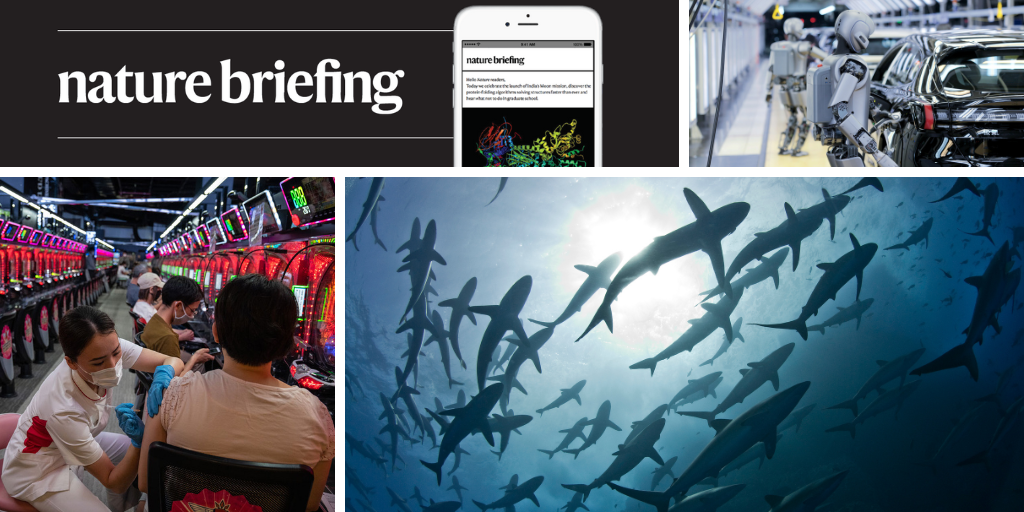
The text of the High Seas Treaty was finalised in 2023, and ratification by 60 countries — a milestone that meant it would be brought it into force — was achieved in September. (Rodrigo Friscione/Getty)
On Saturday, the High Seas Treaty (officially known as the Agreement on Marine Biological Diversity of Areas beyond National Jurisdiction or BBNJ Agreement) came into force. “It’s one of the most important environmental agreements ever,” says marine-policy expert Matt Frost. The treaty brings in a mechanism to safeguard the two-thirds of the ocean that lies beyond any national jurisdiction, such as through the creation of marine protected areas. “This moment shows that cooperation at a global scale is possible,” says marine biologist Sylvia Earle. “Now we must act on it.”
New Scientist | 6 min read (paywall) or Euronews | 6 min read
Under the leadership of anti-vaccine activist Robert F. Kennedy Jr, US health officials have reduced the slate of immunizations recommended for children. Japan offers an example of what this might mean for the country’s health. Japan saw flu and pneumonia deaths spike after the government stopped recommending that children be vaccinated against influenza in 1994. And gaps in rubella coverage helped to spark an epidemic in 2012. It’s “very shocking” that the United States is following that type of path, says infectious-disease epidemiologist Hiroshi Nishiura.
A PhD student’s appetite to undertake potentially risky projects tends to mirror that of their supervisor, even after they’ve moved laboratory. Researchers asked more than 1,200 PhD students to report how likely they were to take part in a safe project – defined as one that would guarantee publication in a mid-tier journal – compared with a risky one, and examined the publication record of the students and their supervisors. The team found that students’ risk-taking dispositions matched that of their supervisors, a link that was stronger when students and their supervisors communicated frequently, and weaker when students were also mentored by scientists outside their lab.
Reference: Research Policy paper
Some gifted dogs can learn words for hundreds of objects and pick up new ones just by listening in to the conversations of human family members — abilities that put them on a par with infants at about 18 months old. Only a few animals, including bonobos (Pan paniscus) and an African grey parrot (Psittacus erithacus), have been observed to recognize objects through unique names. Learning words indirectly through watching human interactions is even harder because it requires following a person’s gaze and, to some extent, understanding their intentions.
Features & opinion

Humanoid robots are being trialed in car manufacturing.Credit: VCG/Getty
Some Chinese and US firms have announced plans to produce humanoid robots at scale in the past three months, claiming that such droids are on the brink of being commercially useful. Many researchers agree that cheaper parts and improved battery lives have heralded a step change in humanoid capability in the past five years. But whether humanoids are saving companies time or money remains to be seen. Many activities still require human operators, and some researchers say that technical and safety limitations mean that humanoids won’t be populating homes and offices anytime soon.
“I feel I’ve been left to do my PhD alone without any guidance from my adviser,” writes a discouraged engineer asking for advice from Nature’s careers team. Three academics who study workplace dynamics respond that communication and advocating for yourself will be key to reconnecting with your adviser. And, if you can’t get the support that you need from your PI, they suggest seeking help and mentorship elsewhere.
Far from a coldly intellectual duel between competing theories, a mathematical revolution around the turn of the twentieth century was driven “by temperaments, loyalties, neuroses and sheer chance”, notes science writer Ananyo Bhattacharya in his review of The Great Math War, by journalist Jason Socrates Bardi. “Bardi is at his best when excavating the overlooked corners of history,” writes Bhattacharya. “The petty jealousies of editorial boards, the philosophical fights waged through open letters, the strain on marriages and the toll on mental health.”
On Friday, Leif Penguinson was exploring the coastal fig trees in Port Douglas, Queensland. Can you find the penguin? When you’re ready, here’s the answer.
Thanks for reading,
Flora Graham, senior editor, Nature Briefing
With contributions by Jacob Smith
• Nature Briefing: Careers — insights, advice and award-winning journalism to help you optimize your working life
• Nature Briefing: Microbiology — the most abundant living entities on our planet — microorganisms — and the role they play in health, the environment and food systems
• Nature Briefing: Anthropocene — climate change, biodiversity, sustainability and geoengineering
• Nature Briefing: AI & Robotics — 100% written by humans, of course
• Nature Briefing: Cancer — a weekly newsletter written with cancer researchers in mind
• Nature Briefing: Translational Research — covers biotechnology, drug discovery and pharma


