



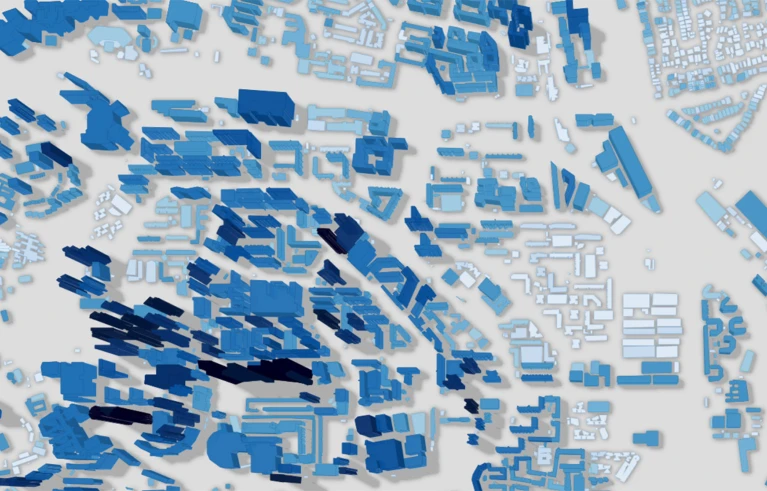
Three-dimensional maps, such as this one of a district in Singapore, could help researchers to keep track of urban planning, disaster risk assessment and climate change.Credit: Zhu et al./ESSD
Scientists have produced the most detailed 3D map of almost all buildings in the world . The map, called GlobalBuildingAtlas, combines satellite imagery and machine learning to generate 3D models for 97% of buildings on Earth.
The data set, published in the open-access journal Earth System Science Data on 1 December1, covers 2.75 billion buildings, each mapped with footprints and heights at a spatial resolution of 3 metres by 3 metres.
The 3D map opens new possibilities for disaster risk assessment, climate modelling and urban planning, according to study co-author Xiaoxiang Zhu, an Earth observation data scientist at the Technical University of Munich in Germany. It could also help to improve how researchers monitor United Nations (UN) Sustainable Development Goals for cities and communities, Zhu adds.
Billions of buildings
Conventionally, creating detailed 3D maps at a global scale has been difficult, say Zhu, because it usually requires either laser scanning or high‑resolution stereo imagery. The team’s solution was to combine deep learning with laser scanning techniques to predict building heights. The tool was trained on reference data obtained using light detection and ranging (LiDAR) from 168 cities, mostly in Europe, North America and Oceania.
The researchers created the 3D maps from approximately 800,000 satellite scenes captured in 2019, using the deep-learning tool to predict building heights, volumes and areas.
The study found that Asia accounts for nearly half of all mapped buildings in the world — approximately 1.22 billion structures. Asia also dominates the total building volume at 1.27 trillion cubic metres, reflecting rapid urbanization and dense metropolitan clusters in China, India and southeast Asia.
Africa has the second largest number of buildings at 540 million, but their combined volume is only 117 billion cubic metres, underscoring the prevalence of small, low-rise structures.
City-scale analyses illustrate how building volume correlates with population density and economic development. In Europe, Finland has six times more building volume per capita than does Greece. The study also highlighted that Niger’s per-capita building volume is 27 times below the world average.
These patterns suggest that conventional 2D measures of urban growth, such as built-up areas, might obscure crucial differences between infrastructure and living conditions.

A aerial model of structures in the Chinese city of Changsha.Credit: Zhu et al./ESSD, (Basemap ©CARTO and ©OpenStreetMap contributors)
Disaster risk assessment
Dorina Pojani, an urban planning researcher at the University of Queensland in Brisbane, Australia, says that the data set would be extremely valuable for her research, because she has previously relied on static, 2D data.

