


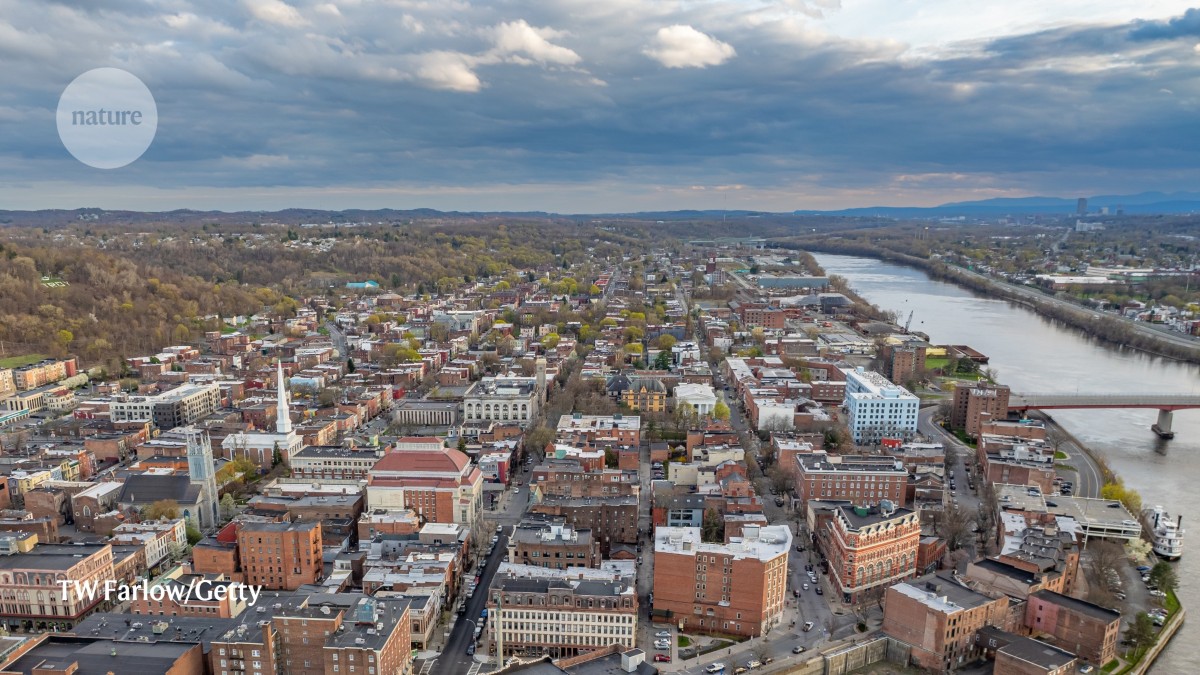

Troy in New York state is one of the first cities to use an innovative type of heat pump.Credit: TW Farlow/Getty
The half-a-dozen nineteenth-century commercial buildings huddled beside the Hudson River that make up an arts centre in Troy, New York, are destined for a distinctly twenty-first-century energy makeover. The same goes for an apartment building across the street and a department store-turned-technology hub a few blocks away.
The plan — hatched by Troy’s economic-development office to revitalize the downtown area and now driven by regional utility company National Grid — is to combine the buildings’ heating and cooling systems in a single high-efficiency, low-carbon network. The hope is that more buildings will join the scheme before the thermal network begins operating in 2027. Ultimately, it might wean all of the Central Troy Historic District off natural gas.
Heat pumps installed in the buildings will do most of the work. But these are not the same heat pumps commonly used to maintain the temperature of individual homes and businesses. Those devices warm indoor spaces by extracting heat from cold air, and cool them by pushing heat out into already hot air. In Troy, a once-prosperous industrial city about 200 kilometres north of New York City whose manufacturing economy collapsed, the new heating and cooling system will work quite differently.

Nature Outlook: Cities
Behind the Arts Center of the Capital Region, dozens of boreholes are set to be drilled 150 metres into the ground, where the average temperature is 13 °C all year round. In the Hudson Valley’s increasingly scorching summers, the network’s heat pumps can dump heat into the cooler bore holes. And on freezing winter nights, the pumps will keep residents warm by drawing heat from the relatively warm ground.
The thermal energy networks (TENs) that tap geothermal resources in this way are radically changing the image of a technology that utility companies had previously dismissed as prohibitively expensive. “Geothermal would be written off on day one,” says Eric Bosworth, an independent energy consultant in Hopkinton, Massachusetts. “Now there are examples of successful projects all over the place.”
More than 100 of these systems already operate in relatively carbon-conscious Europe, where they are usually called fifth-generation district heating and cooling (5GDHC) networks. There are more than 50 in Germany alone, where installations are accelerating to eliminate the country’s dependence on Russian gas. In North America, the first TEN built by a US utility company began operating last year in the city of Framingham, Massachusetts. More than 20 others are either operating or in development in New York state, including in Troy, and in other cities, such as Boston in Massachusetts, Chicago in Illinois and Toronto in Canada.
Proponents of TENs say that the technology’s efficiency could accelerate a transition from natural gas and ease the demand on power grids. But the technology needs extensive research and development to meet its full potential. The design varies from place to place, and some overly conservative choices are pushing up costs. “There are still no good official or even unofficial design guidelines,” says Marco Wirtz, founder and chief executive of district-energy modelling firm nPro Energy, based in Düsseldorf, Germany. “Engineers are learning as they do.”
Drilling down
The system in Framingham exemplifies many of the common denominators for urban TENs systems. Its pipes form a 1.6-kilometre loop, circulating a blend of water and antifreeze that exchanges heat between the ground and 36 buildings along the route. Customers include 22 single-family homes and duplexes, a 108-unit city-run housing complex, a fire hall, a school and several small businesses. The loop reaches underground by means of 90 bore holes, each of which is 16.5 centimetres in diameter and about 200 metres deep.
Most of the holes were drilled vertically, 6 metres apart, using equipment typically used to create drinking-water wells. But the 35 holes under the school’s car park, which will provide about half of the system’s total geothermal capacity, were drilled at various angles, as if tracing the outline of a pyramid under the ground. This spreads the bores apart, so they are not trying to dump or draw heat in the same zones underground, which would cause large shifts in ground temperature and reduce the system’s performance. “You eliminate the interaction between bores, which means that you can extract and sink more energy into the ground,” says Tunca Alikaya, drilling operations director at Celsius Energy in Cambridge (a geothermal spin-off from the oil and gas-services firm SLB in Houston, Texas).
TENs can use other heat sinks and sources to supplement or replace geothermal fields. In Denver, Colorado, a TEN that would draw heat from treated sewage is being considered to serve 11 downtown municipal buildings. A project close to New York City plans to use the Hudson River as a heat source and sink, as well as geothermal boreholes and a sewer main. Some projects in the United States and Europe already tap waste heat generated by data centres.
Most TEN designs worldwide have circulatory systems with separate pipes for warm and cool fluids. In such a two-pipe network, which is the only approach operated in Europe, users in heating mode draw fluid from the network’s warm pipe, take some heat and then send the cooled water to the network’s cool pipe. Users operating in cooling mode do the opposite.
The design at Framingham exchanges heat by means of a simpler one-pipe scheme. Of the eight New York projects that are new-build systems, five are single-pipe systems, including the one in Troy.

Geothermal loops are required for the geothermal heat pumps.Credit: Peter Fairley
The single-pipe design is easier to control, because buildings always withdraw and expel water from the same pipe. The water pressure in each building is also controlled locally. By contrast, buildings using a two-pipe system are hydraulically coupled to the network, which means that pressure swings can affect the system’s performance. Two-pipe systems therefore require extra controls and valves that add cost and occupy more space, and because they generally use progressively smaller pipes towards the network’s extremities, they are also more difficult to expand.
A 2020 simulation study1 that compared the two designs predicted that single-pipe systems would be marginally cheaper. But the two-pipe system is preferable in networks serving buildings with both large and small demands, says Brian Urlaub, senior vice-president and director of geothermal operations at engineering company Salas O’Brien in Irvine, California. This is because separate hot and cold piping ensures that all users get fluids at the correct temperature. In a one-pipe network, big buildings adding or subtracting a lot of heat from the loop can cause temperature deviations that degrade the performance for smaller users downstream.
So far, two-pipe systems have been established almost exclusively in new urban developments that present few design constraints. The simpler one-pipe systems are being retrofitted into existing neighbourhoods, such as in Troy and Framingham, where space is limited and expandability is important.
Design versus cost
Zeyneb Magavi, executive director of Boston-based non-profit organization HEET and co-creator of the Framingham project, says that Framingham’s TEN is operating well. A full breakdown of the costs and benefits is yet to be revealed, however, and this applies to other TENs, too.
It is clear that some of the proposed TENs will be more expensive than expected. The budgets for some pilot projects in New York state have more than doubled since the preliminary estimates, according to Urlaub. That increase is in part a symptom of the technology’s appeal: rising demand for TENs is driving up the cost of the limited geothermal drilling capacity.
The challenge of retrofitting old buildings included in the pilot projects can also drive up costs. Elizabeth Reiss, chief executive of the Arts Center of the Capital Region in Troy, unapologetically admits to having asked National Grid to ensure that the makeover of her scrappy non-profit organization would be sized to serve the entire complex, including upper floors that are currently undeveloped. “They’ve never had somebody ask for equipment for an unbuilt component of their building. But I mean, I’ll ask a dead man for a match,” says Reiss.
One long-standing cost driver for TENs is overdesign. A 2023 report2 by the US National Renewable Energy Laboratory (NREL) noted that three of the TENs it studied made minimal use of back-up systems that had been installed. It concluded that “conservatively designed” TENs both incur higher capital costs and consume excessive energy.
One way to ease this problem is to introduce design standards that would provide risk-averse utility companies with greater certainty. Bosworth says that some engineers are currently using design software created with single-building geothermal systems in mind, and are therefore overlooking some of the benefits of a network, such as how heat removed from commercial buildings that need year-round cooling can help to keep their residential neighbours warm in winter. To address this problem, HEET has installed fibre-optic sensors to measure heat flows across Framingham’s network. The NREL is now using the data to validate a TENs model commissioned by HEET.
HEET has also established data standards to enable comparisons between projects. “We really need comparable data sets from real projects, and a model that actually is verified, so that we can de-risk the process and bring the cost down,” says Magavi.

Some bore holes in Framingham were drilled at angles to prevent interactions between them.Credit: Eversource
European research projects are doing similar work. Wirtz of nPro Energy built on research from his years at RWTH Aachen University in Germany to craft a commercial software package designed to simplify, standardize and accelerate the planning of district heating and cooling systems. “It makes state-of-the-art design knowledge available to a much broader user base and evolves as the industry gains more experience,” he says.
The software’s strengths include its ability to benchmark the cost and performance of TENs against those of alternative district-energy systems or building-by-building electrification. However, Wirtz does acknowledge one blind spot: nPro’s software does not yet model the single-pipe variant that is taking off in North America.
This limitation speaks to the dearth of knowledge crossing the Atlantic, which limits any comparative assessment of European and North American projects. “There’s just no learning and knowledge sharing going on between the regions,” Bosworth says.
A popular transition
Many studies have documented the relative efficiency of TENs. A 2020 study3 by Wirtz and his colleagues at RWTH Aachen, for example, projected that using a TEN to heat and cool their 17-building campus would reduce the lifetime cost by 42% compared with installing air-source heat pumps. But some advocates of TENs say that a full accounting of the technology’s benefits requires a larger view of energy systems and the transition away from fossil fuels.
Allison Considine, a campaign strategist and lobbyist at the Building Decarbonization Coalition, which is based in Petaluma, California, points to research projecting long-term infrastructure savings for both gas and electricity systems. The higher heating and cooling efficiency of TENs promises to slash the peak loads that power grids will need to generate and deliver.
A 2023 study4 by the Oak Ridge National Laboratory and NREL found that installing geothermal heat pumps in about two-thirds of the US homes that could feasibly use them would negate the need to construct 345 gigawatts of battery and power generation capacity, as well as nearly 40,000 kilometres of transmission wires, to decarbonize the US grid by 2050. These savings add up to more than $600 billion in investment that would otherwise be needed.
Giving gas companies and their pipe-laying workers a renewable-energy future would make it easier for them to accept the inevitable phase-out of gas distribution as electrification takes over. One of New York’s pilot projects plans to remove about 150 metres of leak-prone gas pipe. Replacing gas with TENs could free up considerable resources to accelerate urban electrification, says Considine. “We have hundreds of miles of very old, leak-prone gas mains in New York that utility companies plan on repairing and replacing in the decades to come, to the tune of hundreds of millions, or billions, of dollars.”
Magavi says that one of the biggest takeaways from the Framingham project was the ability of gas workers to change gears and install the thermal network pipes after just a couple of hours of training. “It was one of the most seamless, almost magical, workforce transitions you could imagine,” she says.
That transferability of skills helps to explain why New York’s utility companies and their associated unions have embraced TENs. Gas companies and workers see installing thermal networks as an opportunity to expand their roles, even when governments are moving to reduce the use of natural gas.
The overlap between TENs, gas systems and drilling is also helping to maintain political support in the United States as federal politics swings against renewable energy and decarbonization. While President Donald Trump and the Republican-led Congress have waged a concerted attack on wind and solar power, geothermal energy has remained unscathed. This summer, the US Department of Energy restarted contract negotiations for a $7.8-million grant, awarded to HEET by the Biden administration, that will help to triple the size of Framingham’s network.
Magavi is receiving help in her efforts to promote the benefits of TENs from the International Finance Corporation (IFC), the arm of the World Bank that lends to the private sector. She and Bosworth are advising a programme launched by Hela Cheikhrouhou, an IFC regional vice-president, to evaluate the potential of TENs in seven Asian countries, including Jordan, Turkey, Pakistan and Kyrgyzstan.
Consultants funded by Cheikhrouhou’s office are studying the feasibility of using TENs to serve 10,000–30,000 housing units and businesses, which would be much larger than any network so far seen in Europe or North America. Cheikhrouhou has touted TENs as a long-term cost-saver that can create local jobs, because it can be installed and maintained by small businesses without the need for highly skilled workers.
Magavi says that officials in countries where the IFC programme is operating grasp the value proposition of TENs better than many of their counterparts in the United States. Many countries, she says, “see energy infrastructure as the fundamental basis of their socio-economic development and well-being. We’ve had it for so long, we’re so used to it, that we’ve forgotten that core connection.”
Proponents in post-industrial US cities, who think that TENs can contribute to their regeneration, might be an exception. As Magavi puts it, TENs can “get people excited and hopeful about the future”.
Reiss says that Troy’s TEN reflects a commitment to preserve the city’s individuality that dates back to the 1970s, when citizens fought off a highway project that would have radically altered its downtown area. “Troy is in love with itself,” she says, and that inspires a lot of experimentation. “Something like a geothermal programme fits into that visionary thinking. This whole area is filled with people who say, ‘what if?’.”

