


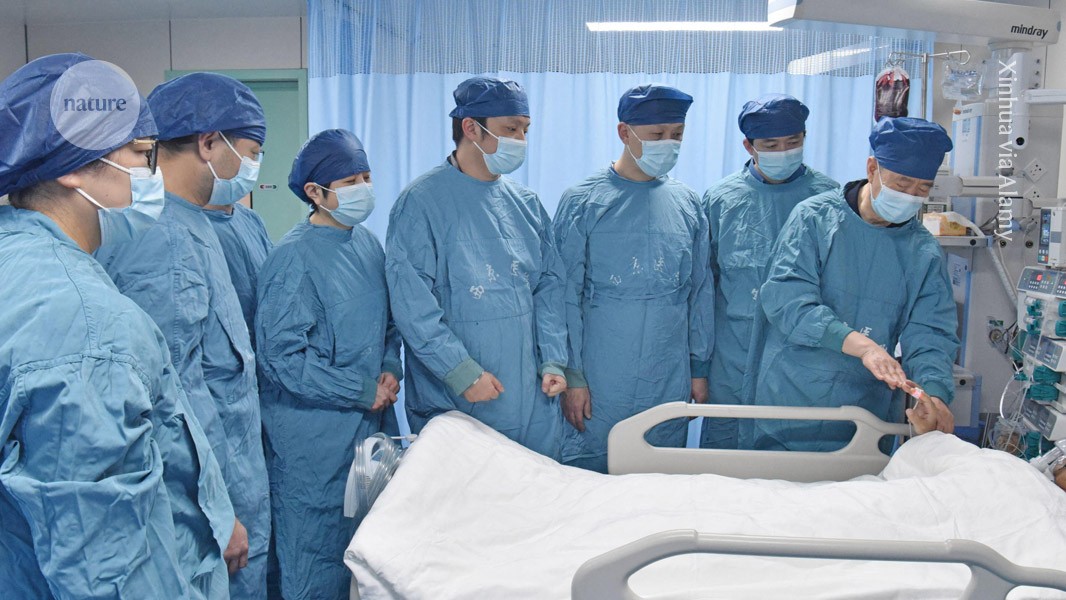
A medical team at Xijing Hospital of the Air Force Medical University in Xi’an, China, surgically connected a man with liver failure to an external, genetically modified pig liver. Credit: Xinhua via Alamy
A 56-year-old man with liver failure has become the first living person to be surgically connected to a genetically modified pig liver, say the team that conducted the surgery. The pig organ filtered the man’s blood for a few days while he waited for a human liver transplant, they say.
The man has since received a human liver and is recovering well, says Lin Wang, one of the surgeons who led the procedure in January at Xijing Hospital of the Air Force Medical University in Xi’an, China. Wang says his team plans to submit the results to a peer-reviewed journal.
Proponents of transplanting genetically modified animal organs into people, a procedure called xenotransplantation, hope that the method could reduce the number of people who die while waiting for a human organ. At least a dozen people in the United States and China have received pig organs, including hearts, kidneys, livers and a thymus – and clinical trials are under way in both nations. But, organ transplants are high-risk surgeries and recipients must take immunosuppressants for the rest of their lives. In the latest surgery, the recipient was connected to a pig liver outside their body — a procedure called extracorporeal perfusion.
The procedure is a bridging therapy that allows a person’s organs to recover, and it can be lifesaving for people who are too sick to wait for a human donor organ without intervention, says Wayne Hawthorne, a surgeon and transplant researcher at the University of Sydney in Australia.
‘Remarkable’
Extracorporeal perfusion using pig organs has been performed since the 1990s, but the development of genetically modified pig organs that are more compatible with people reduces the risk of organ rejection. A US team have connected at least four clinically dead people to external, genetically modified pig livers1. That surgeons in China have been able to do this in a living person is “a remarkable achievement,” adds Hawthorne.
Muhammad Mohiuddin, a clinician-researcher at the University of Maryland School of Medicine in Baltimore, who led the first pig-heart transplant into a living person in 2022, agrees that the technology could be lifesaving.
Hawthorne and Mohiuddin say they are eager to know more details about the surgery in China, including the amount of immune-suppressing therapy that was used, how the man’s health changed over time and how long could someone be connected to the external liver. Results of liver-function tests before, during and after the surgery will also be needed if the team publishes its findings, Hawthorne adds. “This is all the basics for a liver transplant paper.”
The recipient in China had chronic hepatitis B infection, a serious liver illness, and damage caused by alcohol, which led to a sudden deterioration in his liver function, says Wang. He had been hospitalized in Shanghai, China, for a month before Wang’s team treated him. Without a donor organ available, the surgeons decided — with consent from the man and his family — to test whether a pig liver could take over the functions of his failing liver.
The pig liver contained six genetic modifications, says Wang, and was supplied by the company ClonOrgan Biotechnology in Chengdu, China. The six genetic modifications included three deactivated pig genes and introduced three genes that produce human proteins, to reduce the risk of the recipient rejecting the organ.
External filter
The surgeons stitched tubes to a vein in the man’s leg, connecting him to a perfusion device containing the pig liver. His blood was redirected through the pig liver to remove harmful waste products that build up owing to liver failure. The physicians said that there were no signs that the organ was being rejected, and that the man’s own liver function began to improve.

