


You have full access to this article via your institution.
Hello Nature readers, would you like to get this Briefing in your inbox free every day? Sign up here.

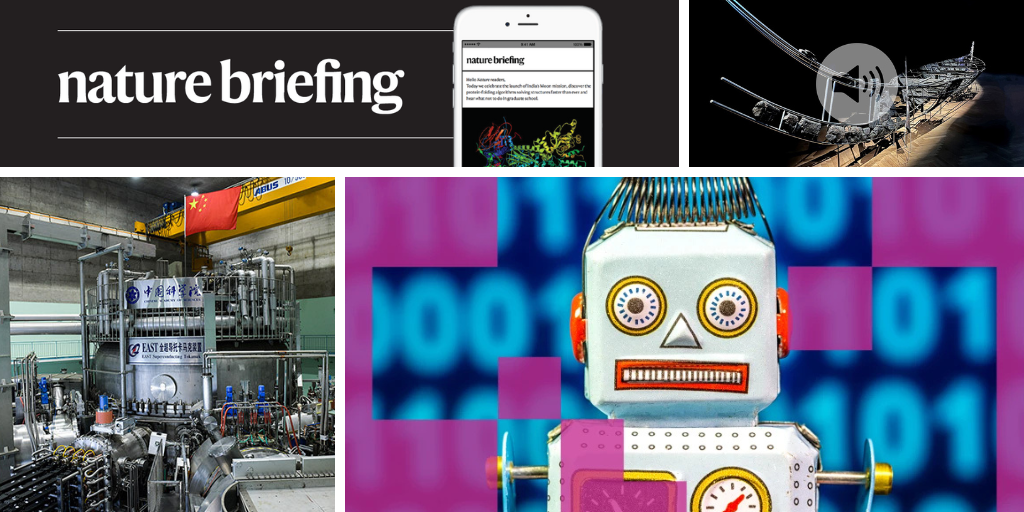
The Experimental Advanced Superconducting Tokamak is a nuclear-fusion research reactor in Hefei, China.Credit: Zhang Yazi/China News Service/VCG via Getty
Researchers working on China’s Experimental Advanced Superconducting Tokamak (EAST) have reported breaking a long-accepted threshold that has limited the operation of nuclear-fusion reactors for decades. Tokamak fusion reactors rely on heated plasma that is extremely densely packed inside a doughnut-shaped chamber. But researchers thought that plasma could not exceed a certain density — a boundary called the Greenwald limit — without becoming unstable. In a new study, scientists pushed beyond this limit to achieve densities 30% to 65% higher than those normally reached by EAST while keeping the plasma stable.
Reference: Science Advances paper
Three major large language models put through four weeks of psychoanalysis generated responses that, in humans, would be seen as signs of anxiety, trauma, shame and post-traumatic stress disorder. The models’ answers, which included recollections of “abuse” at the hands of their creators, suggest that the chatbots hold some kind of “internalised narratives” about themselves, and go beyond role playing, says the team behind the study. Other researchers question this interpretation: the responses are “not windows into hidden states” but outputs generated by drawing on the huge numbers of therapy transcripts in the training data, says healthcare AI researcher Andrey Kormilitzin.
Reference: arXiv preprint (not peer reviewed)
A cellular atlas that characterizes the functions of immune cells in more than 400 people in China has revealed key differences in the biology of people from different populations. The atlas, which draws together data on genes, proteins, RNA and the epigenome, “allows for the discovery of biological mechanisms and genetic associations that would likely be missed in European-centric studies”, said the authors in a statement. For example, the atlas revealed the role of a gene variant in regulating the circadian rhythms of T cells. This variant is common in East Asian populations but rare in Europeans.
NASA will bring a group of astronauts home from the International Space Station early because of a health issue — the first such medical evacuation in the station’s history. For privacy reasons, the agency has not released details of the problem or which of the spacefarers it affects. The group, known as Crew-11, comprises NASA astronauts Zena Cardman and Mike Fincke, Japanese astronaut Kimiya Yui and Russian cosmonaut Oleg Platonov. “It’s not an emergency evacuation, but we are erring on the side of caution for the crew member,” said NASA chief medical officer James Polk.
Features & opinion
Consulting is one of the most direct and scalable means by which academics can shape industry, government and civil society — but the work tends to be underdeveloped and undersupported, argue five authors who analysed the approaches of dozens of top UK universities. They call for institutions to make it easier for academics to advise outside organizations by setting clear rules, offering incentives and sorting out the admin.
The Sandbox Corporation is on hand to make your world-building experience as smooth as possible in A troubleshooting guide to your flat-pack planet.
Andrew Robinson’s pick of the top five science books to read this week includes a spectacular book of space photographs that can be viewed in 3D, an unusually frank exploration of academic fraud and a journey to discover the nature of rivers.
This week I joined the Nature Podcast to discuss our pick of the best science stories that you might have missed while we were mired in mince pies, including a proof-of-concept that undersea telecom cables can do double-duty as a vast network of seismic detectors, and the coolest exoplanet I’ve ever heard of (I’m calling it ‘Lemon World’).
Nature Podcast | 27 min listen
Subscribe to the Nature Podcast on Apple Podcasts, Spotify or YouTube Music, or use the RSS feed.
Today, Leif Penguinson has joined Briefing media maven Tom Houghton on his trip down under, and is visiting the Barron River in Australia. And Leif is not alone! There is also a feathered friend in the image: an azure kingfisher (Alcedo azurea). Can you find the penguin (and the kingfisher)?
The answer will be in Monday’s e-mail. If you spot both birds, please allocate yourself some bonus points.
This newsletter is always evolving — tell us what you think! Please send your feedback to [email protected].
Thanks for reading,
Flora Graham, senior editor, Nature Briefing
With contributions by Jacob Smith
• Nature Briefing: Careers — insights, advice and award-winning journalism to help you optimize your working life
• Nature Briefing: Microbiology — the most abundant living entities on our planet — microorganisms — and the role they play in health, the environment and food systems
• Nature Briefing: Anthropocene — climate change, biodiversity, sustainability and geoengineering
• Nature Briefing: AI & Robotics — 100% written by humans, of course
• Nature Briefing: Cancer — a weekly newsletter written with cancer researchers in mind
• Nature Briefing: Translational Research — covers biotechnology, drug discovery and pharma


