


You have full access to this article via your institution.
Hello Nature readers, would you like to get this Briefing in your inbox free every day? Sign up here.
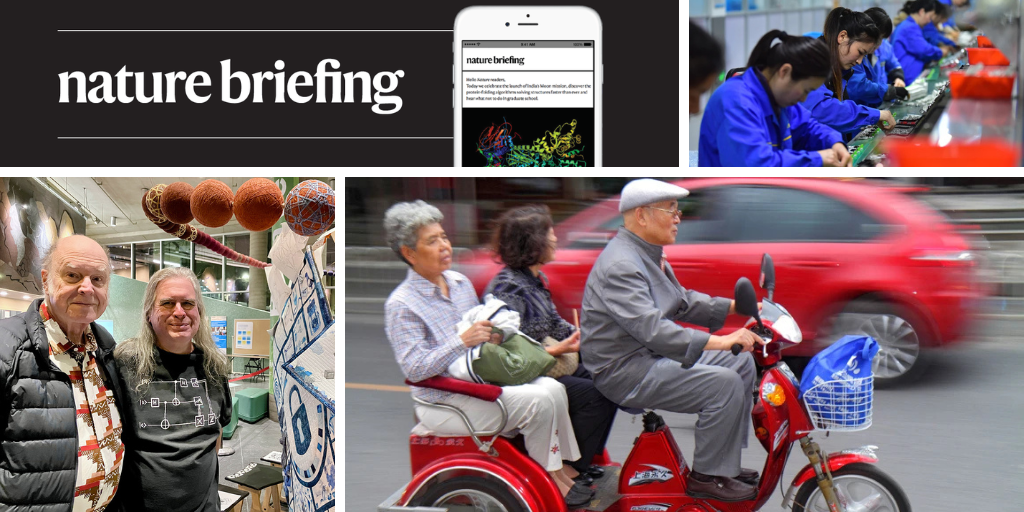
Charles Bennett (left) and Gilles Brassard pose for a photograph next to a cryptography quilt. Credit: Lise Raymond
The US$1 million A. M. Turing Award — one of the most prestigious prizes in computer science — has been awarded to computer scientist Gilles Brassard and physicist Charles Bennett “for their essential role in establishing the foundations of quantum information science and transforming secure communication and computing”. The win marks the first time that the Turing Award has recognized work related to quantum physics. “Had I been asked to choose one recognition at any point in my career, it would have been the Turing Award,” says Brassard.
The oldest known recording of a whale has been re-discovered on a disc labelled ‘Fish Sounds’ in the archives of the Woods Hole Oceanographic Institution. The humpback whale (Megaptera novaeangliae) was recorded near Bermuda in 1949. But the researchers who did so probably didn’t know what they’d got, says Woods Hole bioacoustician Peter Tyack, because it predates biologist Roger Payne’s influential Songs of the Humpback Whale album. “For me, it was almost more mesmerizing to hear the ocean soundscape that whale was experiencing [more than] 75 years ago,” says Tyack.
CBC | 6 min read or 5 min listen
The US National Institutes of Health (NIH) — the world’s largest funder of biomedical research — is no longer allocating many of its grants by asking researchers to submit proposals that address specific scientific problems. Instead, the agency is focusing on ‘unsolicited’ research proposals driven by the interests of individual scientists. The NIH says that the move will save money on admin and will offer scientists more flexibility to choose the direction of their research. But some researchers worry that will mean fewer large, collaborative projects that require agency coordination, such as the Human Genome Project, and that it could widen knowledge gaps in areas such as neglected diseases or underserved populations.
Under the new system, funding must be approved by political appointees, rather than solely by panels of politically independent scientists. “It eliminates the scientific stewardship function that programme staff have exercised for decades,” argues Elizabeth Ginexi, who wrote funding calls for 22 years as an NIH programme official. “This is about centralized control.”
Nature | 6 min read & The Chronicle of Higher Education | 13 min read (free reg required, or read a version on Elizabeth Ginexi’s personal blog)

Source: Data from grants.nih.gov
Features & opinion

Demand for electric tricycles is on the rise, with 320,000 sold in 2023 in China. Credit: Jeffrey Isaac Greenberg/Alamy
From golf buggies to electric tricycles, low-speed electric vehicles (EVs) offer a cheap, clean option for short distance travel, saving emissions compared to bigger cars and serving those for whom a two-wheeled e-bike doesn’t tick the boxes. “Yet they remain sidelined in sustainability discussions, which show a persistent bias towards technocentric solutions that tend to prioritize innovation over practicality,” argue engineers Linni Jian, Yunwang Chen and Ching-chuen Chan. It’s time to smooth out regulatory hurdles, finalize international standards and bring low-speed EVs firmly into the mainstream, they write.
In Breakneck, tech analyst Dan Wang fills in the gaps in many Western scholars’ accounts of China’s economic and technological success, on topics such as the complexity of the country’s one-child and zero-COVID policies. Breakneck is “one of the best English-language texts on China published in the past few years”, says political scientist Xiaoyu Zhang in his review. But Wang distils his account into the narrative that China is led by engineers, whereas the United States is led by lawyers, which means it “doesn’t always follow the facts”, Zhang says.
Brazil is developing an artificial-intelligence agent to provide climate-disaster information and advice for its residents. It is one of the first large-scale national initiatives to integrate AI, simulations and citizen participation into a tool for disaster preparedness aimed at individuals. “Developing such a tool is a human challenge as much as a technical one,” writes Soraia Raupp Musse, who studies crowd dynamics and is coordinating the simulations aspect of the agent. “Understanding fear, trust and attention is crucial: an alert that is technically correct but psychologically ineffective might fail to save lives.”
Infographic of the week

There are now more than 10,000 satellites in orbit as part of the Starlink system run by entrepreneur Elon Musk’s company SpaceX. “Starlink has changed our relationship with space,” says space debris expert Hugh Lewis. “The character of the night sky is no longer the same as it once was, and I’m not sure it will ever be again.” (Scientific American | 9 min read)
Read more: Swarms of satellites are harming astronomy. Here’s how researchers are fighting back (Nature | 14 min read, from 2025) (Amanda Montañez; Source: Jonathan’s Space Pages (data), with additional consulting by Jonathan McDowell)
If your last attempt at injecting some humour into a talk got a laugh, chalk it up as a big win: two-thirds of jokes in presentations fall flat. A survey of more than 500 presentations at biology meetings found that almost one-quarter of attempted jokes were judged as a “moderate success”, and the elite 9% were deemed hilarious. As someone who loves a good wry aside, I think it’s a case of ‘nothing ventured, nothing gained’: 40% of the talks had no jokes at all.
Heard any good jokes lately? I’d love to hear a favourite — especially if it was told during a scientific event — at [email protected].
Thanks for reading,
Flora Graham, senior editor, Nature Briefing
With contributions by Jacob Smith
• Nature Briefing: Careers — insights, advice and award-winning journalism to help you optimize your working life
• Nature Briefing: Microbiology — the most abundant living entities on our planet — microorganisms — and the role they play in health, the environment and food systems
• Nature Briefing: Anthropocene — climate change, biodiversity, sustainability and geoengineering
• Nature Briefing: AI & Robotics — 100% written by humans, of course
• Nature Briefing: Cancer — a weekly newsletter written with cancer researchers in mind
• Nature Briefing: Translational Research — covers biotechnology, drug discovery and pharma

