


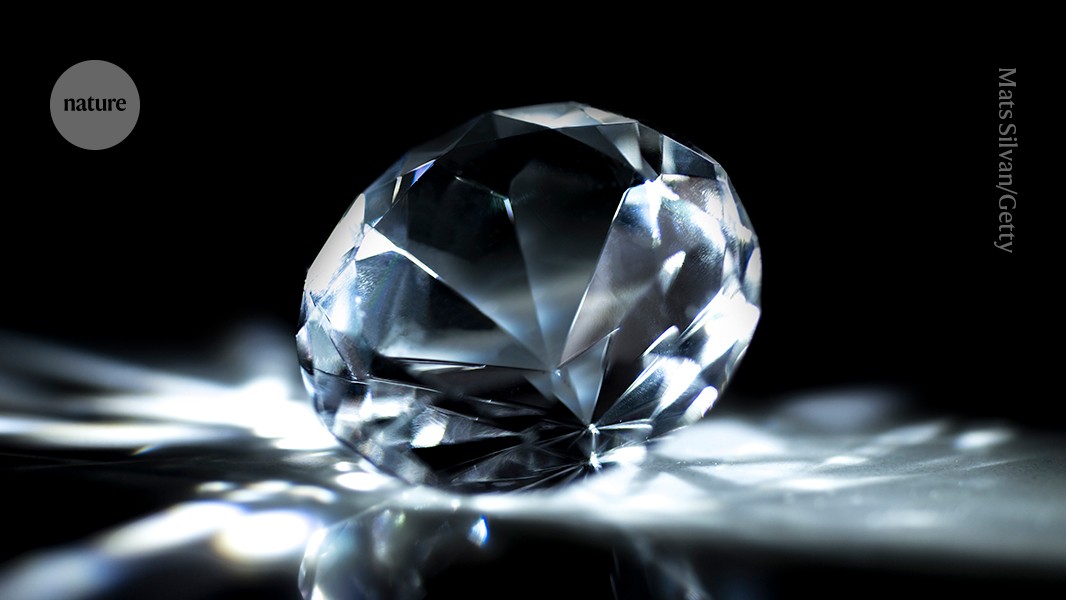

Conventional diamond, called cubic diamond, is known as the hardest substance in the world. But researchers think hexagonal diamond could be harder.Credit: Mats Silvan/Getty
Diamond is famously known as the hardest mineral on Earth. But researchers have been pursuing an unusual variant of it — known as hexagonal diamond — that might be even harder. After decades of claims and counterclaims about whether this mysterious material can be synthesized in a laboratory, researchers in China report that they have done it1.
Scientists covet the material because it “has potential applications in many fields, for example in cutting tools, in thermal management materials and in quantum sensing”, says Chongxin Shan, a physicist at Zhengzhou University, who co-led the work.
“There are hundreds of claims from people who believe they have seen it,” says Oliver Tschauner, a mineralogical crystallographer at the University of Nevada, Las Vegas, who peer-reviewed the paper. “But this is the first very accurate characterization of this elusive material.”
Shock value
Conventional diamond consists entirely of carbon atoms arranged into tetrahedra, which ultimately form a cubic crystal structure. Viewed from a specific angle, this lattice of atoms looks like a stacked series of buckled honeycomb layers. Each successive layer is offset slightly relative to its neighbours, in a pattern that repeats every three layers. But in 1962, researchers predicted that diamond could adopt a different structure — one with hexagonal features — in which the pattern repeats every two layers2 (see ‘Diamond’s elusive form’).

In conventional, or cubic, diamond, the carbon bonds between layers are marginally weaker than those within layers, which limits diamond’s strength. In the hexagonal form, the bonds between layers are shorter and stronger than those in cubic diamond, and predictions suggest that these features should make hexagonal diamond more than 50% harder.
In 1967, researchers reported finding hexagonal diamond in a meteorite found in Arizona, which was part of the space rock that created the iconic Meteor Crater nearby3. The team suggested that the shock of the impact had transformed graphite in the meteorite into hexagonal diamond, and named this new mineral lonsdaleite, after pioneering crystallographer Kathleen Lonsdale.
Around the same time, a separate research team said that it had produced hexagonal diamond in the lab by heating and compressing graphite4. But some scientists have cast doubt on that report5. And others argued that lonsdaleite wasn’t hexagonal diamond at all; they said it was just cubic diamond with several defects6.
Peak demand
Much of the debate stems from the X-ray diffraction experiments used to discern the material’s crystal structure, Tschauner explains. In this type of experiment, as X-rays scatter through a crystal, some of them combine and produce peaks in X-ray intensity that reveal atoms’ positions. However, the pattern of diffraction peaks obtained from highly defective cubic diamond would closely mimic hexagonal diamond, Tschauner says. To demonstrate the hexagonal structure conclusively, a few extra telltale peaks must be present. “This new paper shows those peaks,” he says. “That’s why I believe it.”

Meet ‘goldene’: this gilded cousin of graphene is also one atom thick
Shan and his colleagues started with highly oriented pyrolytic graphite, and then squeezed it in between anvils made of tungsten carbide under 20 gigapascals of pressure (200,000 times atmospheric pressure) at 1,300–1,900 °C to produce millimetre-sized samples of hexagonal diamond. Tests showed that the material was stiffer, more resistant to oxidation and slightly harder than cubic diamond.

