


Among the leading young universities (aged 50 years or younger) in the Nature Index, these four institutions stand out. From subject specialists to technology hubs and regional training grounds, they are charting their own course to success.
Pohang University of Science and Technology

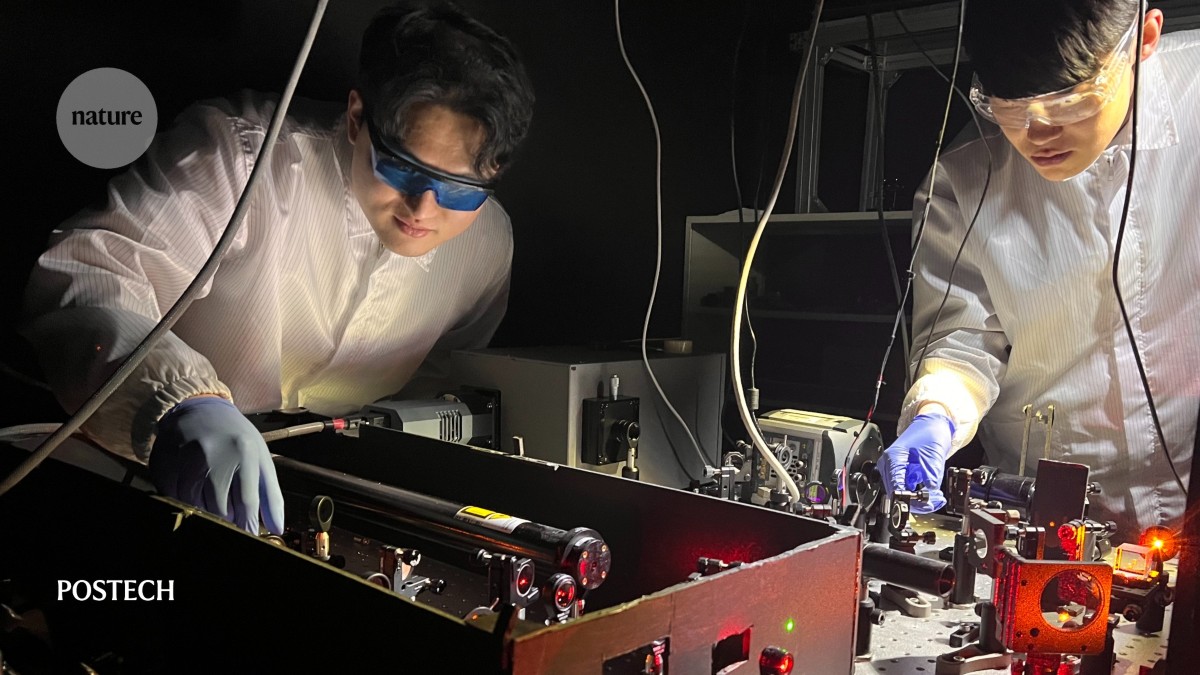
POSTECH students use an advanced imaging technique called tip-enhanced nano spectroscopy to study materials at the nanoscale.Credit: POSTECH
At less than 40 years old, Pohang University of Science and Technology (POSTECH) is already looking for ways to reinvent itself. In 2024, it launched its POSTECH 2.0 strategy — a ten-year plan to elevate its global status, supported by 1.2 trillion South Korean won (US$888.9 billion) in funding, half of which comes from the university itself, and the other half from local and federal governments, corporate backing and donations.
Part of this initiative is to become South Korea’s first ‘AI-native’ university. The plan, announced in July, is to integrate artificial intelligence into all aspects of its system, from research to education. This includes deploying personalized ‘AI tutors’ to assess learning patterns in real time to help students study more efficiently, and equipping teaching staff with AI tools to monitor students’ progress. The initiative will help to prepare POSTECH for “a new leap forward” to meet the challenges of a rapidly changing world, says Sung-Min Park, a biomedical engineer at POSTECH.
Nature Index 2025 Young universities
Building a future-oriented campus will require close collaboration with industry —something that POSTECH has been set up to do since its inception. Based in Pohang, an industrial hub on South Korea’s east coast, POSTECH was established as a research-oriented university in 1986 by POSCO, one of the world’s largest steel manufacturers.
Although POSTECH and POSCO operate as separate entities, they remain deeply connected through training and research programmes. In 2022, for example, POSTECH launched a postgraduate course in battery-materials research in collaboration with POSCO Future M, a subsidiary of POSCO. The master’s and doctoral programmes allow students to conduct field research and participate in projects at the company, and guarantee them a job there after graduating.
“Industry collaboration is not just an activity, but part of POSTECH’s DNA,” says Park. Before joining POSTECH, Park spent more than a decade developing health-care technologies in the United States and South Korea. He now aims to merge that industry experience with POSTECH’s research strengths to develop new medical technologies.
In the Nature Index 2025 Young Universities rankings, POSTECH placed 15th overall and 8th in physical sciences. It’s also within the top 10 fastest-rising young universities in the biological and health sciences for the period 2023 to 2024.
Since 2018, POSTECH has run an ‘open major’ system, allowing some undergraduates to choose courses in any fields in the first four semesters of their degree before deciding on their final core subject. In a country where high-school education is heavily focused on college entrance exams, the system helps students to discover what truly excites them, Park says. He adds that the broad understanding that students gain across disciplines is a valuable asset for their future study.
For Joo Yeon Yoo, a cell biologist at POSTECH, one of the university’s biggest strengths is its small size. Although several South Korean universities, such as Seoul National University and Yonsei University, both in Seoul, have tens of thousands of students, POSTECH has just over 4,000. Yoo says this makes it easier to collaborate with colleagues in other departments on interdisciplinary research — “a critical factor in producing impactful outcomes”. — Xiaoying You
City University of Hong Kong

City University of Hong Kong puts on its annual HK Tech 300 Expo to showcase new start-up projects.Credit: City University of Hong Kong
City University of Hong Kong (CityUHK) has climbed the ranks since it was established in 1994. In the Nature Index 2025 Young Universities rankings, it placed fourth overall, and fourth in the physical sciences. It also placed fifth in chemistry and was the third fastest-rising young university overall.
A major focus of the university is fast-tracking the development and commercialization of new technologies. One of its flagship initiatives is HK Tech 300, a HK$600-million (US$77.22-million) programme that aims to kickstart new businesses based on CityUHK research and technology. Since its launch in 2021, more than 900 start-ups have completed the HK Tech 300 incubation programme, which includes access to resources such as training, workspaces and legal support, as well as eligibility for up to HK$100,000 in seed (early-stage) funding. Of those 900 start-ups, 200 have gone on to secure up to HK$1 million in angel investment (early-stage funding that grants the funder some equity).
One such start-up is Super Bamboo, which produces a sustainable bamboo material with a higher strength-to-weight ratio than steel and titanium, according to company co-founder and director Andy Ong. Ong is a former research assistant at CityUHK, whose supervisor Lu Yang, a materials scientist, carried out the research that inspired the bamboo material. Super Bamboo went on the market in early 2025, offering products for use in areas such as construction and interior design.
Ong says programmes such as HK Tech 300 are crucial for bringing ideas from the lab to the market. “Everywhere around the world, people care more and more about impact and application, not just theoretical research.”
Strong cross-sector collaborations are an important part of CityUHK’s strategy, says the university’s senior vice-president of innovation and enterprise, Michael Yang Mengsu. CityUHK has established partnerships with 19 companies across Hong Kong and mainland China to provide financial support to start-ups via HK Tech 300, he says.
The university also has close ties with the health-care sector. In September, CityUHK signed an agreement with Huadong Hospital in Shanghai to establish a joint research institute that is focused on developing new medical technologies, such as surgical robotics.
A key part of CityUHK’s draw is the diversity of its people. In 2024 and 2025, it was named the most international university in the world by UK publisher Times Higher Education, which ranks institutions on metrics such as proportion of international students and staff and strength of international collaborations. CityUHK has exchange programmes with roughly 400 institutions around the world, which 65% of its undergraduates take part in.
According to Anderson Shum Ho-cheung, vice-president of research at CityUHK, forging relationships with developing nations is part of the university’s goal to ensure that its research responds to real-world needs. In May, the university opened its first central Asian branch, the CityUHK Institute for Research and Innovation at Satbayev University in Kazakhstan. The institute offers joint undergraduate and postgraduate programmes, which award students a degree from both CityUHK and Satbayev University in areas such as computer science, architecture and materials science. — Xiaoying You
IIT Guwahati
Founded on the banks of the Brahmaputra River in northeast India in 1994, the Indian Institute of Technology Guwahati (IITG) is one of the country’s 22 IITs — institutions that are autonomous of, but funded by, India’s Ministry of Education.
The first IITs were established in the 1960s as India’s leading research and engineering institutions. Through their foundational charter, the government tasked them with furthering India’s national development by serving their local areas as places of scientific excellence. IITG gave itself a broader regional mission: to serve not only its own state of Assam and its neighbouring Indian states, but also parts of Bangladesh, Bhutan and Nepal, whose borders are less than 500 kilometres away.
“We’re the only IIT in this part of India,” says Gopal Das, IITG’s dean of academic research. “IIT Guwahati plays a key role in supporting the research activities of all the other smaller institutes in this region.”
This support involves hosting academics and students from nearby areas and making sure the partnership feels mutually beneficial, says Das. The visiting researchers bring samples and data to collaborate on and IITG offers training, such as how to use its scanning electron microscope, nuclear magnetic resonance machine and other specialized equipment.
“We give a free hand to all the PhD students to use the equipment,” says Das, adding that other Indian research institutes tend to be more restrictive with their facilities. “We give all newcomers hands-on training for three to six months, depending on the importance of the instrument. Then we test them and allow them to operate independently.” This creates more autonomous and competent researchers, says Das, and because many students stay on as postdocs, IITG benefits from a higher quality of research output.

