


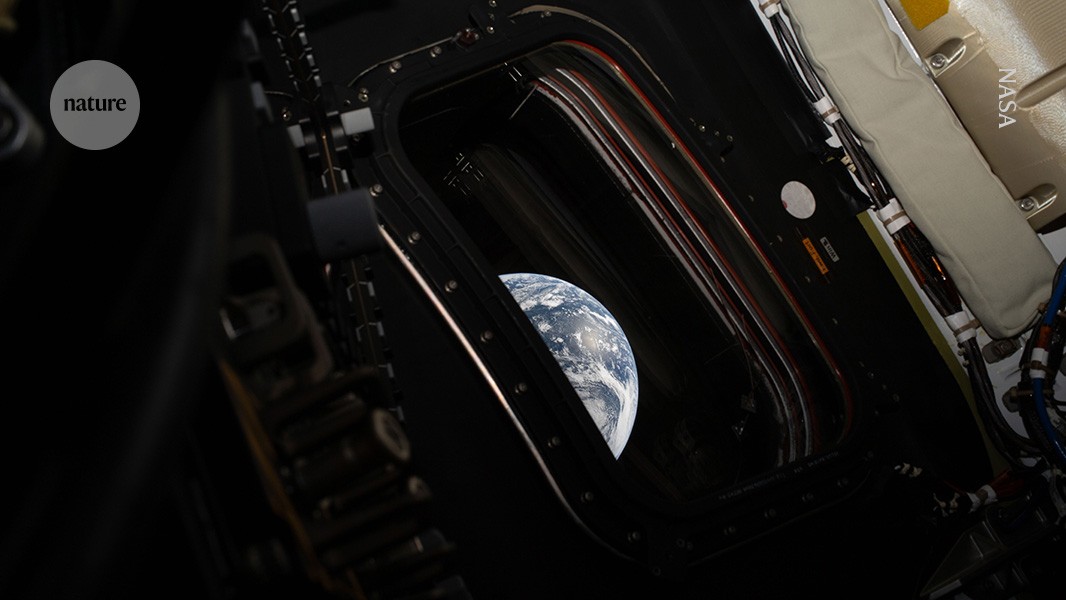

Artemis II astronaut Reid Wiseman took this image of Earth through one of the Orion capsule’s windows.Credit: NASA
Updated 6 April 2026, 9.32 a.m. CDT (Houston time)
Here’s where we are in the mission so far. Artemis II launched last Wednesday, 1 April, from Cape Canaveral in Florida. After orbiting Earth to check out their systems, the astronauts set a course for the Moon. Their capsule is already in the ‘lunar sphere of influence’, which means that the Moon’s gravity exerts more of a tug on the spacecraft than Earth’s gravity does.
Today’s a big day because the astronauts will be passing behind the Moon, at the closest distance they will ever be to our celestial neighbour. For a period of about six hours, they’ll orient their capsule’s biggest windows towards the Moon and gather in pairs at those windows, photographing and observing the Moon as they whizz past.
The fly-by (see a visualization here) will unfold between 1.45 p.m. and 8.20 p.m. central daylight time, the time zone here in Houston. Before that, the astronauts will set a record for the farthest distance ever travelled by humans. Towards the end of the fly-by, they will also spend nearly an hour observing a solar eclipse, as the small disk of the Sun moves behind the Moon from their point of view.
It all adds up to an exciting time in space exploration history. — Alexandra Witze

Astronaut Christina Koch (left) reads on a tablet inside the Orion capsule on 3 April while astronaut Jeremy Hansen (right) looks out a window.Credit: NASA
Updated 6 April 2026, 8.46 a.m. CDT (Houston time)
This is Alex Witze, correspondent for Nature, kicking off our coverage of today’s historic lunar fly-by. I arrived in Houston two days ago to cover Artemis II’s closest approach to the Moon. In all my time reporting — I’ve been a science journalist for more than 30 years — I’ve covered some momentous stories, from Mars landings to the space shuttle Columbia disaster. But I never thought I’d be covering a human mission to the Moon.
The mood here at mission control is electric. The press area is packed with reporters, NASA representatives and social-media influencers filming themselves. Well-coiffed television anchors are running around. There’s one main auditorium that we file into for the daily mission briefings; outside of that is a scrum of temporary work tables.
Amid the chaos, I’m incredibly excited to be here in the heart of the moment. The world has many problems, and some people are underwhelmed by this mission. But for the moment, everyone here is laser-focused on the four humans who are about to sail around the far side of the Moon, in the spacecraft that they named Integrity for this specific mission, after the ethos of everyone who worked to make Artemis II happen. — Alexandra Witze

