


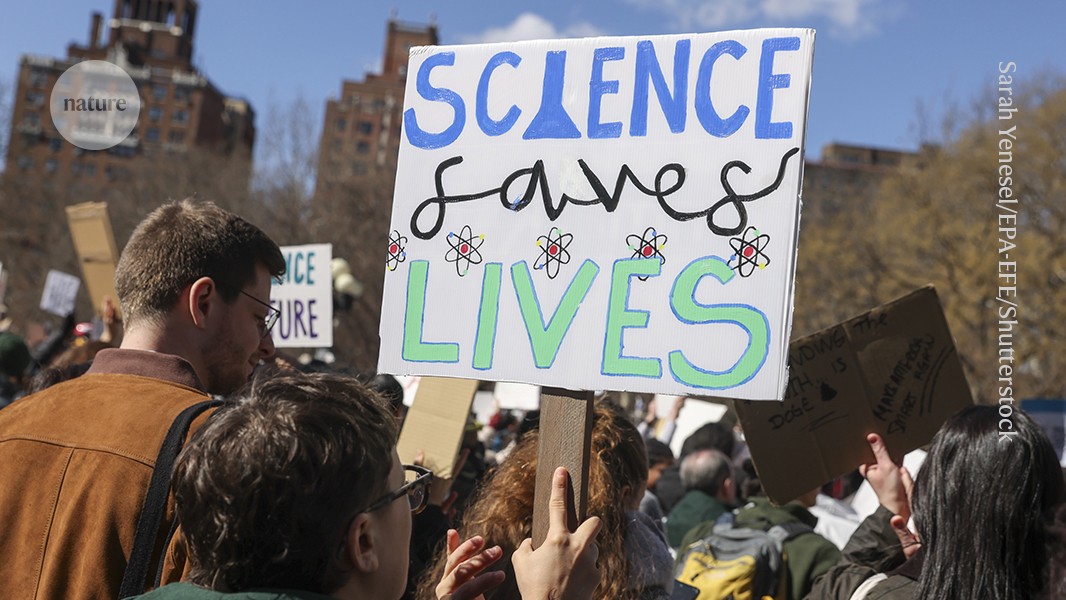

Attendees of a ‘Stand Up For Science’ rally in 2025 protest against the Trump administration’s cuts to research funding. Credit: Sarah Yenesel/EPA-EFE/Shutterstock
The coming year could prove as unpredictable — and consequential — for US science as 2025 was.
In the tumultuous year since President Donald Trump returned to office last January, some of his administration’s actions — including firing thousands of government scientists, cancelling billions of dollars in grants and blocking funding for elite universities — have foundered. Many are tied up in the courts, and Trump’s proposals to slash federal science budgets are still pending before a sceptical US Congress. But some science-policy observers say that the administration’s efforts to overhaul how science is conducted and funded by the federal government are just getting started.
Although the US Congress sets the budget for science spending, the Trump administration has “aggressively set the table such that they have political control over pretty much all issues related to science”, says Wendy Wagner, a science-policy specialist at the University of Texas at Austin. The White House did not respond to a request for comment about this and other allegations in this article.
Here’s what US scientists and their global collaborators can expect in 2026.
Congressional support for science
The US Congress could finalize the federal budget for 2026 as early as this month, and science advocates are hopeful that the most extreme cuts sought by Trump will be avoided.
Last year, the administration proposed drastic reductions in science funding, such as a 57% cut to the US National Science Foundation (NSF). Legislation moving through the US Congress would reject most of those cuts. For example, last Thursday, the House of Representatives approved a budget bill rejecting Trump’s request to slash funding for the NSF and other agencies. The Senate still needs to approve the bill.
But the administration might try to block Congressionally approved research funding that does not align with its goals, as it did in 2025. For example, the administration has blocked funding allocated by Congress for diversity research and clean-energy development. The White House did not respond to Nature’s request for comment on this scenario.
Fresh ideas for overhead costs
The final spending legislation could also save universities billions of dollars by heading off the administration’s efforts to reduce overhead, or ‘indirect’, costs on federal grants.
Indirect costs, which pay for things such as electricity for laboratory buildings, are typically worth 40–75% of the value of federal research grants. The NSF, National Institutes of Health (NIH), Department of Defense and Department of Energy (DoE) have sought to cap universities’ indirect costs at 15%, and the administration is expected to propose a similar policy across all grant-awarding agencies as early as this month.
NSF plan to slash ‘indirect’ science funding: will it stick?
In an initiative led by Kelvin Droegemeier, who served as White House science adviser during the first Trump administration, academic associations have floated an alternative proposal designed to more accurately and transparently account for indirect costs in scientists’ applications for federal funding. They are now pushing lawmakers to put their proposal into federal statute.
“It’s high stakes,” says Droegemeier, an atmospheric scientist at the University of Illinois Urbana–Champaign. “This is fundamentally about universities’ ability to perform research.”
In the latest spending legislation approved by the House, Congress included language that would maintain the current system of calculating indirect costs at the NSF and the DoE. Science advocates hope that separate legislation released on 11 January but not yet approved by either chamber of Congress will block the Trump administration from imposing a government-wide 15% cap. The White House did not respond to a request for comment about congressional efforts to block its indirect cost proposals.
The rise of political appointees
Policy changes last year will make the Trump administration’s priorities central to which research projects will be funded. Among the changes is a measure that gives political appointees power over several key steps.
Historically, civil servants, many of whom are scientists, have overseen federal grant-making. But in August, Trump issued an expansive executive order that gives political appointees control over grants, from initial funding announcements to final review. Grants should not advance “anti-American values”, the order said.
The administration has already started re-shaping the cadre of people involved in grant making at the NIH. Last year, the Trump team dismissed dozens of academic scientists who were set to join NIH grant-review panels. Staff were directed to replace them with individuals aligned with the administration’s priorities, Nature reported in July.
Trump called for ‘gold-standard science’: how the NIH, NSF and others are answering
In October, NIH director Jayanta Bhattacharya replaced the director of the NIH’s environmental-health institute in Durham, North Carolina, with Kyle Walsh, a neuroepidemiologist with limited government or environmental-health experience who is close to vice-president JD Vance. A job opening had not been published for the role.
In November, the NIH posted job ads for directors of 11 of the NIH’s 27 institutes and centres. The agency did not announce the formation of formal search committees involving prominent scientists — a departure from the process that it typically undertakes to fill these roles. These positions, which are open because the previous directors had either retired or were pushed out by the administration, have not yet been filled.
Trump officials have also de-emphasized peer-review scores in deciding which grants to fund, instead directing reviewers to consider non-merit factors, such as the applicant’s geographical location.
With merit being deprioritized, the NIH’s “mission is shifting to cater to political expediency, rather than scientific advancement”, Jennifer Troyer, who worked at the NIH for 25 years until she resigned on 31 December because of these changes, wrote in her resignation letter.
Assertions that the NIH’s grant-making process are becoming politicized “reflect an effort to politicize science rather than engage with the facts”, responded Andrew Nixon, spokesperson for the Department of Health and Human Services, which includes the NIH. “NIH remains firmly committed to gold-standard, unbiased and evidence-based science.”
More changes for universities
The coming year could also feature new investigations into elite universities as the Trump administration seeks to correct what it sees as a liberal bias on campuses.

