


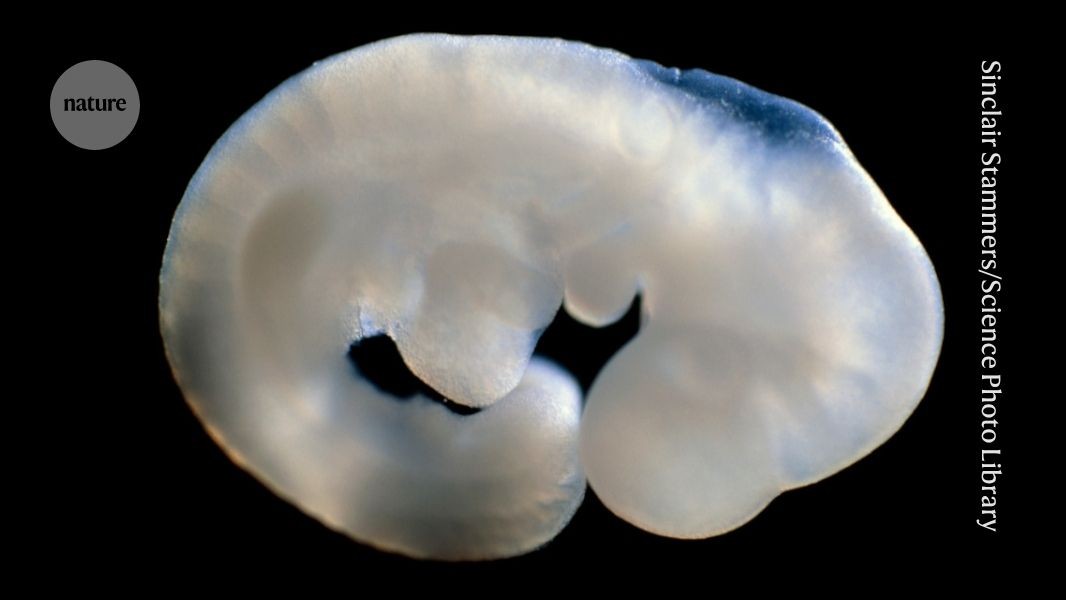
Small changes to the non-coding genome can alter whether a mouse embryo (pictured here at 9.5 days old) develops male or female sex organs.Credit: Sinclair Stammers/Science Photo Library
Female mouse embryos with a single letter change in a specific region of their DNA develop male reproductive organs, finds a study1 published today in Nature Communications.
Typically, female mouse embryos with two X chromosomes develop ovaries because a gene called Sox9 is suppressed. In male mouse embryos with XY chromosomes, the expression of Sox9 triggers testis development.
In male mice, Sox9 is controlled by a segment of non-coding DNA — part of the genome that does not encode proteins — called enhancer 13 (Enh13). Studies have shown that deleting Enh13 causes mice with XY chromosomes to develop female organs2, but until now, modifying Enh13 was not known to have any effects in female (XX) mice.
Nitzan Gonen, who studies sex determination at Bar-Ilan University in Ramat Gan, Israel, and her colleagues show that modifying both copies of Enh13 in female mice causes them to develop male genitals and small testes. Female mice carrying just one modified copy of Enh13 still developed female organs, however. The team suggests that Enh13 acts as both an enhancer and a silencer of Sox9, and is a site where the ‘battle of the sexes’ plays out.
This study is the first to unravel the mechanism that determines whether an embryo develops ovaries or testes, says Katie Ayers, a genetics researcher at the Murdoch Children’s Research Institute in Melbourne, Australia.
The region of DNA that the team modified is also important for human sex determination, says Ayers. Around 50% of people with disorders affecting their sexual development do not have a genetic diagnosis3. In part, that’s because sequencing to identify disease-causing mutations looks only at parts of the genome that encode proteins. Ayers says that researchers are increasingly studying non-coding areas of the genome, and that looking for small changes in the Enh13 region could identify other genetic alterations responsible for disorders of sex development.
Sex reversal goes both ways
Gonen was part of the team that discovered that Enh13 had a role in sex development. In 20182, the researchers showed that deleting this enhancer caused male mice with XY chromosomes to develop female organs. Then, in 2024, the team made a smaller modification — deleting parts of Enh13 that bind to transcription factors (proteins that regulate gene activity) — and found that it triggered the same sex reversal in XY mice3.

