




Normally, when a company asks the Federal Communications Commission (FCC) to approve a request, the regulator asks for public comments, quietly takes them under advisement, and determines what’s best for the people and industry of America. But last week, FCC Chairman Brendan Carr said no to all that. Instead, he publicly flamed Amazon while defending SpaceX, a highly unusual move that sure makes the FCC look like it has a favorite company. Since the FCC can approve or deny satellites from ever going into space, which way the government goes in this case might just determine who wins the commercial space race.
This all started last month, when SpaceX filed a request to put one million AI data center satellites into orbit (seemingly as a response to China requesting to put up 200,000 satellites just the month prior). Considering that there are only about 15,000 or so satellites in total right now, you might say that “one million” is an implausible number. Well, during the FCC’s window for public comments, somebody in fact did say so. And that someone just so happened to be e-commerce juggernaut Amazon, which is also in a race with SpaceX to deploy its own satellite constellation — what a coincidence! The concerns are fairly straightforward, just pointing out that at current rocket launch rates, it would take hundreds of years to deploy that many satellites.
You could argue whether Amazon is right or wrong here, depending on how exponentially you think SpaceX can increase its launch cadence. Carr, however, skips that whole debate and just goes straight into direct attack mode. Again, an FCC chairman weighing in like this is highly unusual.
Amazon should focus on the fact that it will fall roughly 1,000 satellites short of meeting its upcoming deployment milestone, rather than spending their time and resources filing petitions against companies that are putting thousands of satellites in orbit.
Star (regulatory) wars
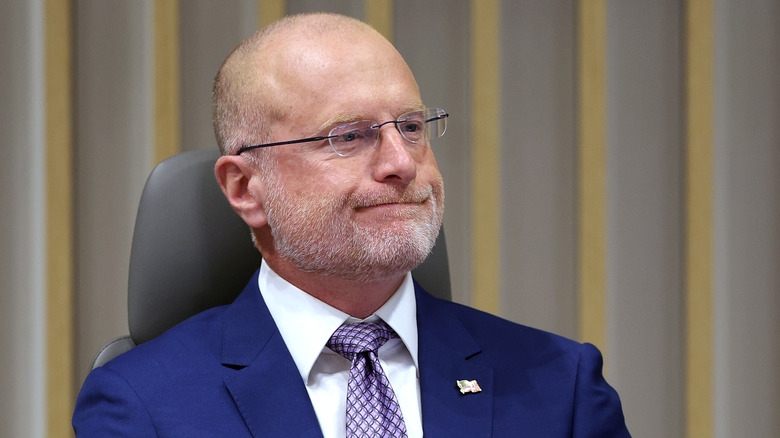
How dare Amazon comment publicly during the public comment window! After all, it’s not like poor, innocent SpaceX would ever do literally the exact same thing to a rival of its own, such as AST SpaceMobile just last year. Carr’s point appears to be that companies shouldn’t be using public comments to fight with each other in the regulatory domain. Again, you could argue whether or not you agree, but it is noteworthy that Carr brought this hammer down on one particular company and in defense of another. It’s worth pointing out that Carr has a long history of supporting SpaceX, including criticizing the FCC’s handling of the company before his tenure, per CNBC.
The other half of Carr’s statement focuses on the fact that Amazon is facing some regulatory issues of its own. Part of the FCC’s job is to ensure that satellite operators don’t engage in what it calls “spectrum and orbital warehousing.” That is, if an operator were to ask for some huge amount of approvals (like, oh say, one million), the FCC wants to make sure they actually use it and don’t just hog a bunch of precious space turf. So the operators have to hit certain milestones within certain deadlines: if it doesn’t launch enough satellites in time, it loses the approval.
As Ars Technica points out, Amazon’s in trouble on this point. The company needs to get thousands of its Leo internet satellites into space by July 30, and, well, it’s not going to make it. It has asked the FCC for a two-year extension. Carr seems to take issue with the fact that Amazon is asking for special treatment on the one hand but for SpaceX’s request to be dismissed on the other. That said, as SpaceX itself has often proved, this is just what companies do.
There’s a space race between America and China, and a separate race between private companies. The winners of that race will have a huge hand in shaping the century to come. How the U.S. government acts here is critical to the outcome, and for the moment at least, it appears to be openly signaling who it wants those winners to be.

