


Mouse experiments
All mice were handled in accordance with NIH guidelines and protocols approved by the UCSF Institutional Animal Care and Use Committee. Mice were housed under specific pathogen-free conditions in individually ventilated cages in a barrier facility on a 12 h:12 h light:dark cycle, with controlled temperature (20–26 °C) and humidity (30–70%). Housing density did not exceed five adult mice per cage; breeding cages (one male and up to two females) were maintained in a dedicated high-barrier area. Cages were changed weekly under laminar flow hoods, access was restricted with required PPE and colony health was monitored using sentinel mice. Both sexes were used, no sex-specific differences were observed and mice were randomly assigned to experimental groups.
C57BL/6 wild-type mice were obtained from the Jackson Laboratory (JAX:000664).
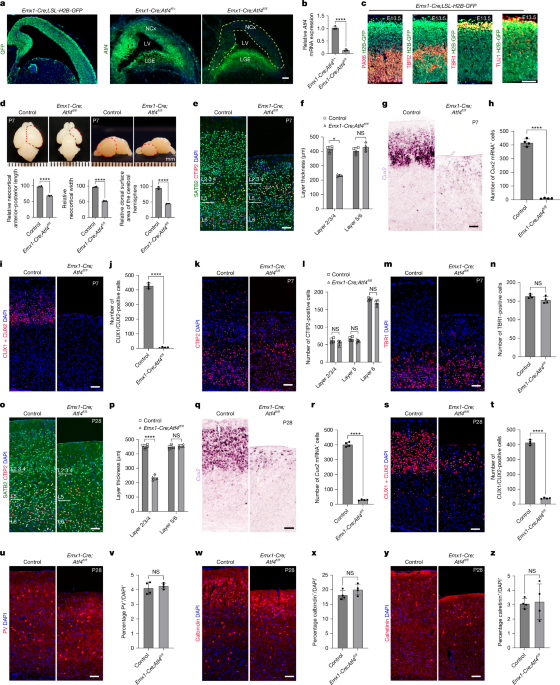
The Emx1-Cre line (B6.129S2Emx1tm1(cre)Krj/J, JAX:005628) has been previously described49. These mice were crossed with Atf4 floxed mice to delete Atf4 specifically in the early embryonic cortex. To assess phenotypes after blocking cell death, Emx1-Cre mice were also crossed with Atf4 floxed and p53-null animals. Emx1-Cre mice were crossed with LSL-H2B-GFP mice for lineage tracing of EMX1+ cortical cells across developmental stages.
The Atf4fl/fl line (C57BL/6-Atf4tm1.1Cmad/J, JAX:033380) carries loxP sites flanking exons 2–3, which include the ATG start codon of the Atf4 gene. These mice have been described previously50 and were crossed with Emx1-Cre and/or p53-null mice to knock out the Atf4 expression.
The p53-null (p53−/−) line (B6.129S2-Trp53tm1Tyj/J, JAX:002101) carries a neomycin cassette replacing exons 2–6 (including the start codon) of the Trp53 gene. This line has been previously described51. These mice were crossed with Emx1-Cre and Atf4 floxed mice to block p53-dependent cell death.
The LSL-H2B-GFP line (B6.Cg-Gt(ROSA)26Sortm8(CAG-HIST1H2BB/EGFP)Zjh/J JAX:036761) has a targeted mutation in the Gt(ROSA)26Sor locus with a loxP-flanked STOP cassette preventing transcription of a CAG promoter-driven enhanced green fluorescent protein (EGFP). EGFP expression occurs only after Cre-mediated recombination. This line has been previously described52 and was crossed with Emx1-Cre mice for lineage-tracing experiments.
Antibodies
For the immunostaining: GFP was detected with antibody GFP-1020 (Aves) at 1:1,000 dilution; mouse PAX6 was detected with antibody AB2237 (Millipore) at 1:500 dilution; mouse TBR2 was detected with antibody ab23345 (Abcam) at 1:500 dilution; mouse TBR1 was detected with antibody ab31940 (Abcam) at 1:1,000 dilution; mouse TUJ1 was detected with antibody T2200 (Sigma) at 1:1,000 dilution; mouse SATB2 was detected with antibody ab51502 (Abcam) at 1:500 dilution; mouse CTIP2 was detected with antibody ab18465 (Abcam) at 1:1,000 dilution; mouse CUX1 + CUX2 was detected with antibody ab309139 (Abcam) at 1:500 dilution; mouse calretinin was detected with antibody MAB1568 (Millipore) at 1:500 dilution; mouse parvalbumin was detected with antibody MAB1572 (Millipore) at 1:500 dilution; mouse calbindin was detected with antibody CB38a (Swant) at 1:500 dilution; human PAX6 was detected with antibody 901301 (Biolegend) at 1:500 dilution; mouse γH2A.X was detected with antibody ab2893 (abcam) at 1:500 dilution or 05-636 (Millipore) at 1:500 dilution; mouse CC3 was detected with antibody 9661 (Cell Signaling Technology) at 1:400 dilution; mouse Phospho-KAP-1 (Ser824) was detected with antibody A300-767A (Bethyl Laboratories) at 1:1,000 dilution; mouse p53 was detected with antibody 2524 (Cell Signaling Technology) at 1:500 dilution; mouse PCNA was detected with antibody 2586 (Cell Signaling Technology) at 1:500 dilution; mouse Ki67 was detected with antibody 550609 (BD Biosciences) at 1:500 dilution; mouse 53BP1 was detected with antibody NB100-304 (Novus Biologicals) at 1:500 dilution; mouse DNA-RNA Hybrid S9.6 was detected with antibody ENH001 (Kerafast) at 1:500 dilution; mouse p-ATM(Ser1981) was detected with antibody 05-740 (Millipore Sigma) at 1:500 dilution; mouse PHH3 was detected with Phospho-Histone H3 (Ser10) Antibody 9701 (Cell Signaling Technology at 1:500 dilution; mouse Nestin was detected with antibody MAB353 (Millipore Sigma) at 1:500 dilution; and mouse SOX2 was detected with antibody ab92494 (Abcam) at 1:500 dilution. All secondary antibodies for immunostaining were used at a dilution of 1:1,000. For immunoblotting: β-actin was detected with antibody 66009-1-Ig (Proteintech) at 1:1,000 dilution; EBF1 was detected with antibody AB10523 (Millipore) at 1:500 dilution; UBA52 was detected with antibody 18039-1-AP (Proteintech) at 1:500 dilution; CIRBP was detected with antibody 10209-2-AP (Proteintech) at 1:500 dilution; and ATF4 was detected with antibody 11815 (Cell Signaling Technology) at 1:500 dilution. All secondary antibodies used for immunoblotting were applied at a dilution of 1:20,000. For ChIP-qPCR, ATF4 antibody 11815 (Cell Signaling Technology) used at 1:50 dilution.
In utero electroporation
Timed-pregnant C57BL/6 wild-type or other indicated genotype mice were anaesthetized and the uterine horns were exposed for the procedure. All plasmids used were Maxiprepped using the GeneJET Endo-Free Plasmid Maxiprep Kit (K0861) and then concentrated to 6 µg ul−1 using NaCl and isopropanol. A total of 2 μl of Cirbp shRNAs or Uba52 shRNAs or other indicated shRNA plasmid mixture (1:1 molar ratio, final concentration 3 mg ml−1) mixed with pCAG-GFP at a 3:1 molar ratio and fast green (2 mg ml−1) was microinjected into the fetal brain ventricles using a micropipette (made with Sutter P-30 Vertical Micropipette Puller). The plasmid mixture was then electroporated into the ventricular cells of the fetal brain using an electroporator (BTX ECM830). For each electroporation, five 40-V pulses of 50-ms duration were applied at 1-s intervals. After electroporation, the uterus was returned to the abdominal cavity and the abdominal wall and skin were sutured. EdU (50 mg per kg) was injected intraperitoneally before collecting the embryos, and pregnant mice were killed at different time points for phenotype analysis. Fetal brains were fixed in 4% paraformaldehyde (PFA) overnight, then dehydrated in 30% sucrose at 4 °C. Sub-regions of the cortex were identified based on cell density and visualized with DAPI nuclear staining. In all in IUE experiments, brains from at least three embryos were collected for analysis.
RNA purification and RT–qPCR analysis
For RT–qPCR, the brain tissue or cell culture were homogenized and dissolved in 1 ml TRIZOL (Invitrogen) for 15 min on ice, then total RNA was extracted with Direct-zol RNA Miniprep kits, following the manufacturer’s protocol. For reverse transcription, 2 µg RNA was used to synthesize the cDNA, cDNA was synthesized using the First-Strand cDNA Synthesis kit (APExBIO, K1072) and RT–qPCR was done using SYBR Green qPCR Master Mix (APExBIO, K1070) on a QuantStudio 5 system according to the manufacturer’s instructions. The expression of specific mRNAs was quantified using the primer sequences listed in Supplementary Table 8. Relative mRNA expression levels were calculated using the comparative cycling threshold method (ΔΔCT), with β-actin serving as the normalization control.
Cell culture
All cell cultures were maintained at 37 °C with 5% CO2 in sterile, humidified incubators.
HEK293FT cells were cultured in DMEM medium supplemented with 10% FBS and penicillin–streptomycin.
NSCs were isolated from the embryonic cortex at stages E11.5, E12.5 and E13.5. Dissected embryonic cortices were collected in DMEM medium (Gibco) on ice and digested with 40 U ml−1 papain (Worthington Biochemical) for 5 min at 37 °C in calcium- and magnesium-free EBSS (Gibco). The digested tissue was centrifuged at 500 r.p.m. for 30 s to remove papain, washed twice with DMEM and gently triturated in NSC culture medium (50% DMEM/F12, 50% Neurobasal medium, 0.5% GlutaMAX, 1% non-essential amino acids, 10 ng ml−1 bFGF, 10 ng ml−1 EGF and 1% penicillin–streptomycin) to dissociate the cells. The cell suspension was then filtered through a 40-μm strainer to obtain single NSCs.
For the acute comet assay, NSCs collected at different time points were used directly, according to the manufacturer’s instructions. For lentivirus infection experiments, NSCs were plated on plates pre-coated with poly-d-lysine (10 μg ml−1) and laminin (10 μg ml−1). After growing in proliferation medium for 12 h, cells were infected overnight with lentivirus and cultured for an additional 24 h before immunohistochemistry analysis. To induce DSBs, aphidicolin was added to the medium at a final concentration of 500 nM, and cells were cultured for 24 h before analysis.
Plasmid construction, lentiviral production and transductions
The Atf4, Cirbp, Uba52, Ebf1 full-length cDNA was subcloned into the pCDH-E2A-MCS-EGFP lentiviral overexpression vector with Takara PrimeSTAR Max DNA Polymerase, and all shRNAs targeting Cirbp, Uba52, Ebf1 and four indicated amino acid transport genes were cloned to the pSicor knockdown lentiviral vector.
All batches of lentivirus were produced with target plasmid or control plasmid with psPAX2 (Addgene, 12260) and pMD2.G (Addgene, 12259) packaging plasmids. In brief, one million HEK293T cells were plated into six-well plates. After 12 h, two mixtures were made for the transfection. Mixture 1 contained 1.5 μg psPAX2, 1 μg pMD2.G and 2 μg target plasmid in 100 μl DMEM, and mixture 2 contained 13.5 μl PEI (1 mg ml−1) in 100 μl DMEM. Mixture 2 was added to mixture 1 and gently mixed as the transfection mixture. The final mixture was incubated for 10 min before adding to 1 ml culture media in the six-well plate. Then, 6 h after the transfection, PEI-containing medium was replaced with 2 ml fresh medium. Two batches of viral media were collected 36 h and 72 h after the transfection. Then, the media were combined and centrifuged at 3,000g for 10 min to remove cell debris. For transduction of NSCs, the collected lentivirus was added to the NSC culture medium at a 1:1 ratio, along with polybrene (final concentration 800 ng ml−1) to enhance infection efficiency. The medium was replaced 12 h after infection. To increase the knockdown efficiency, we mixed two lentiviruses at a 1:1 ratio for those target genes. The overexpression or knockdown efficiency for each virus (or virus mixture) was tested by western blot or RT–qPCR with infected NSCs. All shRNA oligonucleotide sequences are listed in Supplementary Table 8.
Comet assay
After infection and treatments, cultured NSCs were trypsinized, suspended in prechilled PBS and diluted to a concentration of 1 × 10⁵ cells per ml. For acutely isolated NSCs from cortex at different time points, cells were similarly diluted and directly subjected to the following steps. The cell suspension was mixed with an equal volume of 1% low-melting-point agarose, maintained at 37 °C, and immediately layered onto frosted glass slides (Fisher) precoated with 1% agarose. The cell–agarose mixture was gently compressed with a coverslip, then slides were placed flat on ice in the dark to allow the single-layer cell mixture to harden. Coverslips were removed after 10 min. Slides were kept in the dark on ice or at 4 °C for all subsequent steps.
Subsequent steps were performed following the Comet Assay Single Cell Gel Electrophoresis Assay manual (4250-050-K). In brief, slides were immersed in prechilled lysis buffer overnight at 4 °C, washed twice with prechilled distilled water (10 min each) and then placed in prechilled Alkaline Unwinding Solution for 30 min. Electrophoresis was done at 1 V cm−1 in alkaline electrophoresis solution, adjusted according to the size of the electrophoresis chamber, for 30 min. After electrophoresis, the slides were neutralized in 0.4 M Tris-HCl (pH 7.0). Comets were stained with SYBR Gold (1:10,000 in PBS) for 10 min.
All experiments were done in triplicate, and a minimum of 50 comet-tail moments were imaged using a Zeiss apotome microscope and analysed using the ImageJ OpenComet plugin for quantification.
Chromatin immunoprecipitation assay and qPCR
NSCs were acutely isolated from the cortex of E11.5 wild-type embryos. The isolated NSCs were fixed in 1% formaldehyde by adding 550 μl of 37% formaldehyde to 20 ml of growth medium and incubated at room temperature for 10 min with gentle swirling to ensure even mixing. Unreacted formaldehyde was quenched by adding glycine to a final concentration of 0.125 M and incubating at room temperature for 5 min.
Cells were collected by centrifugation at 1,500 r.p.m. for 10 min at 4 °C, followed by two washes with ice-cold PBS. The cell pellet was resuspended in ice-cold PBS containing 1× protease inhibitor cocktail, then centrifuged at 800g for 5 min at 4 °C to pellet the cells. Cells were lysed using cell lysis buffer followed by nuclear lysis buffer, as described in the EZ-Magna ChIP A/G Chromatin Immunoprecipitation Kit manual (17-10086). Chromatin was sheared into manageable sizes (200–1,000 base pairs) by sonication.
For downstream analysis, 5% of the lysate was set aside as input control, and the remaining 95% was used for immunoprecipitation following the kit’s protocol. Immunoprecipitation was done using either IgG or anti-ATF4 antibodies. After elution of the protein–DNA complexes, reverse crosslinking was done to free the DNA, which was then purified using the columns provided in the kit.
The purified DNA was subjected to real-time qPCR analysis. Primers used for cloning and specific gene promoters are listed in Supplementary Table 8.
Immunoblotting
Cell lysates were extracted using RIPA buffer supplemented with a protease inhibitor cocktail (CST) at 4 °C for 30 min, followed by sonication to ensure complete lysis. The supernatant was collected after centrifugation at 10,000 r.p.m. for 10 min at 4 °C. Proteins were separated on 10–15% SDS-PAGE gels and transferred onto 0.2 μm PVDF membranes. Blots were blocked with 5% BSA for 30 min at room temperature. Standard immunoblotting procedures were subsequently performed, followed by development using Li-COR IRDye secondary antibodies. Membranes were imaged using a Li-COR Odyssey CLx imaging system, and band intensities were quantified using ImageJ.
Immunohistochemistry
Embryonic tissues were isolated and fixed overnight in 4% PFA. Postnatal tissues were collected after perfusion and fixed in 4% PFA overnight. After fixation, the tissues were washed with PBS and equilibrated in 30% sucrose (prepared with DEPC-PBS) at 4 °C. The samples were then cryopreserved in Tissue-Tek OCT Compound (Sakura Finetek) and sectioned at a thickness of 12 μm. For consistency in phenotypic analysis, we focused on primary somatosensory cortex areas across all postnatal stages shown in the figures, using rostral-to-caudal level-matched coronal brain sections for all data.
For immunostaining, tissue sections underwent antigen retrieval using pH 6.0 sodium citrate buffer, followed by washes in PBST (PBS containing 0.1% Triton X-100). Sections were then incubated in a blocking buffer (PBST with 10% normal goat serum (NGS); Millipore) for 1 h at room temperature. Next, sections were incubated overnight at 4 °C with primary antibodies diluted in PBST containing 1% NGS. After three washes, sections were incubated with secondary antibodies (Invitrogen) diluted in blocking buffer for 1 h at room temperature. Finally, sections were washed and mounted with Fluoromount-G.
For cultured cells, cells were washed with PBST, fixed with 4% PFA at room temperature for 15 min, and then washed with PBS. The same blocking and staining protocol used for tissue sections was applied to the cultured cells.
Images were acquired using a Zeiss apotome microscope, with identical parameters applied to all samples from the same experiment.
Human brain tissue
Human specimens were collected from autopsy, with previous patient consent to institutional ethical regulations of the University of California San Francisco Committee on Human Research, as previously reported53.
EdU labelling and staining
EdU powder was dissolved in PBS (10 mg ml−1) and incubated on a shaker at 37 °C until fully dissolved. Cumulative EdU labelling was done by administering intraperitoneal injections of 50 mg per kg EdU in sterile PBS to pregnant mice at the time points indicated in the figures. Tissues were collected at the corresponding time points, as shown in the figures. Before dissection, all embryos were transferred to ice-cold PBS to halt further EdU incorporation. Mouse brains were then dissected and fixed in ice-cold 4% PFA for 8–10 h. Cryostat sections were prepared and incorporated EdU was detected using the Click-iT EdU Alexa Fluor 594/647 imaging kit, following the manufacturer’s protocol. Before imaging, the sections were incubated with primary antibodies overnight at 4 °C, followed by incubation with secondary antibodies at room temperature for 1 h. After three washes, the sections were stained with DAPI, mounted and prepared for imaging and analysis using the Zeiss Apotome and ZEN software.
OPP labelling and staining
NSCs were isolated from E11.5 control and Emx1-Cre;Atf4fl/fl cortices by 5 min of papain digestion at 37 °C, followed by gentle trituration and filtration through a cell strainer. Cells were immediately plated on glass coverslips pre-coated with poly-d-lysine (10 µg ml−1) and laminin (10 µg ml−1). After 3 h in proliferation medium (50% DMEM/F12, 50% Neurobasal medium, 0.5% GlutaMAX, 1% non-essential amino acids, 10 ng ml−1 bFGF, 10 ng ml−1 EGF and 1% penicillin–streptomycin) to allow attachment, OPP was added according to the Click-&-Go Plus 647 OPP kit instructions (CCT-1496) for 30 min (cells without OPP served as negative controls). Cells were then fixed with 4% PFA and subjected to immunostaining. The OPP intensity of each cell was measured using Zeiss Apotome and ZEN software.
Isolation of single nuclei from embryonic cortices for snRNA-seq
Nuclei were isolated by pooling frozen brain tissue from two samples of the same genotype. All procedures were done on ice or at 4 °C in an RNase-free environment. In brief, frozen mouse brain cortex tissue was gently lysed in 3 ml of homogenization buffer (250 mM sucrose, 150 mM KCl, 30 mM MgCl2, 60 mM Tris, 0.01% (v/v) Triton X-100, 0.001% (v/v) Digitonin, 0.01% (v/v) NP40, 1 mM DTT), supplemented with 0.2 U ml−1 RNase inhibitor (NEB, M0314) and complete protease inhibitor cocktail (Roche, 11697498001). Lysis was done using a Wheaton Dounce Tissue Grinder (30 strokes with pestle B).
The lysate was filtered through a 40-µm cell strainer and centrifuged at 1,000g for 8 min to collect a nuclear pellet. To remove debris, the pellet was resuspended in 350 µl of homogenization buffer, mixed 1:1 with 50% iodixanol buffer (iodixanol 60% (v/v) in a buffer containing 250 mM sucrose, 150 mM KCl, 3 mM MgCl2, 60 mM Tris) and layered over 600 µl of 29% iodixanol buffer (iodixanol 29% (v/v) in the same buffer). The sample was centrifuged at 13,500g for 20 min.
The supernatant was discarded and the nuclei were gently resuspended and washed in 1 ml of 1% BSA/PBS. Nuclear integrity and complete lysis were confirmed visually. Nuclei were counted manually and diluted to a concentration of 1,000 nuclei per µl in 1% BSA/PBS.
Single-nucleus RNA-seq library preparation and sequencing
Single-nucleus RNA-seq libraries were prepared using Chromium Next GEM Single Cell 3′ Reagent Kit v.3.1 (10x Genomics), following the manufacturer’s instructions. In brief, single-nucleus gel-bead-in-emulsions (GEMs) were generated in Chromium Controller with NextGEM Chip G (10x Genomics). The first-strand cDNA was synthesized on beads, followed by clean-up and amplification. The amplified cDNAs were examined in Bioanalyzer with a high-sensitivity DNA chip (Agilent). Then, 10 μl of cDNAs was forwarded to the library preparation. The dual-indexed libraries were pooled and sequenced on an Illumina NovaSeq 6000 (Illumina).
Single-nucleus RNA-seq alignment and filtering
Demultiplexed FASTQ files were aligned to the Mus musculus reference genome (mm10-2020-A assembly) using the cellranger count pipeline provided by 10x Genomics (v.7.0.1) with default parameters, unless otherwise specified. Cell Bender (v.0.3.0) was used to eliminate technical artefacts, specifically ambient RNA contamination and barcode swapping, from the raw gene-expression counts.
Cell-type annotation and clustering
Downstream analyses were done mainly using Scanpy (v.1.8.1) and DESC (v.2.1.1). Highly variable genes were identified using the highly_variable_genes function in Scanpy, and the top 2,048 genes were selected for subsequent analyses. These genes were used as input for DESC, a deep learning-based framework for dimensionality reduction, batch correction and unsupervised clustering. DESC learns a nonlinear low-dimensional representation of the data using a three-layer encoder architecture (1,024, 256 and 32 nodes). Cell clusters were annotated based on canonical marker gene expression. Differentially expressed genes for each cluster were identified using the rank_genes_groups function in Scanpy, and cell identities were assigned by comparison with established cell-type markers reported in the literature.
Gene-set score analysis
Gene-set score analysis was done using the score_genes function in Scanpy (v.1.8.1). For each cell, a gene-set score was calculated based on an enhanced gene list curated from public databases and recent publications. Parameters were set to ctrl_size = 500 and n_bins = 25. The resulting scores reflected the relative expression levels of the corresponding gene sets.
The source of the genes for each gene set is listed here:
DNA damage repair gene set: a comprehensive list of 698 DNA damage-repair genes was assembled by merging genes annotated under GO:0006281 (DNA repair) and HALLMARK_DNA_REPAIR (M5898), and integrating this with the curated Human DNA Repair Genes list by R. Wood and M. Lowery54.
UPR gene set: this set includes 116 genes associated with GO:0006986, sourced from the Mouse Genome Informatics (MGI) database.
ISR gene set: this comprises 23 genes, based on GO:0140467 from the MGI database.
Amino acid transport gene set: this set includes 193 genes annotated under GO:0006865, sourced from the MGI database.
Peroxidase Activity Gene Set: Consisting of 64 genes, this set is derived from GO:0004601 (peroxidase activity), also sourced from the MGI database.
NRF2 target gene set: this set includes 37 genes identified as NRF2 targets, based on a curated list from ref. 55.
Eukaryotic translation factors gene set: this set includes 69 genes including initiation, elongation, termination and ribosome recycling factors.
All genes for gene-set score analysis are listed in Supplementary Tables 1–7.
DEG analysis, volcano plot and pathway analysis
DEGs were identified using the rank_genes_groups function in Scanpy with the Wilcoxon rank-sum test. Individual nuclei were treated as independent observations, and biological replicates (n = 3) were not explicitly incorporated into the statistical model. Pathway and gene ontology enrichment analyses were done using the clusterProfiler R package (v.4.14.6), restricted to the biological process category and the top ten activated and suppressed pathways. Enrichment was assessed using the gseGO function with an adjusted P value < 0.05.
PPI and gene ontology network analysis
PPI analysis of upregulated DEGs associated with the DDR was done using STRING (v.11.5). Analyses were conducted with the following settings: organism, Mus musculus; network edges, confidence-based; interaction sources, experiments and databases; minimum interaction score, high confidence; and no limit on maximum interactors. STRING networks were generated to represent both functional and physical protein associations, as specified in the corresponding figures.
Direct PPI enrichment P values were obtained from STRING. Gene ontology enrichment analyses in the PPI networks were prioritized, and FDR-corrected P values were reported using the whole genome as the background. Network visualization of the most significantly enriched GO terms and their associated genes was done using the GOenrich function in clusterProfiler (v.4.14.6).
RNAscope
Mouse and human tissues were analysed using single-molecule fluorescence in situ hybridization (smFISH) with the RNAscope LS Multiplex kit, following the manufacturer’s instructions. In brief, tissue sections were subjected to antigen retrieval by heating slides in buffer to unmask RNA targets, followed by protease treatment to enhance probe permeability. After washing, specific RNAscope probes were applied at the recommended concentration and hybridized at 40 °C. Signal-amplification reagents were then added sequentially, followed by fluorescent detection reagents (for example, tyramide-conjugated fluorophores). Slides were washed thoroughly between each step to remove unbound probes or reagents and counterstained with DAPI to visualize cell nuclei.
For combined RNAscope and immunostaining, standard immunohistochemistry procedures were followed. After completion of RNAscope, slides were protected from prolonged light exposure and incubated in blocking buffer (PBS containing 0.01% Triton X-100 and 10% normal goat serum; Millipore) for 1 h at room temperature. Sections were then incubated overnight at 4 °C with primary antibodies diluted in PBST containing 1% NGS. After three washes, sections were incubated with secondary antibodies (Invitrogen) diluted in blocking buffer for 1 h at room temperature. Finally, slides were mounted with ProLong Glass Antifade Mountant and imaged under a fluorescence microscope.
In situ hybridization
Brain tissues were collected as previously described53 and cryoprotected in 30% sucrose containing 0.1% diethyl pyrocarbonate (DEPC) to preserve mRNA integrity. Serial coronal or sagittal sections (13 μm thick) were prepared using a cryostat (Leica CM1950). For in situ hybridization, sections were incubated overnight at 65 °C with diluted denatured antisense probes. This was followed by three post-hybridization washes at 65 °C and two washes at room temperature. Sections were then incubated overnight at 4 °C with an anti-Digoxigenin-AP Fab fragments antibody (1:1,500, Sigma-Aldrich, 11093274910). DIG-labelled antisense CUX2 probes were used to identify CUX2-positive upper-layer neurons. The mRNA-expressing cells were visualized the next day as dark purple deposits using the NBT/BCIP–alkaline phosphatase substrate combination (Sigma-Aldrich, 11681451001). Images were captured using a Zeiss Axioscan microscope under bright-field illumination. To make the probe for the mouse Cux2 mRNA, a partial mouse Cux2 CDS sequence was cloned into the pGEM-T Easy Vector System (Promega) based on the sequence used in the Allen Brain Atlas ISH probe (https://mouse.brain-map.org/gene/show/12829). Images were captured using a Zeiss Axioscan microscope under bright-field illumination.
Nissl staining
We used 13-μm frozen brain sections, fixed in 4% PFA, for Nissl staining. The sections were washed in absolute alcohol for 5 min (twice), followed by 90% alcohol for 3 min and 70% alcohol for 3 min. Staining was done with 0.1% cresyl violet solution for 30 min at room temperature. After staining, the slides were rinsed in water to remove excess dye, followed by washes in graded ethanol (70%, 80%, 90% and 100%) to gradually dehydrate the tissue and enhance contrast. The slides were then immersed in xylene for 5 min to clear the tissue. A resin-based mounting medium was used to mount the slides. To improve imaging quality and help the automated imaging system to focus more accurately, coverslips were pressed with a heavy objective lens. Images were captured using a Zeiss Axioscan microscope under bright-field illumination.
Quantification and statistical analysis
We followed standard practices for statistical analysis of biological data. Results are presented as the mean ± s.d. along with raw dot plots. Statistical significance between experimental and control groups was assessed using a two-tailed unpaired Student’s t-test or two-tailed multiple t-test. Microsoft Excel and Graphpad Prism 10 were used to perform these statistical analyses unless specified otherwise. The threshold for statistical significance was set at 0.05, with significance levels denoted as follows: P ≥ 0.05, not significant; *P < 0.05, **P < 0.01, ***P < 0.001, ****P < 0.0001. Details of the number of biological replicates (n) and their definitions and P values are given in the figure legends and source data. All data were analysed blindly, without consideration of genotype, to minimize bias.
Reporting summary
Further information on research design is available in the Nature Portfolio Reporting Summary linked to this article.

