


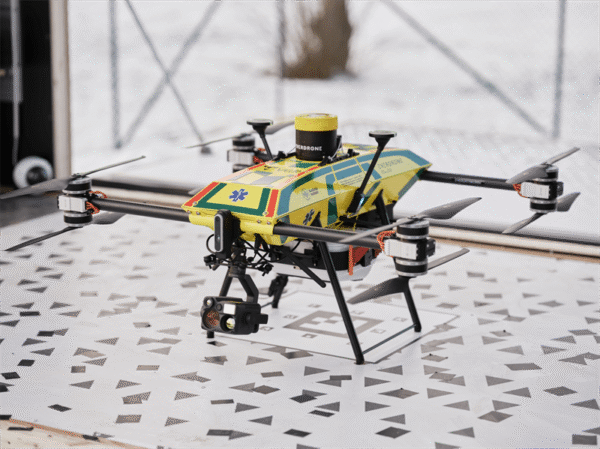
Swedish drone developer Everdrone has unveiled the E3, its next-generation emergency medical drone. Built entirely in-house, the E3 delivers a major performance upgrade over its predecessor.
Built From the Ground Up
Everdrone, headquartered in Gothenburg, previously used the E2 as a development platform built from commercial components. The company determined that no off-the-shelf drone met the demands of emergency medical care.
“Our initial focus was on developing software for drone services, but we realized that there were no commercially available drones that matched the needs of emergency medical care. Therefore, we chose to develop our own,” says Mats Sällström, CEO of Everdrone.
The E3 uses a combination of OEM products and proprietary components, sourcing parts from suppliers including Ligpower and Aston Harald Composite. The drone features four rotor pairs with eight blades total.
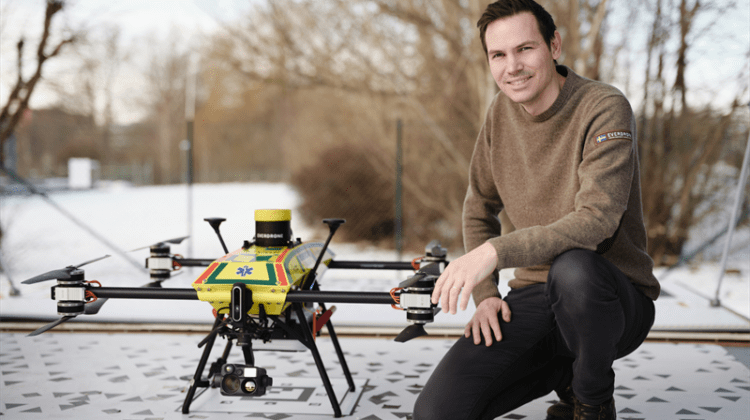
E3 Specifications
The E3 measures 90 × 75 × 55 cm, excluding propellers, and weighs 24 kg. Proprietary damping systems enable a vibration-free cruising speed exceeding 80 km/h. The drone flies autonomously and operates under continuous monitoring by a drone operator.
Battery capacity provides margin for multiple deployment types. Everdrone says it continuously evaluates its battery supplier to improve performance and endurance.
Doubled Payload for Broader Medical Use
The E2 carried a 2 kg payload — typically a defibrillator. The E3 raises that ceiling to 4.5 kg. Its flexible payload module supports a wide range of emergency equipment, including:
-
Defibrillators (AEDs)
-
Adrenaline auto-injectors for anaphylactic reactions
-
Opioid overdose antidotes
-
Bandages and tourniquets for life-threatening bleeding
“The new drone is faster, safer, and can carry heavier payloads. This will save lives,” says Mats Sällström.
Response Times Under Three Minutes
The core value proposition of the E3 as an emergency medical drone lies in speed. Ambulances in Sweden take an average of ten minutes to reach an emergency scene.
“Allowing drones to transport emergency medical equipment significantly reduces transport time. On average in Sweden, it takes ten minutes for an ambulance to arrive at an emergency scene. While waiting for an ambulance, Everdrone’s new drone can be on site in under three minutes, making it a complement to emergency medical services that saves lives,” says Mats Sällström.
Everdrone’s work has been published in leading medical journals including The Lancet and The New England Journal of Medicine. The company is currently expanding its drone emergency medical network across Europe.
Read More

Ian McNabb is a journalist focusing on drone technology and lifestyle content at Dronelife. He is based between Boston and NH and, when not writing, enjoys hiking and Boston area sports.

