


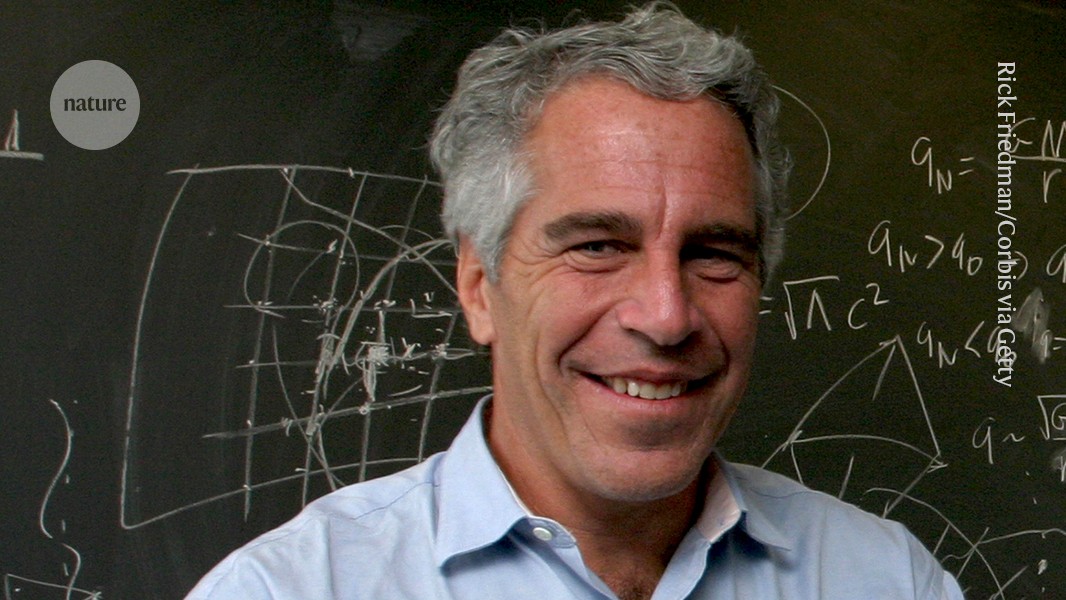

Financier and sex offender Jeffrey Epstein had a strong interest in science, maintaining close contact with a number of researchers.Credit: Rick Friedman/Corbis via Getty
Newly released files from the investigation of convicted sex offender Jeffrey Epstein reveal that his ties to the scientific community were deeper than previously known.
Epstein, who died by suicide in 2019 after being arrested and charged with sex trafficking, was a wealthy financier who invested millions in science projects and socialized with researchers. It was already known that, after Epstein’s initial conviction for sex crimes in 2008, some scientists continued to associate with and take money from him, prompting fallout at top research institutions. For instance, Epstein gave US$800,000 to the Massachusetts Institute of Technology in Cambridge, which led two scientists to resign and the university to suspend another.
But last Friday’s release of more than three million files linked to Epstein — including e-mails, photographs and financial documents — has unveiled even more scientists in his orbit. Mentions of the researchers do not indicate wrongdoing or involvement in Epstein’s criminal activity, but they do shed light on how deeply he was involved in some of the science he funded. This is the largest batch of files made public by the US Department of Justice since Congress passed the Epstein Transparency Act late last year, mandating that the federal government release all documents pertaining to the financier.
Science stars
The files include new information about interactions between Epstein and scientists whose links to him were already known. For example, the documents contain correspondence from theoretical physicist Lawrence Krauss, whose science-outreach organization received $250,000 from Epstein. “I thought we agreed no comment !!!!!,” Epstein wrote in 2018, as Krauss responded to media inquiries about an investigation of sexual misconduct that led to Krauss’s ousting from Arizona State University in Tempe.
Krauss explained his interaction with Epstein in an e-mail to Nature: “I sought out advice from essentially everyone I knew when false allegations about me were circulated.” He added that he had no knowledge of the “horrendous crimes” — the sex trafficking — that Epstein was later accused of. “I was as shocked as the rest of the world when he was arrested.”

Havard University in Cambridge, Massachusetts, was once home to the Program for Evolutionary Dynamics, a centre funded by Epstein. The university shut it down in 2021.Credit: AP Cortizas Jr/Getty
The files also showed that Epstein maintained a list of nearly 30 top scientists, including Krauss, and revealed previously unknown connections with some of them. One was Lisa Randall, a theoretical physicist at Harvard University in Cambridge, who joked in an e-mail with Epstein about his house arrest (following his 2008 incarceration for soliciting sex with a minor, he was under house arrest in 2009–10). She also visited his private island in the Caribbean in 2014. Randall did not respond to Nature’s request for comment, but told the Harvard Crimson: “I am appalled by the full extent of allegations against him and deeply regret maintaining contact.”
Among the latest tranche of documents were also correspondences in which some scientists contacted Epstein with funding opportunities. For instance, in 2013, Nathan Wolfe, then a virologist at Stanford University in California, proposed that Epstein fund a sexual-behaviour study of undergraduate students to test “our horny virus hypothesis” — that certain vaginal and penile microorganisms might drive increased sexual activity.
In an e-mail to Nature, Wolfe says that although he visited Epstein’s homes in New York and Florida to discuss the research, Epstein never funded it. Wolfe says he regrets “not recognizing at the time how inappropriate [Epstein’s] framing was” and his association with the financier.
Evolving understanding
One of Epstein’s closest academic connections was mathematical biologist Martin Nowak. In his 2011 book SuperCooperators, Nowak describes how he was cold-called by Epstein while at Princeton University in New Jersey, and invited to Epstein’s island. “On the last day of my visit, Jeffrey said he would build an institute for me,” Nowak wrote.
Epstein’s $800,000 MIT donations prompt resignations and investigation
Nowak moved to Harvard in 2003 and, with a $6.5-million cheque from Epstein, founded the Program for Evolutionary Dynamics (PED), a centre that modelled evolution using mathematics. Epstein was not just a donor, but deeply involved: Office 610 in the PED building was known as ‘Jeffrey’s Office’. Epstein visited several times each year, scheduling meetings with Nowak and other academics in the area. In 2021, after renewed scrutiny, Harvard closed the PED and placed sanctions on Nowak, which were lifted in 2023.
In 2008, Corina Tarnita, a mathematician from Romania, became Nowak’s PhD student. E-mails show she was in contact with Epstein as early as December 2008, six months after his conviction. They also show that, in April 2009, Tarnita provided wire-transfer details for two Romanian women, one of whom Epstein sent $10,000, and the other $5,000. The financial transaction, first reported by Romanian media outlet Semnal, prompted online speculation because of its apparent similarity to Epstein’s alleged wire payments for sex trafficking in Eastern Europe.
However, Tarnita, now a mathematical biologist at Princeton, says that the payments were scholarships for young female mathematicians in Romania. In a statement to Nature, she said that Epstein was “inspired” by her own career trajectory “to support other early-career women in mathematics”. A spokesperson for Princeton confirmed Tarnita’s account by showing Nature e-mails from 2008 between Tarnita and a Romanian academic, which corroborate that the wire transfers were for scholarships. There is no indication that Tarnita faced any criminal allegations related to Epstein.

