


Experimental setup
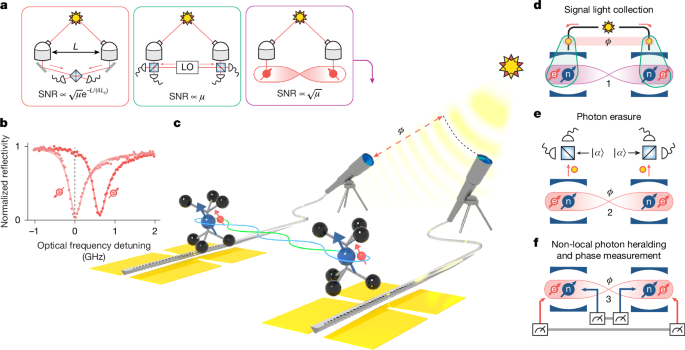
The experiment encompasses two labs, each containing one station with an SiV inside a dilution refrigerator (BlueFors BF-LD250) at about 100 mK and connected as shown in Extended Data Fig. 1. Light signals are prepared in the laser setup, including for entanglement and erasure interferometer locking (NewFocus TLB-6700 Velocity), right station SiV readout, entanglement qubit generation, signal light generation, and erasure LO generation (MSquared SolsTiS Ti:Sapphire), left station SiV readout and filter cavity locking (Toptica DLPro) and SiV de-ionization (Thorlabs Green diode LP520-SF15). All free space and in-fibre acousto-optic modulators (AOM) are driven with 215 MHz. The entanglement qubit, signal light and erasure LO pulses are shaped by modulating the radiofrequency signal sent to in-fibre AOMs. We bridge the frequency difference between the SiVs at each station of ΔfL−R ≈ 10 GHz (Extended Data Fig. 8) by generating sidebands with electro-optic modulators (EOM) driven with a radiofrequency signal at ΔfL−R inside the entanglement interferometer and filtering the light with a Fabry–Perot cavity9. Free space AOMs at the left and right stations act both as a switch between the entanglement path and signal-erasing path, as well as frequency shifters for entanglement interferometer phase locking. Photon counts for erasure are detected with pairs of superconducting nanowire single-photon detectors (SNSPD) (Photon Spot) at each station, and entanglement photon heralding clicks are detected with a single-photon avalanche photodiode (APD). We note that the erasure SNSPDs are not instantaneously photon-number-resolving but can effectively resolve photon number when the detector deadtime is much lower than the photon length. All counts are logged with a time tagger (Swabian Instruments Time Tagger Ultra), and two Zurich Instrument HDAWG 2.4 GSa/s arbitrary waveform generators are used for sequence logic, control of the AOMs and EOMs, as well as MW and radiofrequency pulse generation for SiV control.
SNR and Fisher information
The SNR can be evaluated through the Fisher information \(\mathcalF_I\) of the measurement, which is equivalent to (SNR)2 and bounds the ϕ estimation variance as \(\mathrmvar(\phi _\mathrmest)\ge 1/\mathcalF_I\) (refs. 3,55):
$$\mathcalF_I=\sum _y\frac1P(y\left(\frac\rm\delta P(y\rm\delta \phi \right)^2,$$
(7)
where for our experiment P(y|ϕ) is the probability of obtaining a nuclear two-qubit parity measurement outcome y for a given ϕ. The probabilities P(y|ϕ) are
$$\beginarraycP(\mathrmdiscarded|\phi )=1-P_\mathrmsucc\\ P(\pm \,\mathrmparity|\phi )=P_\mathrmsucc(1\pm V\cos (\phi ))/2,\endarray$$
(8)
where V is the visibility of the measurement and Psucc is the probability to herald a photon (including the photon presence probability itself). Using equations (7) and (8) for small visibility V2 ≪ 1, we get \(\mathcalF_I\propto P_\mathrmsuccV^2\).
For our implemented protocol, \(P_\mathrmsucc=\eta _\mathrmerasure\eta _\mathrmheraldP(n_\mathrmphoton\ge 1)\), where ηerasure(herald) are constant factors given by the erasure (signal photon heralding) efficiency. The signal photon heralding efficiency is limited to 50% by the use of amplitude-based SMSPG, but can be increased to 100% by using phase-based gates instead (Supplementary Information). The sequence heralds whether there was at least one signal photon but does not distinguish between single and multi-photon events. As the protocol fails when more than one photon is collected, the visibility is given by \(V=\barVP(n_\mathrmphoton=1|n_\mathrmphoton\ge 1)\) (Fig. 4e, dashed red curve), where \(\overlineV\) is the constant overhead factor due to fidelity reduction from imperfect photon erasure, gate errors and initial qubit state fidelities (Extended Data Table 1). For a light signal obeying Poissonian photon-number statistics (as our signal results from an attenuated laser with scrambled local phase but constant intensity) with average photon number μsig arriving at the stations, the Fisher information is
$$\mathcalF_I=\eta _\mathrmerasure\eta _\mathrmherald\barV^2\frac\mu _\mathrmsig^2\rme^-2\mu _\mathrmsig1-\rme^-\mu _\mathrmsig,$$
(9)
which reduces to \(\mathcalF_I\propto \mu _\mathrmsig\) for small signal μsig ≪ 1.
Without signal photon heralding, \(P_\mathrmsucc=\eta _\mathrmerasure\) and \(V=\eta _\rmherald\) \(\overlineVP(n_\rmphoton=1)\) (Fig. 4e, solid blue curve), so that the resulting Fisher information is
$$\mathcalF_I=\eta _\mathrmerasure(\eta _\mathrmherald\barV)^2\mu _\mathrmsig^2\rme^-2\mu _\mathrmsig,$$
(10)
which reduces to \(\mathcalF_I\propto \mu _\mathrmsig^2\) for μsig ≪ 1. This precisely shows that the key feature that enables SNR scaling enhancement is the non-destructive non-local signal photon heralding. This step, enabled by pre-generated entanglement, is what gives the remote phase sensing protocol its non-local character.
By contrast, when using non-local signal photon heralding, mis-heralding events (with probability εmh) corrupt the signal, modifying Psucc to \(\eta _\rmerasureP(\rmherald\cup \textmis-herald)\) and V to \(\barVP(n_\rmphoton\,=\) \(1|(\rmherald\cup \textmis-herald))\) (Fig. 4e, solid red curve). This results in
$$\mathcalF_I=\eta _\mathrmerasure\eta _\mathrmherald\barV^2\frac\mu _\mathrmsig^2\rme^-2\mu _\mathrmsig1-\rme^-\mu _\mathrmsig\,(1-\varepsilon _\mathrmmh/\eta _\mathrmherald),$$
(11)
which scales as \(\mathcalF_I\propto \mu _\mathrmsig\) for \(\mu _\mathrmsig\gtrsim \widetilde\varepsilon _\mathrmmh\) (where \(\widetilde\varepsilon _\mathrmmh=\varepsilon _\mathrmmh/\eta _\mathrmherald\) is the effective mis-heralding probability) but curves down to \(\mathcalF_I\propto \mu _\mathrmsig^2\) for \(\mu _\mathrmsig\lesssim \widetilde\varepsilon _\mathrmmh\) (Extended Data Fig. 5 and Supplementary Information). The visibility improvement from signal photon heralding can be seen both in Fig. 4d and Extended Data Fig. 2.
SMPHONE gate error detection
Similarly to the PHONE gate8,9, the SMPHONE gate entangles a photonic qubit with the nuclear spin—but in the Fock basis instead of the time-bin basis—mediated by the electron spin. Starting the nucleus and the photon in superposition states (|↓⟩ + |↑⟩)n/√2 and (|0⟩ + |1⟩)phot/√2 and the electron in the |↑⟩e state, we implement the SMPHONE gate (Extended Data Fig. 3a):
$$1\rangle )_\mathrmphot_\rme(_\rmn\to _\rme(0\rangle _\mathrmphot_\rmn+1\rangle _\mathrmphot\rm\downarrow \rangle _\rmn\,/\sqrt2).$$
(12)
Here the nucleus is entangled with the photon and the electron is always in the |↑⟩ state, unless a MW error occurred during the SMPHONE gate operation. We note, however, that the nucleus does not directly interface with light, and the nucleus–photon entanglement generation is mediated by the electron (which does interface with light), so that MW errors on the electron translate to errors on the nucleus–photon entangled state. Therefore, by measuring the electron state we can detect these MW errors and post-select on |↑⟩ results to boost the nucleus entanglement fidelity (Extended Data Fig. 3b). As measuring the electron in the |↑⟩ state (as opposed to the |↑⟩ state) does not cause decoherence of the 29Si nucleus state8, we can perform error detection mid-circuit, as in Fig. 4b.
Entanglement interferometer phase
The entanglement interferometer phase δφe stability (Extended Data Fig. 4c) is limited by noise from the fibre link between the two labs in which the stations are located and vibrations from the pulse tube motor-head of the dilution refrigerators. We reduce phase noise introduced in the fibre link by packaging the fibre in a rubber tube filled with sand for vibration damping (Extended Data Fig. 4a). We limit the phase noise introduced by the pulse tube motor-head by clamping the motor-head between aluminium plates padded with foam. To reduce vibrations guided to the dilution refrigerator through the flexline connecting to the pulse tube head, we clamp the flexline in bags of sand that further damp vibrations (Extended Data Fig. 4b). With this passive stabilization, the interferometer phase auto-correlation time increases from about 4 ms to 500 ms (Extended Data Fig. 4c). When we add the two spools of 1.5 km for the long-baseline operation (Fig. 5), the auto-correlation time of the entanglement interferometer decreases again (Extended Data Fig. 4c, inset).
We then lock the interferometer phase by alternating phase probing with SiV readout every 50 μs. A field-programmable gate array integrates the phase probing light for 1 ms and locks the interferometer phase by adjusting the drive frequency of acousto-optic modulators in each arm, resulting in a locked optical interference visibility of around 0.93 (Extended Data Fig. 4d).
Quantum-memory-assisted interferometry details
After generating entanglement and collecting the signal in the non-local phase sensing protocol, with the resulting state in equation (6), we erase the photonic spatial mode
$$[|+_\rme_\rmL+_\rme_\rmR\rangle +\sqrt\mu _\mathrmsig/2(|+_\rme_\rmL\rm\uparrow _\rme_\rmR\rangle +\rme^\rmi\phi |\rm\uparrow _\rme_\rmL+_\rme_\rmR\rangle )]_\rmn_\rmL,\rmn_\rmR.$$
(13)
Then, with local CnNOTe and π/2 pulses at each station, we transform the state to
$$\beginarrayc(|\rm\downarrow _\rme_\rmL\rm\uparrow _\rme_\rmR\rangle |\rm\downarrow _\rmn_\rmL\rm\uparrow _\rmn_\rmR\rangle -|\rm\uparrow _\rme_\rmL\rm\downarrow _\rme_\rmR\rangle |\rm\uparrow _\rmn_\rmL\rm\downarrow _\rmn_\rmR\rangle )/\sqrt2\\ \,+\,\sqrt\mu /2[|\rm\downarrow _\rme_\rmL\rm\downarrow _\rme_\rmR\rangle (|\rm\downarrow _\rmn_\rmL\rm\uparrow _\rmn_\rmR\rangle -\rme^\rmi\phi |\rm\uparrow _\rmn_\rmL\rm\downarrow _\rmn_\rmR\rangle )\\ \,+\,|\rm\uparrow _\rme_\rmL\rm\uparrow _\rme_\rmR\rangle (\rme^\rmi\phi |\rm\downarrow _\rmn_\rmL\rm\uparrow _\rmn_\rmR\rangle -|\rm\uparrow _\rmn_\rmL\rm\downarrow _\rmn_\rmR\rangle )\\ \,+\,|\rm\downarrow _\rme_\rmL\rm\uparrow _\rme_\rmR\rangle (1+\rme^\rmi\phi )|\rm\downarrow _\rmn_\rmL\rm\uparrow _\rmn_\rmR\rangle +|\rm\uparrow _\rme_\rmL\rm\downarrow _\rme_\rmR\rangle (1-\rme^\rmi\phi )|\rm\uparrow _\rmn_\rmL\rm\downarrow _\rmn_\rmR\rangle ],\endarray$$
(14)
so the electron two-qubit parity is even (|↑↑⟩ or |↓↓⟩) only if a signal photon was present, and the probability of measuring these states scales with the probability of at least one signal photon arriving (Fig. 4c). We note that the mis-heralding probability is higher for heralding on the |↓e↓e⟩ than the |↑e↑e⟩ electron state due to experimental errors accumulating coherently in the |↓e↓e⟩ state. The nuclear two-qubit parity oscillation curves with and without non-local signal photon heralding in function of signal phase separated by signal strength are shown in Extended Data Fig. 6. These curves are combined to plot the curve in Fig. 4e. Figure 4c has 9,898 successful experimental trials for a 16 h 24 min run time. Figure 4d has 6,645 successful experimental trials with and 16,270 without non-local heralding for a 155 h 43 min run time. Figure 4e has 3,167 successful experimental trials with and 7,400 without non-local heralding for a 74 h 58 min run time.
The phases of the LO pulses used in the photon erasure step at the left and right stations are also imprinted onto the nuclear state, so that the relevant phase is ΔΦL−R = δϕL − δϕR with δϕL the differential phase between the signal and the LO pulses at the left station and δϕR at the right station. ΔΦL−R reduces to simply ϕ when the phases of the LO pulses are locked to one another. However, it is enough to simply know the phases through calibration measurements, which we perform every four experimental trials (Supplementary Information).
Signal state preparation
A weak coherent state, used to emulate the signal light, is split on a beam splitter and sent to both stations. The optical phases δϕL and δϕR at the left and right stations, respectively, are not phase-locked and therefore fluctuate freely. After interacting with the SiVs, the signal undergoes a photon-erasure step, during which it is combined with an LO. The LOs at the two stations are also not phase-locked.
Rather than stabilizing the phases, we probe them using bright reference lasers for each experimental shot. This allows us to determine the phase at each station for every shot. The phase of the LO at each station can be taken as the zero reference, as we measure all quantities relative to it.
For local phases δϕL and δϕR at the left and right stations, respectively, and differential phase ΔΦL−R = δϕL − δϕR, the photonic state density matrix in the basis for weak signals μ ≪ 1 is
$$\beginarrayc\rho _\rmsig=|\alpha _L\rangle \otimes |\alpha _\rmR\rangle =|\sqrt\mu /2\,\rme^\rm\delta \phi _\rmL\rangle \otimes |\sqrt\mu /2\,\rme^\rm\delta \phi _\rmR\rangle \\ \,\approx \,\left(\beginarrayccc1 & \rme^-\rmi\rm\delta \phi _\rmR\sqrt\mu /2 & \rme^-\rmi\rm\delta \phi _\rmL\sqrt\mu /2\\ \rme^\rmi\rm\delta \phi _\rmR\sqrt\mu /2 & \mu /2 & \rme^-\rmi(\rm\delta \phi _\rmL-\rm\delta \phi _\rmR)\mu /2\\ \rme^\rmi\rm\delta \phi _\rmL\sqrt\mu /2 & \rme^\rmi(\rm\delta \phi _\rmL-\rm\delta \phi _\rmR)\mu /2 & \mu /2\endarray\right).\endarray$$
During data analysis, we group the measurements according to the same differential phase ΔΦL−R = δϕL − δϕR between the stations. On averaging, terms depending on the individual local phases δϕL and δϕR cancel out, whereas terms depending on the fixed differential phase remain (Extended Data Fig. 7), so that the density matrix becomes
$$\beginarrayc\mathop\rho \limits^ \sim _\mathrmsig\approx \left(\beginarrayccc1 & 0 & 0\\ 0 & \mu /2 & \rme^-\rmi\Delta \varPhi _\rmL-\rmR\mu /2\\ 0 & \rme^\rmi\Delta \varPhi _\rmL-\rmR\mu /2 & \mu /2\endarray\right)\approx \rho _\mathrmth,\endarray$$
which is approximately the density matrix of a weak thermal state (with mean photon number μ and complex visibility \(g=\rme^\rmi\Delta \varPhi _\rmL-\rmR\)) (ref. 3). Although the photon number statistics of the light remain Poissonian rather than thermal, in the low-mean-photon-number regime and to first photon order, the corresponding density matrices are effectively the same.
We note that in our work, the generated signal visibility is unity, but this is often not the case in practical astronomical imaging3. The value of the visibility can, in principle, also be estimated with our protocol, although care must be taken to distinguish the intrinsic signal visibility from the measurement protocol infidelity, as well as from environmental noise sources. With additional quantum resources, more advanced quantum-processing techniques10 can be used to extract the intrinsic visibility from unknown and fluctuating noise contributions without needing to reconstruct the noise itself.

