


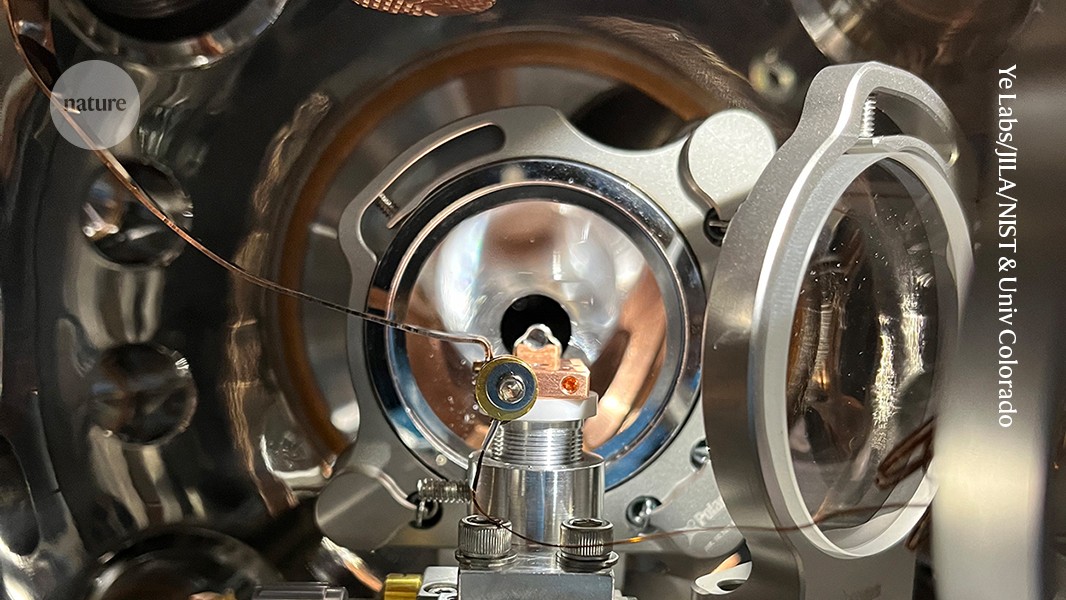

Researchers are attempting to build the world’s first nuclear clock. This is a view inside the vacuum chamber that holds crystals doped with the isotope thorium-229, which can be excited by a laser.Credit: Ye Labs/JILA/NIST/University of Colorado
Denver, Colorado
Physicists are getting closer to creating a long-sought ‘nuclear clock’. This device would keep time by measuring energy transitions in the nuclei of atoms and could become the most precise clock on the planet.
Decades ago, scientists predicted that the isotope thorium-229 could be used in such a clock, but they couldn’t pin down its unusual nuclear energy transition. That feat, achieved with a laser in 2024, started the countdown to a nuclear clock.
‘Nuclear clock’ breakthrough paves the way for super-precise timekeeping
Now, such a clock is “way closer than people think”, says Eric Hudson, a physicist at the University of California, Los Angeles, who is working on one. “You’ll see nuclear-clock measurements in 2026, I’m sure.”
Nearly a dozen research teams spread across China, Europe, Japan and the United States are closing in on assembling the components of such a clock, including a source of thorium-229 — which is radioactive — and a powerful continuous-wave ultraviolet laser to excite the energy transition. At the American Physical Society (APS) Global Physics Summit in Denver, Colorado, this week, researchers provided updates on their progress, including details of laser development.
Claire Cramer, the executive director of quantum science at the University of California, Berkeley, who was in attendance, expressed optimism about the potential of solid-state nuclear clocks: “This is a really, really promising technology for commercial applications.”
That’s because nuclear clocks could be resilient to noise and have a compact design for use outside the laboratory. They might also surpass the precision of optical atomic clocks, the field’s current top timekeepers, which lose only one second every 40 billion years.
Laser jockeying
Timekeeping, whether in a pocket watch or a physics laboratory, boils down to counting rapid, regular events — the ‘ticks’ in any clock. In optical atomic clocks, these events are the hopping of electrons in an atom between a ground and excited energy state. A laser with a wavelength in the 350- to 750-nanometre range (the visible, or optical, part of the electromagnetic spectrum) excites this transition, which can ‘tick’ trillions of times per second.

Countdown to a nuclear clock: a three minute guide
By contrast, a nuclear clock would count transitions between nuclear states of thorium-229. These have the same number of protons and neutrons, but different energies depending on how the particles are squeezed together in the nucleus.
For half a century, the precise energy of the thorium-229 transition remained uncertain. Several independent research groups began to close in on an answer a few years ago1. The search culminated in a 2024 experiment2 led by Chuankun Zhang, a physicist now at the California Institute of Technology in Pasadena, and Jun Ye, a physicist at JILA research institute in Boulder, Colorado. Using a frequency comb — a laser with about 30 million frequencies that can hit a crystal simultaneously — Zhang, Ye and their colleagues pinpointed the transition with ultra-high precision. To access it in a functioning nuclear clock, however, scientists now need a powerful and stable continuous-wave laser with an ultraviolet wavelength of around 148 nanometres. And no such laser has been made.
A group based at Tsinghua University in Beijing, China, has taken some of the most promising strides towards constructing one. Last month, the team reported in Nature3 that it had delivered 100 nanowatts of power at 148.4 nanometres. Although researchers have praised the advance, some at the APS meeting expressed hesitation about the laser’s long-term prospects, because it requires heating toxic cadmium vapour to 550 ºC.

