


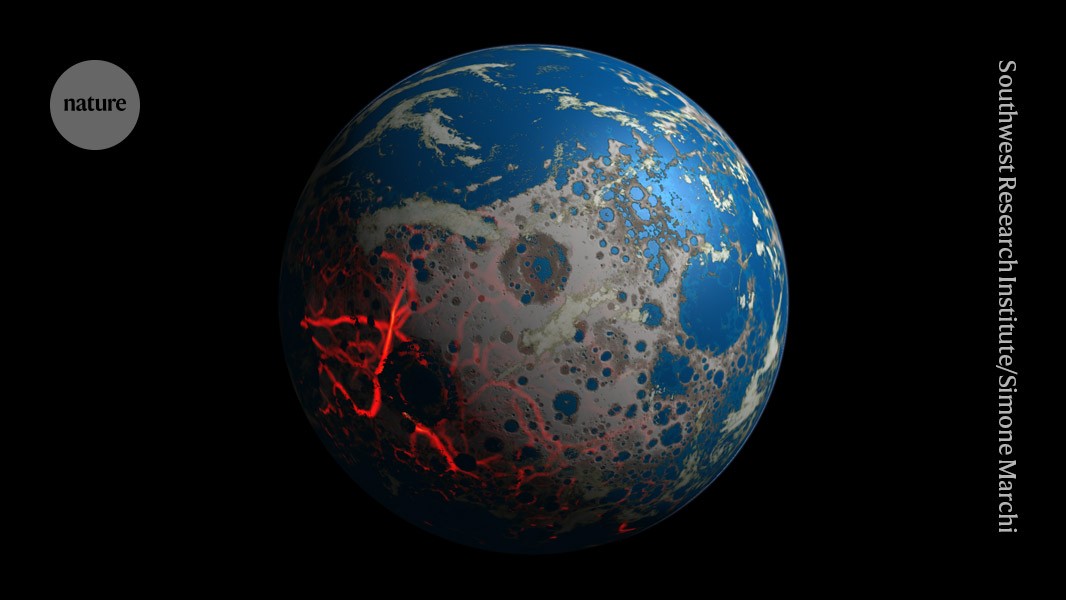

A scientifically faithful impression of Earth during the Hadean Eon.Credit: Southwest Research Institute/Simone Marchi
Ancient rock crystals from Australia suggest that the early Earth might not have been as different as scientists had thought from the planet that exists today.
Earth’s earliest history is shrouded in mystery, because the shuffling of tectonic plates has erased many geological clues. One of the few lines of evidence comes from zircon crystals, which preserve chemical information in their durable mineral structures. A zircon study published today finds that the ancient Earth could have contained more oxygen — and possibly more water — than researchers had suspected, and suggests that the movement of tectonic plates was already happening at least 3.3 billion years ago, relatively early in Earth’s 4.5-billion-year-old history1.
“It’s an important contribution to our understanding of the first billion years on Earth,” says John Valley, a geochemist at the University of Wisconsin–Madison.
The presence of more oxygen than expected in these ancient rocks suggests that conditions on the planet could have been more conducive to life during this period than previously thought. And if tectonic plates were already moving, this suggests that Earth was already hosting some of the geological processes that shape the planet and that — by recycling crucial chemicals — help to make life possible.
The work is just one entry in scientists’ long-running effort to untangle what early Earth was like. “These are maybe 3 or 4 puzzle pieces in a 10,000-piece puzzle,” says Shane Houchin, a geologist at the California Institute of Technology in Pasadena and lead author of the paper, which is published in Proceedings of the National Academy of Sciences1.
On the rocks
Houchin and his colleagues studied dozens of zircon crystals from the Jack Hills in Western Australia. These are the oldest known fragments of Earth rocks. Some date back to the Hadean Eon, which began when the planet formed and ended around four billion years ago.
The scientists probed the zircons using a number of techniques, including a sophisticated X-ray analysis of the chemical state of the crystals’ rims with the Advanced Photon Source at the Argonne National Laboratory, near Chicago, Illinois. Uranium in those crystal rims turned out to be more oxidized — meaning it had lost electrons, which could have happened in the presence of oxygen — than anticipated.

Zircons from Jack Hills, Western Australia, imaged with cathodoluminescence revealed chemical details about the early Earth.Credit: Shane K. Houchin
Because the zircons formed from molten magma in Earth’s crust, they hold clues to how that magma interacted with the atmosphere. “The gases that are coming out at volcanoes are going to be a function of how oxidized a magma is, and that will affect how much oxygen could actually be in the atmosphere,” Houchin says.
The paper’s approach is novel, but more work needs to be done to pin down those conclusions, say geochemists Simon Turner at Macquarie University in Sydney, Australia, and Hugh O’Neill at Monash University in Melbourne, Australia. In an e-mail to Nature, they argue that the oxidized uranium in the zircon rims could have come about as a result of other factors, including how gases behaved in the original magma.

