


You have full access to this article via your institution.
Hello Nature readers, would you like to get this Briefing in your inbox free every day? Sign up here.

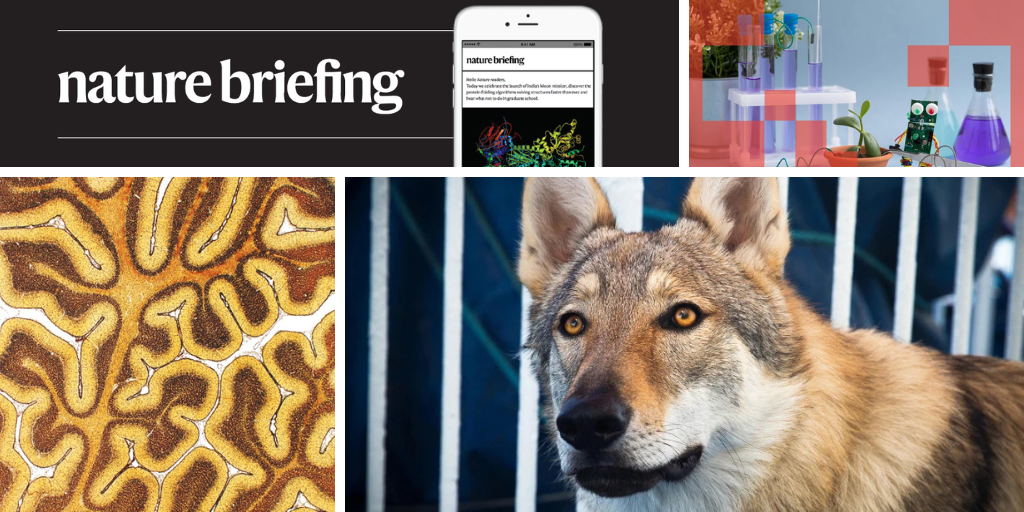
Dogs (Canis lupus familiaris) were domesticated from grey wolves (Canis lupus) at least 14,200 years ago, towards the end of the last ice age.Credit: Martin Schroeder/CHROMORANGE via Alamy
Researchers have identified the earliest known dog genomes, which push the genetic record for dogs back by more than 5,000 years. They recovered these genomes from remains of between 14,000 and 16,000 years old found at archaeological sites that span Europe and the Middle East. The team also identified an early domestic dog population (Canis lupus familiaris) that spanned Western Eurasia and was kept by diverse human hunter-gatherer groups. The findings show that dogs were exported and exchanged by various human groups, underlying dogs’ importance to early communities with different ways of living.
Reference: Nature paper 1 & paper 2
Scientists have created the first atlas of key patterns of ‘chatter’ between different areas of the brain over the entire human lifespan. Drawing on brain scans from 3,600 people — ranging from infants to centenarians — the guide maps a property called functional connectivity, which describes the level of coordination between separate brain regions. Such a guide could be useful for understanding when developmental issues and neurodegenerative conditions emerge, says neuroscientist Jakob Seidlitz. But it can’t capture how functional connectivity might differ between individuals.
Go deeper with analysis from neuroscientists Richard Bethlehem and Daniel Margulies in Nature News & Views (7 min read)
‘AI Scientist’ — a system that aims to fully automate the scientific process — is one of the first artificial intelligence tools to go through the peer-review process at a leading academic journal. The resulting paper, published in Nature, updates a 2024 preprint that described the tool, including by toning down its reported capabilities. AI Scientist is a collection of ‘agents’ built on top of existing large language models, such as GPT-4o, that perform the full cycle of scientific discovery, from idea generation to testing its ideas to writing them up in a scientific paper.
The grades attained by master’s and PhD students at one large public university in the United States have crept up over the past two decades, without a demonstrable improvement in the quality of students’ work in that period. The spike likely amounts to what researchers call ‘grade inflation’, a phenomenon that has scarcely been documented at graduate level. The reasons behind such inflation aren’t clear, but university professors might be incentivized to give higher grades to receive better student evaluations or to boost enrolment, says psychologist and study co-author Vivien Lee.

Source: Ref. 3
Many graduate programmes in the United States assign a grade point average, measured on a scale of 0 to 4. “What’s really striking is that we are seeing grade increases, even though 20 years ago grades were already high,” says Lee.
Features & opinion
With science funding dwindling in the United States, environmental scientists must find new and imaginative ways to continue their research, argues socio-ecologist Michael Paul Nelson. Scientists should take inspiration from humanities researchers and pursue projects that re-use existing data, or collaborate with other teams to pool resources when financial backing is scarce. “If we don’t find fresh ways of keeping science moving forwards, those bearing the cost will be the most vulnerable members of our community: graduate students, postdocs and early-career scholars, cast aside from languishing projects,” Nelson writes.
In the Falkland Islands, effects of climate change such as changing weather patterns and warming oceans are threatening the population of southern rockhopper penguins (Eudyptes chrysocome). To help the birds adapt, researchers on the islands are finding innovative ways to protect the penguin population, including efforts to artificially bolster their nests, and reintroduce co-operative species such as imperial cormorants (Leucocarbo atriceps). These scientists might not be able to alter ocean conditions, “but to help them on land, at the breeding sites, is something we can actually do”, says seabird biologist Sarah Crofts.
Today I’m invested in an avian romantic drama. In the latest chapter, a pair of ospreys (Pandion haliaetus) — the catchily named female CJ7 and male 022 — have returned to a nest in Dorset, United Kingdom, that they’ve shared each mating season since 2022. The pair’s reunion signals that the drama of last year’s reunion — when CJ7 returned to their nest to find 022 with another female — was just a small sideplot in their love story.
Help us keep this newsletter faithful to your interests by sending your feedback to [email protected].
Thanks for reading,
Jacob Smith, associate editor, Nature Briefing
With contributions by Flora Graham
• Nature Briefing: Careers — insights, advice and award-winning journalism to help you optimize your working life
• Nature Briefing: Microbiology — the most abundant living entities on our planet — microorganisms — and the role they play in health, the environment and food systems
• Nature Briefing: Anthropocene — climate change, biodiversity, sustainability and geoengineering
• Nature Briefing: AI & Robotics — 100% written by humans, of course
• Nature Briefing: Cancer — a weekly newsletter written with cancer researchers in mind
• Nature Briefing: Translational Research — covers biotechnology, drug discovery and pharma

