


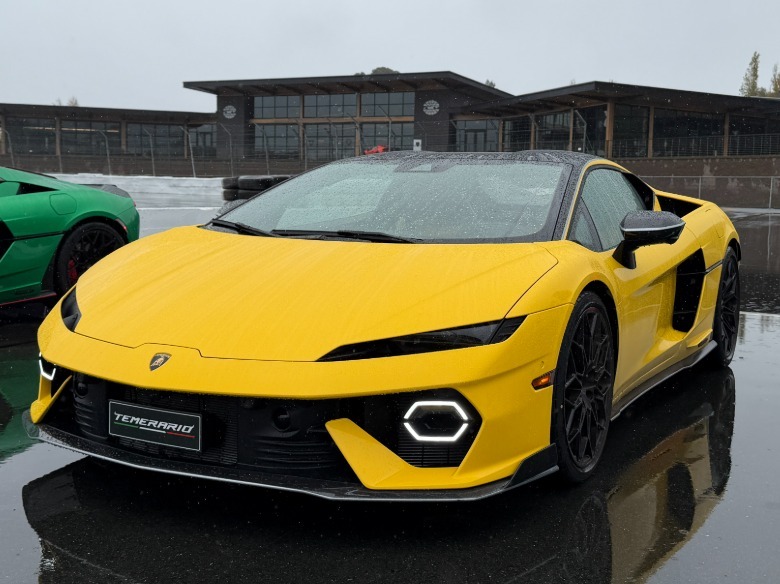
After a few hours of milling around Sonoma’s wonderful new hospitality suite and checking out the various Temerario specs we had at our disposal, the rain actually let up a little bit, and the team said it was safe enough for us to do a handful of very cautious laps before lunch. I hopped into a bright yellow Temerario equipped with the lightweight Alleggerita package, which Lamborghini said it has received very positive customer feedback on. There are more noticeable changes than most lightweight packs — as there should be, given how in its most basic form it costs about as much as a BMW 3 Series. It adds a new front splitter, side skirt and rear spoiler designs that increase aero efficiency and downforce by 62% and 67%, respectively. Those components and other body parts are made from carbon-fiber reinforced polymer, the door panels and passenger foot rest also become carbon-fiber units, and it gets a lightweight rear window and polycarbonate side windows. The Alleggerita pack throws in a titanium exhaust, too. Total weight loss is 55 pounds if you go for carbon-fiber wheels, which none of the cars at this event had.
The yellow Temerario I took on track had the optional manually adjustable sport seats; my 5-foot-9 self fit snugly in them, and it’s easy to quickly notch them into my ideal driving position. Lamborghini keeps leaning hard into its fighter-jet-inspired design language, but at least its new models are also making things more livable for both drivers and passengers in terms of comfort and convenience features — although cupholders are still only an option.
 Daniel Golson/Jalopnik
For each lap I had the car in the most basic Strada drive mode, set to Recharge so it keeps the engine running the whole time. There are also Città, Sport, Corsa and Corsa ESC Off drive modes, plus Hybrid and Performance modes for the hybrid system specifically (along with Recharge), and a multi-level Drift mode thrown in for good measure. In Strada/Hybrid there is 789 horsepower at your disposal, but putting it into Recharge reduces that to a mere 715 horses. It’s not until going into Sport mode that you unlock the full output of 907 hp and 538 pound-feet of torque, achieved thanks to the combination of a twin-turbo 4.0-liter V8 with a flat-plane crank and a 3.8-kWh battery pack feeding a trio of electric motors, two of which are attached to the axle with the third located within the engine’s housing between it and the 8-speed dual-clutch automatic transmission.
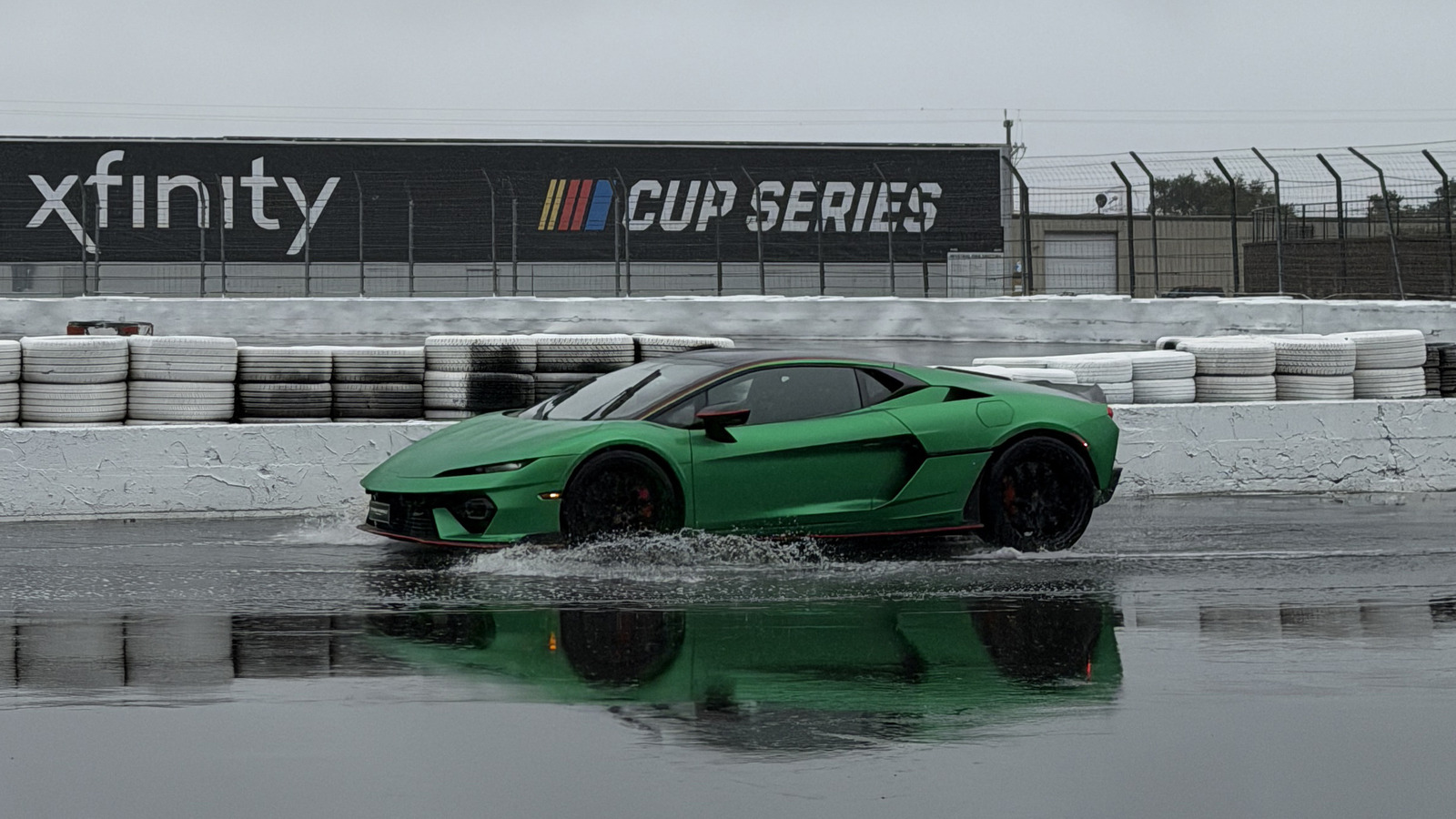
Look, there’s not much I can really say here. It was actively raining hard as I pulled out onto the track, following behind an instructor who talked to us through mics in our helmets. There was tons of standing water and mud pooled up in multiple corners, so we had to take alternate apexes on about half the track. I don’t think I ever surpassed 60 mph or revved the engine past 5,000 rpm.
Still, even at that pace and high level of cautiousness, the Temerario positively bristled with energy. There’s no hiding the monster of an engine behind your head, and the throttle was extraordinarily responsive to even light inputs. There was never a moment where the car didn’t feel stable and sure-footed in the rain, and even at slow speeds it was an enjoyable drive — at least, more so than a more normal car would’ve been in the stormy conditions. And I can confirm that both the windshield wipers and defroster work very well.

