


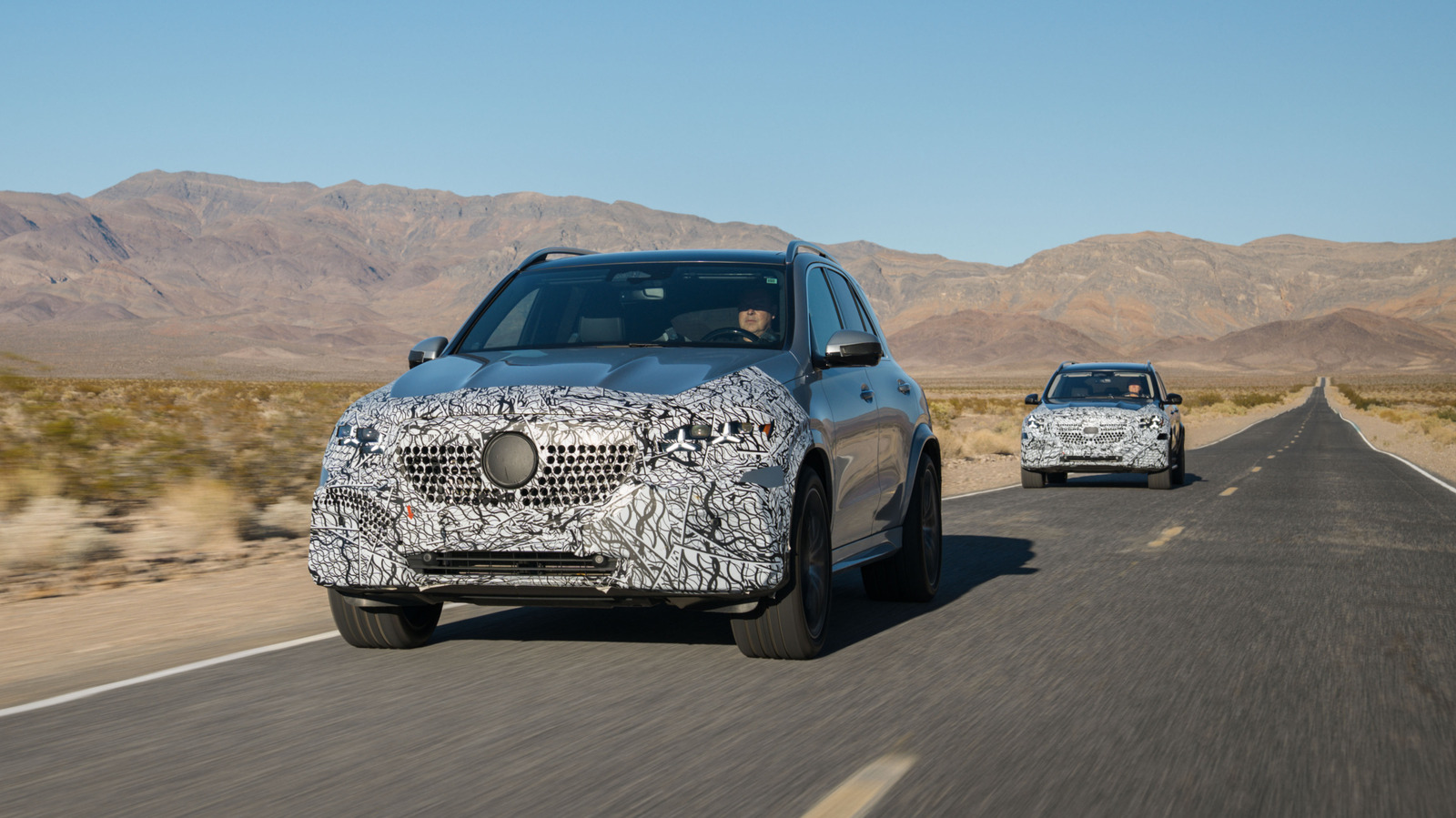
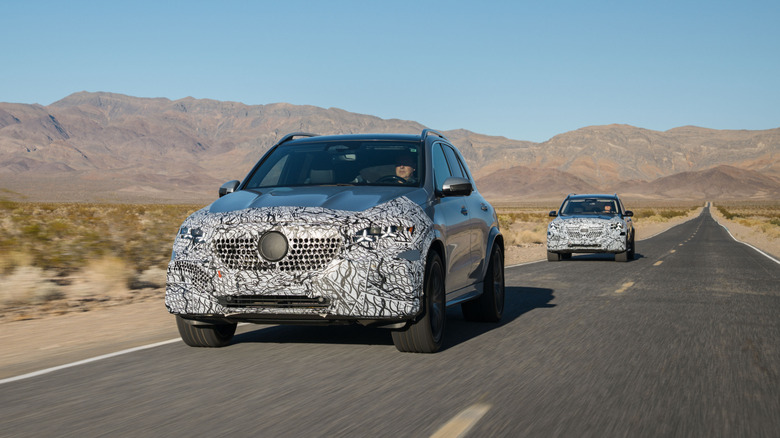
Ever since I was a little kid just learning to read, already obsessed with cars largely because of all the glossy magazines and newspaper sections teaching me new words, my favorite aspect of the car world has been automakers testing camouflaged prototypes and the industry of spy photos surrounding them. I love the different sorts of camo and levels of test mule and prototype, I love figuring out what real details you can actually see and imagining what the car will look like, I love all the artistic renderings of what could be coming. Maybe most of all, I love the mystery.
In my career I’ve had a few opportunities to drive camo’d test cars, but typically in boring locales and only for a brief amount of time, which has been a bit disappointing. One of the most fun aspects of this slice of the industry is the myriad places around the world where cars are tested, from deserts to glaciers to public roads in both the most populated and remote places. Growing up (and also now as an adult, of course) I especially loved the work of Brenda Priddy, who would get amazing shots of camouflaged cars out in Death Valley, like spotting UFOs outside Area 51.
Well, after 32 years of existence my dream finally came true back in October, when Mercedes-Benz invited me to Las Vegas to drive some facelifted GLE and GLS prototypes out into the desert, where we’d then take the electric GLC onto the dunes. While only a taste of what these test drivers go through, the morning spent experiencing what it’s like to do this job for real will last as one of my favorite memories.
Full disclosure: Mercedes-Benz flew me to Las Vegas, put me up in a hotel for a night and fed me so I could drive the GLC, GLE and GLS prototypes.
Inconspicuous depending on where you are
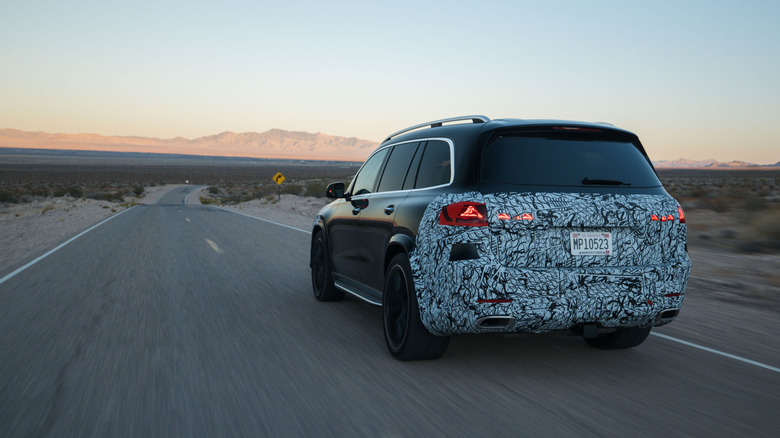
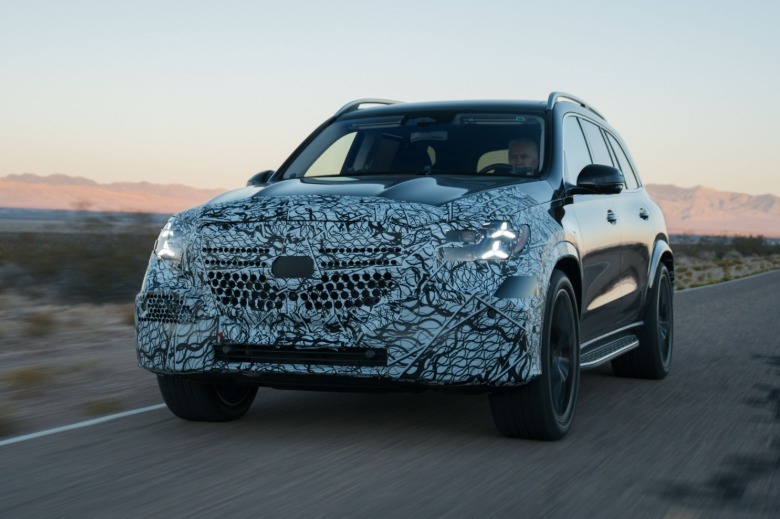
The day started out normal enough, in the valet circle of the Wynn hotel. Also valet parked during the 24 hours I spent in Vegas was a Bugatti Chiron Pur Sport, two Koenigsegg Jeskos, and a Praga Bohema, so even though the GLE and GLS were camouflaged with a partial wild zebra pattern, no one batted an eye. It wasn’t much camouflage, anyway. The badges were covered up, and the front and rear ends were camouflaged, obscuring the design of the lights, bumpers and grilles, but otherwise the SUVs looked normal. What did draw attention in the valet circles were the new GLCs that were driving around camouflaged with fully lit-up grilles.
Visible through the camouflage on both new SUVs were the outlines of even larger, reshaped grilles and new headlights with a multi-star motif. The front bumpers will be different too, but they were all covered up. The taillights will also get stars in them, potentially with a light bar across the tailgate, but design changes back there will be fewer. Both the GLE and GLS are still attractive SUVs despite being eight and nine years old, respectively, so Mercedes didn’t need to do much to keep them looking fresh. Expect a much broader range of Manufaktur paints to be offered, and new wheel designs as well.
 Mercedes-Benz
Most of the interior is covered up, and I can’t really talk about what wasn’t covered (or what the covers were lifted off of to let me get a glimpse). But I am allowed to say that as standard the GLE and GLS will get an MBUX Superscreen that combines three displays under one glass panel, though likely with bezels in between them instead of the seamless unit in the GLC. It’ll be running the latest MB.OS infotainment system, and new features include an available 3D driver’s display, more video streaming options for second-row passengers, and an improved voice assistant.
Again, the interior of these SUVs has aged quite nicely, so Mercedes hasn’t needed to do much. Mercedes put more complex round air vents at either end of the Superscreen instead of the current rectangular ones, but there still are prominent grab handles on either side of the center console. You’ll be happy to know Mercedes also added more physical controls to the steering wheel. Like on the outside, there are more color and trim options, plus a new vibrating massage function.
Testing and testing and testing and
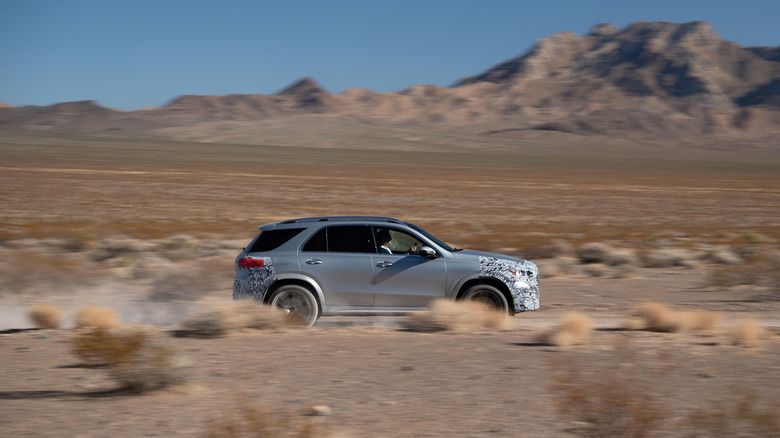
Our convoy consisted of four cars. Bookending the prototypes were two current-model GLS450s that acted as photographer rigs and as chase vehicles leading us on the right route, making sure no civilians got in between us. For the first couple dozen miles, we stuck to suburban surface streets and freeways. The majority of prototype testing is done on normal roads, as that’s where cars will spend the most of their lives, and it’s important to get hoards of data from real-world situations, particularly for the driver-assist systems. In regular traffic people are definitely staring at the SUVs and snapping photos; some clearly knew what we were doing, but for the most part the non-enthusiast public generally doesn’t understand what prototypes like this even are, why they’re camouflaged or even that it’s the automaker who did it.
Mercedes says more than 12 million miles will be put on these SUVs over the course of their development cycle, with teams all over the world sending data to each other and doing weekly calls. Over the two-ish years that Mercedes has been testing them, prototypes have gone to Austria, China, Dubai, Finland, France, Germany, Italy, Japan, South Africa, Spain, Sweden and the United States. Then there’s all the virtual miles logged in simulators, and the humongous amount of testing done at Mercedes’ facilities, like wind tunnels and blizzard simulators and robot rigs that test wear on seats over time. Taking into account all of its vehicles, Mercedes also conducts thousands of crash tests every year. And aside from sheer volume of product and technology, none of that is really special to Mercedes — pretty much every car company in the world does this level of testing. Designs might even be frozen three-plus years before a car goes on sale, so think about that next time you say one automaker copied another.
I started off in the GLE, which was fitted with Mercedes’ wonderful turbocharged 3.0-liter inline-6 with a 48-volt mild-hybrid system. The automaker says the powertrain has been extensively revised and is about 20 horses more powerful, and it’s just as smooth and nice as ever. Instead of using a turbo-four the plug-in-hybrid GLE will use the inline-6 and have a longer EV range, while the base four-cylinder engine gets a 48-volt system. It remains to be seen whether the V8 GLE580 will continue to be offered, but the GLS prototype in our group was a GLS580, using Mercedes’ updated V8 that now has a flat-plane crank and 530 horsepower, as seen in the S-Class facelift.
The fancy suspension is worth it
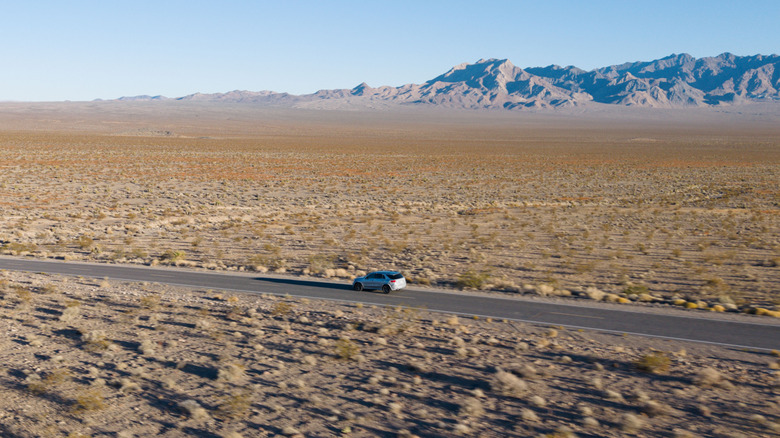
After keeping the convoy together and successfully dodging traffic, we exited the freeway to take backroads through the desert the rest of the way, and it was pure magic. This part of California has a smorgasbord of fantastic tight roads winding around mountains and rock formations, long sweepers and seemingly endless straights, all a great test bed for new car development — especially in extreme heat, which thankfully we did not experience to the level that the test teams purposefully come out to experience in the summertime. Mercedes updated the SUVs’ progressive-ratio mechanical steering rack, which is light, accurate and easy. About halfway into our journey I switched into the GLS, and though it does feel larger than the GLE, it isn’t any “worse” to drive.
Air suspension is standard on the GLS and optional on the GLE, but both of these prototypes were fitted with the available E-Active Body Control suspension system, which uses cameras to scan the road ahead, pre-adjusting the compression and rebound to make the ride as smooth as possible. It will also have Car-to-X technology that uses data from other drivers to inform what your car’s suspension does, like preloading if it knows a pothole is coming up. Ride quality of both SUVs was fantastic, but the GLS was more impressive if only because it was riding on three 23-inch wheels and one 22, as it had gotten an ill-timed flat the day before. If I didn’t already know about it, I wouldn’t have guessed anything was off. Mercedes says the other two suspension setups are improved for 2027, but I think E-ABC is worth the upgrade — on a current GLS580 it’s $6,500, and that shouldn’t change much.
Aside from the off-road recovery mode that is mainly used by customers to make funny videos of their SUVs bouncing, the best aspect of the E-ABC system is the Curve setting. Normally the suspension’s active anti-roll system does a good job keeping these heavy-ass SUVs pretty flat and stable, go into the Curve mode and the suspension will lean into corners. The difference is very noticeable. It definitely might make some people car sick, though I luckily get motion sickness from nothing, and it is a bit unsettling at first. But I absolutely love it, and other suspension systems like it such as Porsche’s Active Ride. I found the Curve mode to be more comfortable and natural-feeling, particularly on twisty canyon roads, and having lived with a Maybach GLS for a few weeks, it’s even nicer with time.
One Benz After Another
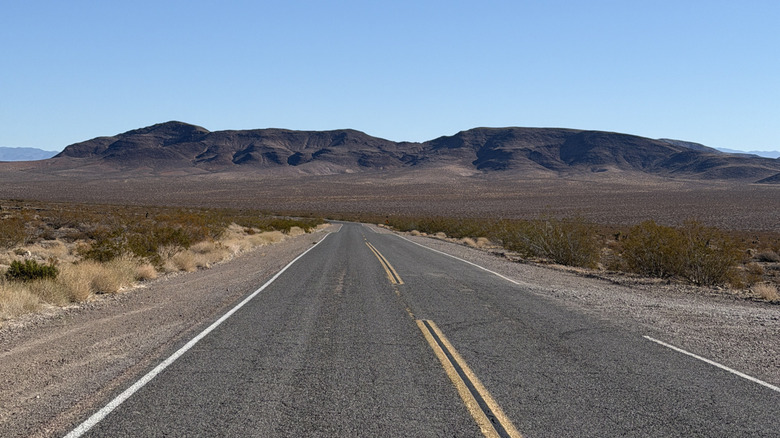
Best picture winner “One Battle After Another” came out just a couple weeks before this trip, so it was very fresh in my mind, and at one point during the drive it was as if we had been teleported straight into the set of the movie. Once we were really out in the middle of nowhere, the German engineers in the lead vehicle decided to put the hammer down. They wanted us to follow suit, we guessed, so with a nod from our minder I did the same. We proceeded to see triple digits on the dash (which was not showing kilometers per hour) for quite a while, on dramatically undulating roads that looked just like the ones in the film. These things are built for the autobahn, after all, and they felt totally normal and stable and quiet even at car chase speeds. I couldn’t help but laugh at how absurd the situation was, and how it would have looked to anyone else on the roads — not that we saw any other cars for miles and miles at a time.
The chase scene in “One Battle” feels like it goes on forever, and so did our drive, though it was thankfully not nearly as tense. The landscape out there stretches past where you think a horizon could possibly end, and even on the flattest sections it looks totally alien. Aside from the rumble of the V8 engine, the whispering of the wind against our windows and Sirius’ Studio 54 channel on the radio, it was totally serene, and sitting in the passenger seat as we approached our destination, I couldn’t help but feel proud of myself.
I’ll have been in the automotive media industry for a decade this summer, and despite my childhood obsession with car magazines, it was never something I saw myself doing for a career. And I definitely never expected that one day I would be driving through the desert in prototypes, doing the exact thing that I geeked out so hard on almost thirty years ago. The updated Mercedes GLE and GLS are going to be great, and you’ll get to see them uncovered next week. But that’s also not really the story here. I could have driven a much, much worse or less consequential prototype vehicle out there and still came away with the same feelings. If you ever have the opportunity to experience that thing you always wanted to do as a kid, do it. Especially if that thing is driving camouflaged test cars.

