


Plasmid construction
The pXG-10×His-DICER plasmid was generated by inserting a DNA sequence encoding human DICER (amino acids 25–1922) and a sequence encoding a 10-histidine tag at the N terminus of DICER into the pXG plasmid using the In-Fusion cloning kit (Takara). The pXG-10×His-DICER mutant variants were obtained through site-directed mutagenesis using the pXG-10×His-DICER plasmid as the template. Mutated sites were confirmed by Sanger sequencing. A list of the plasmids and oligonucleotides used for their construction is provided in Supplementary Table 2.
The Dcr-1-bacmids were prepared as follows. The DNA coding sequence of Drosophila melanogaster Dicer-1 (Dcr-1) was obtained from cDNA synthesized using random hexamers and total RNA extracted from D. melanogaster cells. The coding sequence of Dcr-1 was cloned into the pBIG plasmid42 using a restriction cloning scheme, resulting in the pBIG-Dcr-1 construct. The pBIG-Dcr-1 plasmids were introduced into DH10EMBacY E. coli cells to produce Dcr-1-bacmids. After blue–white selection on agar plates containing Bluo-gal, IPTG and antibiotics, Dcr-1-bacmids were isolated from white colonies testing positive. Purification of bacmids was performed using alkaline lysis and alcohol precipitation methods. The presence of the gene encoding Dcr-1 within the bacmids was confirmed by PCR using the pUC-M13 primer pair. The primers used for generating pBIG-Dcr-1 and amplifying the Dcr-1 coding sequence are listed in Supplementary Table 2.
Protein expression
Wild-type human DICER and mutant variants were expressed using the human cell system HEK293E, as previously described34,35,36. The DICER plasmids were prepared using the MaxiPrep kit (Thermo Fisher Scientific). HEK293E cells were cultured in 100-mm dishes in Dulbecco’s modified Eagle’s medium (DMEM) supplemented with 5% fetal bovine serum (FBS) at 37 °C. Each 100-mm dish was transfected with 10 µg of plasmid DNA and 30 µg of linear polyethyleneimine (L-PEI) as the transfection reagent. Cells were collected 72 h after transfection.
For the baculovirus system, Dcr-1-bacmids were transfected into Sf9 cells (provided by S. Dang), which were cultured in in a six-well plate in 2 ml ESF-921 (Expression Systems) per well using the CellFectin II reagent (Thermo Fisher Scientific) to generate the initial baculovirus stock (P0). The virus was subsequently amplified through two additional passages to achieve a viral titre that was sufficient for efficient protein expression. Sf9 cells infected with the appropriate amount of virus were collected 72 h after infection in a shaking incubator at 27 °C.
Protein purification
For DICER purification, we collected approximately 100 dishes (100-mm) of HEK293E cells expressing DICER. For Dcr-1, we collected around 200 ml cell culture of approximately 400 million insect cells expressing Dcr-1. The purification procedures for the two proteins were similar and are described below.
The cell pellets were resuspended in a lysis buffer at a ratio of 1:10 (cell pellet:buffer volume). The lysis buffer consisted of 50 mM Tris-HCl (pH 8.0), 150 mM NaCl, 4 mM β-mercaptoethanol and 10% glycerol, and was supplemented with RNase A and a protease inhibitor cocktail. After resuspension, the cells were subjected to a brief sonication step to disrupt the cell membranes. The lysates were then clarified by high-speed centrifugation at 18,000 rpm for 30 min.
The clarified supernatant was immediately applied to a pre-equilibrated Ni-NTA column. Unbound and nonspecifically bound proteins were removed with wash buffers containing either 150 mM NaCl or 1,000 mM NaCl, supplemented with 25 mM imidazole. His-tagged proteins were eluted from the Ni-NTA beads using an elution buffer (T150) containing 50 mM Tris-HCl (pH 8.0), 150 mM NaCl, 4 mM β-mercaptoethanol and 200 mM imidazole. The eluate was then applied to Q-Sepharose beads at 100 mM NaCl, and the bound proteins were eluted at 500 mM NaCl to achieve higher purity.
The partially purified protein was further processed using gel-filtration chromatography (Bio-Rad NGC). The final elution buffer consisted of 50 mM Tris (pH 7.5), 500 mM NaCl, 0.5 mM TCEP and 10% glycerol. Peak fractions were collected, pooled and concentrated using Centricon devices with a cut-off of 100 kDa. The concentrated protein was rapidly frozen in liquid nitrogen and stored at −80 °C for future use.
In vitro pre-miRNA dicing assay
The pre-miRNAs were synthesized using the method described in our previous studies34,35,36. The oligonucleotides used for each RNA were synthesized by a commercial company (BGI). We performed two sequential PCR reactions to generate IVT-DNA sequences containing the T7 promoter, hammerhead ribozyme sequence, pre-miRNA sequence and HDV ribozyme sequence. A total of 200 ng of IVT-DNA was added to a 20-µl in vitro transcription reaction using the MEGAscript T7 kit, and the reaction was incubated overnight at 37 °C. The RNA products were treated with 40 mM MgCl2 to activate the ribozyme reaction, resulting in pre-miRNAs with a 3′-phosphate and a 5′-OH group. The pre-miRNAs were then treated with T4 Polynucleotide Kinase (T4 PNK) to convert the 3′-phosphate and 5′-OH groups into 3′-OH and 5′-phosphate, respectively. The oligos that were used to produce pre-miRNAs are listed in Supplementary Table 3.
The in vitro pre-miRNA dicing assay was performed in a 10 µl reaction mixture containing 50 mM Tris-HCl (pH 7.5), 150 mM NaCl, 10% glycerol, 1 mM DTT and 2 mM MgCl2. Approximately 2 pmol of pre-miRNA was incubated with 1–2 pmol of purified recombinant DICER for 30 min at 37 °C. The reaction was terminated by adding 2× TBE loading buffer containing 10 µg ml−1 of proteinase K, followed by heat treatment at 50 °C for 15 min. The reaction mixture was then denatured at 95 °C for 5 min before being loaded onto a pre-run 15% urea–denaturing PAGE gel. Electrophoresis was performed for approximately 50 min at 300 V. The gel was stained with 0.1% SYBR Green II in TBE buffer for 8 min and imaged using the Bio-Rad Gel Doc XR+ system. Quantification of product band intensities was performed using Image Lab v.6.0.1 software.
Massively parallel dicing assays for randomized pre-mir-324 and library construction
Synthesis of randomized pre-mir-324
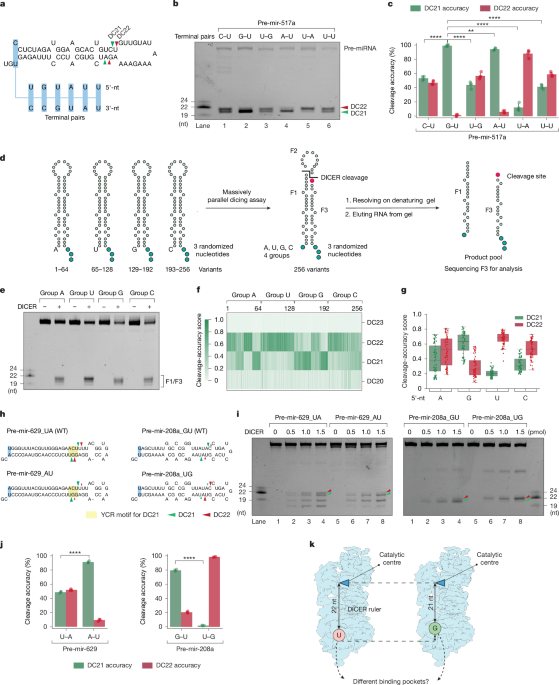
The in vitro synthesis of four randomized pre-mir-324 groups, each containing three randomized nucleotides at the 3′-end and one of four specific nucleotides at the 5′-end, was performed as follows. Note that we removed the 5′-bulged U near the 5′ cleavage site so that the F1 and F3 fragments generated by DICER have the same length, simplifying gel-based interpretation of cleavage. For each group, forward and reverse primers with overlapping regions were annealed and extended by a single-cycle PCR using the Klenow exo fragment to produce double-stranded DNA (dsDNA-1) containing the hammerhead ribozyme and pre-miRNA regions. Each group used a unique forward primer, and all groups shared the same reverse primer. In the second PCR step, a new set of primers was used. The reverse primer introduced three randomized nucleotides at the 3′-end of pre-mir-324, and the forward primer included the T7 promoter and the hammerhead ribozyme sequence. The resulting DNA from the second PCR, referred to as IVT-dsDNA for each group, contained the T7 promoter, hammerhead ribozyme sequence and pre-miRNA sequence. Approximately 400 ng of purified dsDNA from each group was used as the template for in vitro transcription. The oligonucleotides used for this process are listed in Supplementary Table 4.
The in vitro transcription reaction was performed at 37 °C for 12 h using the MEGAscript T7 kit (Thermo Fisher Scientific). Afterwards, 40 mM MgCl2 was added to activate the hammerhead ribozyme’s self-cleavage, separating the pre-miRNA sequence (now with a 5′-OH) from the ribozyme. The reaction mixture was subjected to three thermal cycles (72 °C for 1 min, 65 °C for 5 min and 37 °C for 10 min) to facilitate ribozyme activity. The RNA products were resolved on an 8% urea–denaturing PAGE gel (300 V, 40 min), and the pre-miRNA band was excised on the basis of its expected size. The RNA was extracted using an elution buffer (500 mM NaCl and 5 mM EDTA, pH 8.0) to prevent cation-dependent degradation and purified by isopropanol precipitation. The purified RNA was treated with T4 PNK (Thermo Fisher Scientific) in Thermo Buffer A to convert its 5′-OH to a 5′-phosphate. A final isopropanol purification yielded the randomized pre-miRNAs, which were stored at −80 °C for downstream assays.
Massively parallel dicing assays for randomized pre-mir-324
For the massively parallel dicing assays, 2 pmol of each of the four randomized groups of pre-mir-324 (groups A, U, G and C, based on the 5′-nt) were independently processed with approximately 1 pmol of recombinant human DICER or D. melanogaster Dcr-1 at 37 °C for 30 min. The reactions were terminated by adding 2× TBE sample loading buffer supplemented with 10 µg ml−1 proteinase K. The mixtures were incubated at 50 °C for 15 min, denatured and resolved on a 12% urea–denaturing PAGE gel, separating cleaved products from substrates. Cleaved product bands were excised from the gel and purified using an ethanol–isopropanol precipitation with GlycoBlue (Thermo Fisher Scientific) as a co-precipitant.
Construction of sequencing libraries
To prepare libraries for the original pre-mir-324 substrates, the circular ligation scheme was used. A total of 2 pmol of pooled RNA from all four groups (A, U, G and C) was ligated with a 4N-RA3 oligo using T4 RNA Ligase 2-truncated KQ (Thermo Fisher Scientific). The ligated RNA was reverse-transcribed with a 6N-R-RA3-cirRTP primer at 50 °C for 15 min using SuperScript IV Reverse Transcriptase (Invitrogen). After reverse transcription, the original RNA was degraded by treating the reaction with 0.1 M NaOH at 90 °C for 10 min. The cDNA was purified by 12% urea–denaturing PAGE gel fallowed by ethanol precipitation. The purified cDNA was circularized with CircLigase ssDNA ligase (Epicentre) and separated from linear cDNA on an 18% urea–denaturing PAGE gel. The circularized cDNA served as the template for a final PCR, performed using RP1 and RPx primers from the TruSeq Illumina system, to generate the DNA library for original substrates.
For the cleaved products, separate libraries were constructed for each of the four groups (A, U, G and C). Each RNA sample was ligated with the 4N-RA3 primer using T4 RNA Ligase 2-truncated KQ. After ligation, the samples were resolved on a 12% urea–denaturing PAGE gel to separate ligated products from unligated oligos. The ligated products were then ligated with the 4N-RA5 RNA oligo using T4 RNA Ligase 1. The double-ligated RNA was reverse-transcribed with the R-RA3 primer using Superscript IV Reverse Transcriptase. The resulting cDNA pools were used as templates for the final PCR with RP1 and RPIx primers from the TruSeq Illumina system, generating DNA libraries for cleaved products. Separate libraries were prepared for each of the four subgroups (A, U, G and C).
These libraries for both original substrates and cleaved products were sequenced using an Illumina NovaSeq 6000 in 150-bp paired-end mode (HaploX). The oligonucleotides used for library preparation are listed in Supplementary Table 4.
Analysis of massively parallel dicing assays for randomized pre-mir-324
The raw sequencing reads were processed using the following pipeline. First, the 3′ and 5′ adapter sequences were removed using the cutadapt tool43 with the command cutadapt -a TGGAATTCTCGGGTGCCAAGG -A GATCGTCGGACTGTAGAACTCTGAAC. Next, paired-end reads were joined using the fastq-join tool with default parameters. After obtaining the joined reads, low-quality reads were filtered out using the fastq_quality_filter tool with the parameters -q 20 -p 9044.
The reads were then collapsed using the fastx_collapser tool to remove duplicates that shared the same ligation barcode (http://hannonlab.cshl.edu/fastx_toolkit/index.html, v.0.0.13). After this, a second round of trimming with cutadapt was performed to remove the 4N/4N and 6N/4N ligation barcodes at the 5′- and 3′-ends of the product reads and original substrate reads, respectively.
The processed reads were mapped to the pre-mir-324 reference sequence using the BWA mapping toolkit45. Only reads that were perfectly mapped to a single variant (out of 64 variants for each subgroup) were selected for further analysis. These reads contained the randomized sequence at 3′-ends and the DICER cleavage sites at 5′-ends.
For each pre-mir-324 variant (for example, var1), mapped read counts in the substrate sample were normalized to the total substrate reads and converted to reads per million (RPM), denoted as Control(var1). In the product sample, mapped read counts for each cleaved product were similarly normalized to the total product reads and converted to RPM. A given variant can yield multiple cleaved products with distinct 5′-ends that correspond to different DICER cleavage sites. Let NPx denote the RPM of the cleaved product whose DICER cleavage site is at position x. Cleavage accuracy for position x within a variant is defined as the fraction of reads at x among all cleavage positions observed for that variant, Accuracyx(var1) = NPx/ΣiNPi. Cleavage efficiency for position x within a variant is defined as the fraction of product reads at x relative to the total substrate abundance of that variant, Efficiencyx(var1) = NPx/Control(var1).
Pre-miRNA structure analysis
To investigate the effect of the 5′-nt on selection of DICER cleavage sites in human pre-miRNA dicing, we used data from our previous study about the enrichment of the YCR motif for analysis35. Sequences and major cleavage sites of 566 human pre-miRNAs were collected from MirGeneDB40. The secondary structures of the pre-miRNA sequences were predicted using RNAfold (ViennaRNA Package)46. To pinpoint DICER cutting sites for each pre-miRNA, we analysed either the 5′-terminus of the mature 3′-strand miRNAs or the 3′-terminus of the mature 5′-strand miRNAs. The presence and position of YCR motifs in pre-miRNAs were identified previously35. The pre-miRNA sequences, their corresponding miRNA sequences and the YCR motifs identified are presented in Supplementary Table 5.
In vitro reconstitution of DICER with shRNAs
The chemically synthesized shRNAs 26S-GU (5′-pGGGAUAUUUCUCGCAGAUCUCAUGUGAAAAAAAAAACACAUGACAUCUGUGAGAAAUAUUCUUA) and 26S-UG (5′-pUGGAUAUUUCUCGCAGAUCUCAUGUGAAAAAAAAAACACAUGACAUCUGUGAGAAAUAUUCGUA) and pre-mir-517a_GU (5′-pGCUCUAGAUGGAAGCACUGUCUGUUGUAUAAAAGAAAAGAUCGUGCAUCCCUUUAGAGUGU) were obtained from GenCefe and dissolved in RNase-free water to a final concentration of around 100 µM.
To assemble the RNA–protein complex, 20 pmol of DICER protein was mixed with 60 pmol of shRNA or pre-mir-517a_GU in assembly buffer containing 50 mM Tris-HCl (pH 8), 150 mM NaCl, 0.5 mM TCEP, 2 mM Ca2+ and 5% glycerol. The reaction, performed in a 10-µl PCR tube, was incubated on ice for three hours before being loaded onto EM grids.
Because shRNA binds to DICER at an estimated 1:1 ratio, a 3:1 RNA:protein ratio was used to ensure nearly complete occupancy of DICER by shRNA. Sample homogeneity was assessed by negative staining immediately before EM grid freezing.
Preparation of cryo-EM samples
The assembled samples for both DICER–26S-GU and DICER–26S-UG complexes were prepared using the same protocol. An aliquot of approximately 4 µl sample was applied to glow-discharged Quantifoil R2/2 300-mesh Cu grids. After application, the sample was blotted at 100% humidity and 4 °C, followed by vitrification in liquid ethane using a Vitrobot Mark IV (Thermo Fisher Scientific; blot force 0, wait time 30 s, blotting time 4 s with blotting paper no.2) at the Biological Cryo-EM Center at Hong Kong University of Science and Technology (HKUST). Cryo-EM sample preparation for DICER–pre-mir-517a_GU and DICER(D991G/H992G)–26S-GU followed the same protocol as that for DICER–26S-GU, except that we used Quantifoil R1.2/1.3 400-mesh Au grids. Grids were screened on a Glacios (Thermo Fisher Scientific) at 200 keV, and those with evenly distributed particles and a suitable ice thickness were selected for data collection.
Data collection was done using a 300-kV Titan Krios G3i cryo-TEM microscope (Thermo Fisher Scientific) located at the Biological Cryo-EM Center at HKUST. Microscope settings: Gatan K3 direct electron detector in counting mode; nominal magnification 81,000× (physical pixel size 1.051 Å). Exposure: total dose 50 e− Å−2, fractionated into 40 frames (3.1 s total); dose rate of around 17.7 e− per pixel per second and around 1.25 e− Å−2 per frame. Defocus: −1.0 to −2.4 µm.
For the DICER–26S-GU complex, 23,300 movies were collected from 5 datasets. The DICER–26S-UG complex included 11,241 movies from 3 datasets, DICER(D991G/H992G)–26S-GU had 16,972 movies from 2 datasets and DICER–pre-mir-517a_GU had 14,244 movies from 3 datasets. Detailed data collection parameters for these complexes are provided in Supplementary Table 1.
Cryo-EM data processing and 3D refinement
All image processing was performed in cryoSPARC v.4.6.2 (Structura Biotechnology)47. Movies were corrected using Patch motion correction with default settings and binned to the physical pixel size, and CTF parameters were estimated per micrograph using Patch CTF estimation (with default setting, fit range of around 4–25 Å). Micrographs with poor CTF fits, thick ice or contamination were excluded after manual inspection.
Particles were first identified by blob picking (radii 100–250 Å) and extracted in 256-pixel boxes, followed by multiple rounds of 2D classification to remove junk and retain views characteristic of the DICER–RNA dicing state. High-quality 2D classes were used as templates for template-based auto-picking (particle diameter 200 Å), after which additional 2D cleaning was performed. Cleaned particle sets of around 181,000 particles were seeded for ab initio reconstruction (C1 symmetry) to obtain initial volumes. The appropriate initial volume resembling DICER–RNA complexes was selected and refined with non-uniform refinement to obtain the final maps.
The final DICER–26S-UG map (641,317 particles) reached a resolution of 3.34 Å by GS-FSC, and the DICER–26S-GU map (1,755,133 particles) reached 3.37 Å. The map of DICER(D991G/H992G)–26S-GU (787,381 particles) reached a resolution of 3.29 Å by GS-FSC. The maps of DICER–pre-mir-517a_GU in the pre-dicing (1,272,937 particles) and dicing (475,650) state reached resolutions of 3.00 Å and 3.21 Å by GS-FSC, respectively. Maps were sharpened with CryoTEN (default settings) to obtain final maps for model building48.
Model building
The published model of the DICER protein in the dicing state with pre-let-7a-1GYM (PDB: 7XW2) was used as the initial protein model for the DICER–26S-GU, DICER–26S-UG and DICER–pre-mir-517a_GU in dicing-state maps. The initial RNA models for 26S-UG, 26S-GU and pre-mir-517a_GU were generated using AlphaFold3 for three-dimensional (3D) RNA structure prediction41. The refined DICER–26S-GU model served as the starting model for DICER(D991G/H992G)–26S-GU; D991G and H992G mutations were introduced in ChimeraX (v.1.7)49. For the DICER–pre-miR-517a_GU pre-dicing state, the apo structure (PDB: 7XW3) was used as the initial model. These initial models were aligned with the cryo-EM density maps using the Fit-in-Map tool in ChimeraX v.1.7, followed by manual refinement in Coot (WinCoot v.0.9.8.96)49,50. The manually fitted models were further refined using phenix.real_space_refine in PHENIX (v.1.20.1)51. Model validation was done with phenix.validation_cryoem51.
All figures presented in this study were generated using ChimeraX v.1.749 and PyMOL (Schrödinger)52.
Small-RNA analysis
The DNA sequences coding for pri-miRNA (pre-miRNA sequences with a 20-nt extension on both ends) were cloned into the pcDNA3 vector using a ligation strategy. Detailed primer information is provided in Supplementary Table 2. HCT116 DICER-knockout cells (provided by N. Kim) were cultured in six-well plates using McCoy’s 5A medium supplemented with 10% FBS (Gibco). Transfections were performed with 1.5 µg of either pXG-DICER-WT or pXG-DICER-D991G-H992G, along with 0.25 µg of pcDNA3-pri-mir-517a_GU or pcDNA3-pri-mir-517a_UG, using lipofectamine. Total RNA was extracted 48 h after transfection using TRIzol reagent (Invitrogen).
We constructed RNA libraries from isolated small RNA fragments obtained from 4 µg of total RNA per sample using a 12% urea–PAGE gel. Library preparation was performed using the NEBNext Small RNA Library Prep Set for Illumina (NEB, E7330S). In brief, the purified small RNA fragments were first ligated to an adenylated 3′ adapter (AppAGATCGGAAGAGCACACGTCT-NH2). To prevent excess adapter from interfering with subsequent steps, a reverse complementary oligonucleotide was used. The 3′-ligated RNAs were then ligated to a 5′ adapter (GUUCAGAGUUCUACAGUCCGACGAUC). After adapter ligation, the RNAs were reverse-transcribed into cDNA, which was subsequently amplified by PCR using indexed primers to generate DNA libraries. Each sample was prepared in three biological replicates.
The small-RNA libraries were sequenced using the Illumina NovaSeq 6000 platform in 150-bp paired-end mode (HaploX). For sequencing data analysis, the adapters were first removed from read1 and read2 using the commands cutadapt -a AGATCGGAAGAGCACACGTCT and cutadapt -a GATCGTCGGACTGTAGAACTCTGAAC, respectively45. The reads were then concatenated using fastq-join, and low-quality reads were excluded using fastq_quality_filter with the parameters -q 20 -p 9044. The resulting reads were mapped to a customized reference containing pri-miRNA sequences using Bowtie253. Reads mapping to pri-miRNA sequences were selected for further analysis. The starting positions of reads mapped to the 3′-miRNA regions were used to identify DICER cleavage sites. IsomiR frequency was calculated as the ratio of the positional RPM to the sum of all positional RPMs. We categorized the isomiRs into three groups—DC21, DC22 and DC-other—which correspond to DICER cleavage at DC21, DC22 and other positions, respectively.
Reporting summary
Further information on research design is available in the Nature Portfolio Reporting Summary linked to this article.

