


By Dronelife Features Editor Jim Magill
(Editor’s note: This story is part of a series of reports on efforts to establish new counter-UAS protocols in the U.S. to protect high-profile sporting events, such as the FIFA World Cup, and critical infrastructure from the potential threats posed by drones flown by careless or hostile actors.)
As federal, state and local officials ramp up the counter-UAS capabilities of U.S. cities hosting FIFA World Cup events, the Department of Homeland Security (DHS) has placed its first order for kinetic counter-UAS technology, a system that deploys UAV-launched nets to safely bring down hostile drones.
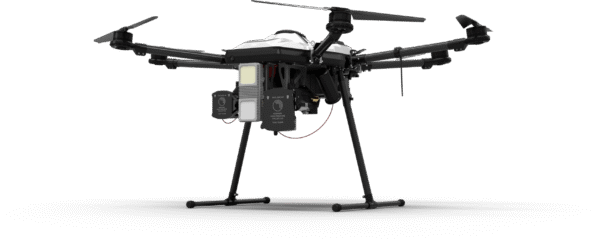
Last month, Lindon, Utah-based Fortem Technologies announced that it had received “a multimillion-dollar order from DHS,” to protect U.S. venues at the upcoming 2026 FIFA World Cup using its net-equipped DroneHunter interceptors that are designed to safely capture and remove hostile drones without creating debris or endangering crowds below.
In an email statement, Fortem’s CEO Jon Gruen said in addition to the DroneHunter interceptors, the DHS order includes the company’s TrueView radar units for drone detection and tracking, and SkyDome command-and-control software for coordinated, autonomous response. He declined to give details of the transaction, referring such questions to DHS. DHS did not immediately reply to DroneLife’s request for comment.
Gruen said that under the framework of its contract with DHS, Fortem will provide equipment, integration, training and operational support in coordination with federal, state, local, tribal and territorial (SLTT) stakeholders in the World Cup host cities. “We work closely with relevant authorities to ensure systems are properly deployed, personnel are trained, and counter-UAS capability is fully established in advance of the event,” he said.
DHS Acquires Kinetic Counter-UAS System
The selection of Fortem’s technology represents DHS’s first procurement of a kinetic counter-UAS system, Gruen said.
With more than 4,500 successful tests for drone captures, Fortem’s DroneHunter F700s is equipped with NetGuns, modular attachments that fire nets that rapidly expand and ensnare their targets.
According to the company’s website, the DroneHunter is capable of bringing down both small, commercially available Group-1 drones, commonly flown by hobbyists, as well as the larger and heavier Group-2 UAVs, more frequently deployed by criminal actors and terrorist groups
The Group-1 drones can by captured by a tether-net connected to the F700, which can then carry the ensnared rouge UAV to a safe location. For larger, heavier drones, the DroneHunter can fire off a DrogueChute, a net connected to a drogue, or parachute. “This forces the target into a slow and predictable landing, allowing ample time to evacuate the zone below,” the company states.
The company boasts that the DroneHunter is capable of mitigating both quadcopters and the faster fixed-wing drones that might present a challenge to infrastructures and people.
Fortem’s patented net-based capture system is designed to safely operate in crowded urban environments, without the drawbacks posed by other drone-mitigation techniques. Systems that rely on jamming or interfering with a drone’s RF signal can disrupt legitimate communications and may not work on autonomous drones, while kinetic-kill systems that use projectiles to shoot down offending drones can create hazards on the ground from falling debris.
The Fortem system – composed of the DroneHunter hexacopter interceptors, the ground-based TrueView R30 radar units and the SkyDome command-and-control software — is designed for rapid deployment and can be quickly be moved to protect different venues and events as the tournament travels from one host city to another.
Gruen said the DHS contract calls for the equipment to be delivered by May, to give security officials sufficient time for system setup, integration and training ahead of the start of the FIFA tournament events. “Our focus is ensuring full operational readiness well in advance of the June–July match schedule,” he said.
The FIFA World Cup matches to be held in the U.S. this year will mark the second time that Fortem technology has been used to protect the international soccer tournament events. The company also had provided counter-UAS solutions at the in 2022 World Cup in Qatar.
Once the World Cup events are concluded Gruen said the DHS will likely continue to deploy the Fortem technology at future large-scale events, such as the America 250 events scheduled to take place later this summer.
“The World Cup deployment reflects a broader federal investment in counter-drone capability ahead of both the tournament and the nation’s 250th anniversary,” he said. “More broadly, we see sustained demand for counter-drone protection at high-profile events and critical infrastructure, and we will continue supporting authorized customers in those environments.”
More information on Fortem is available from their website.
Read More
 Jim Magill is a Houston-based writer with almost a quarter-century of experience covering technical and economic developments in the oil and gas industry. After retiring in December 2019 as a senior editor with S&P Global Platts, Jim began writing about emerging technologies, such as artificial intelligence, robots and drones, and the ways in which they’re contributing to our society. In addition to DroneLife, Jim is a contributor to Forbes.com and his work has appeared in the Houston Chronicle, U.S. News & World Report, and Unmanned Systems, a publication of the Association for Unmanned Vehicle Systems International.

