


As governments invest in infrastructure to unlock tourism and regional growth, the challenge is no longer just building roads. It is building roads that can endure terrain, climate, and time.
A recent case study from Blue Marble Geographics demonstrates how drone-based photogrammetry and watershed modeling are helping engineers design a more resilient transportation corridor along Indonesia’s southern coast.
Blue Marble’s Global Mapper Pro® is a powerful all-in-one GIS software platform designed to unify advanced spatial data processing, lidar and photogrammetric workflows, terrain analysis, and hydrologic modeling within a single environment. With specialized tools such as the Pixels to Points® photogrammetric module, robust point cloud handling, and extensive format support, Global Mapper Pro empowers engineers and geospatial professionals to turn drone and GIS data into actionable insights.
A Strategic Corridor Through Volcanic Terrain
Java Island is home to nearly half of Indonesia’s population and its capital, Jakarta. While the northern coastline has long served as a commercial hub, the southern coast remains more rural. In recent years, however, its volcanic landscapes and beaches have drawn increasing tourism interest.
To support development in Indonesia’s National Tourism Strategic Areas, the government is constructing the South Coast Road, known as Jalur Lintas Selatan Jawa. The corridor links major cities such as Yogyakarta with airports and coastal destinations.
Completed segments have already reduced travel times from approximately seven hours to two. That shift has strengthened tourism access and supported regional economic growth.
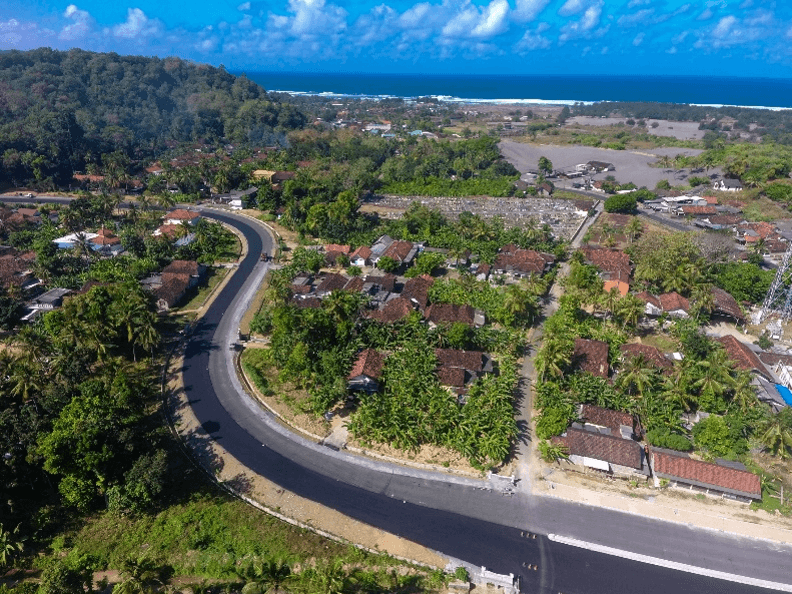
One critical segment, the Jalan Kretek–Girijati Road, connects Yogyakarta International Airport, Adisutjipto Airport, Yogyakarta City, and popular southern coastal areas. The contractor, PT Waskita Karya (Persero) Tbk, faced a complex design environment defined by steep terrain, variable elevations, and intense seasonal rainfall.
In this setting, landslides, erosion, and localized flooding present real risks. Designing a roadway that works with natural drainage patterns is essential for long-term stability and safety.
Turning Drone Imagery into Terrain Intelligence: The Real World Workflow
The workflow begins with high-resolution aerial imagery collected by drones. Surveyed ground control points ensure positional accuracy.
Within Global Mapper Pro, Blue Marble’s photogrammetric module, Pixels to Points®, processes the imagery into 3D point clouds, digital elevation models, and seamless orthophotos. These outputs form an accurate representation of site conditions and provide the foundation for further analysis.
For infrastructure projects in rugged terrain, detailed elevation models enable engineers to assess slope conditions, evaluate cut-and-fill requirements, and understand surface behavior at a granular level. The resulting terrain intelligence becomes central to responsible design.
Modeling Watersheds to Reduce Risk
Once a terrain model is generated, hydrologic analysis begins.
Using Global Mapper’s watershed tools, the project team evaluates surface water flow paths, runoff patterns, and catchment areas. In southern Java’s high-rainfall environment, understanding how water moves across slopes is critical.
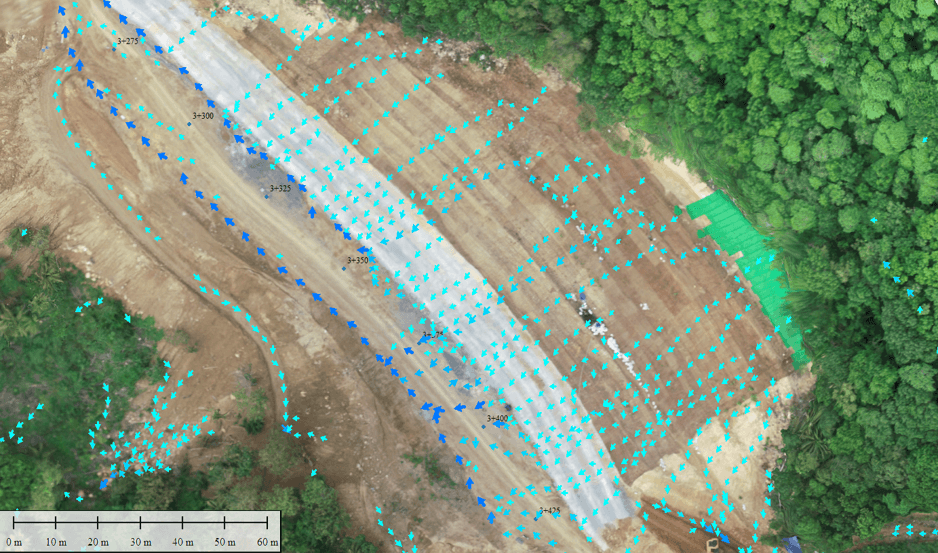
Watershed modeling highlights areas where water may concentrate during heavy storms. These zones often correlate with potential hazards, including landslides, surface erosion, and water pooling.
By integrating drone-derived elevation data with hydrologic modeling, engineers can adjust road alignments, drainage placement, and earthwork strategies before construction progresses too far. Instead of reacting to storm damage after the fact, the design process anticipates risk.
Integrating Internal Project Data
Infrastructure design relies on more than terrain data alone.
PT Waskita Karya maintains internal spatial datasets, including stationing points, road alignments, project boundaries, and right-of-way limits. Through Global Mapper’s Online Data Sources tool, the team connects to custom Web Map Services and overlays these authoritative datasets with terrain and watershed outputs.
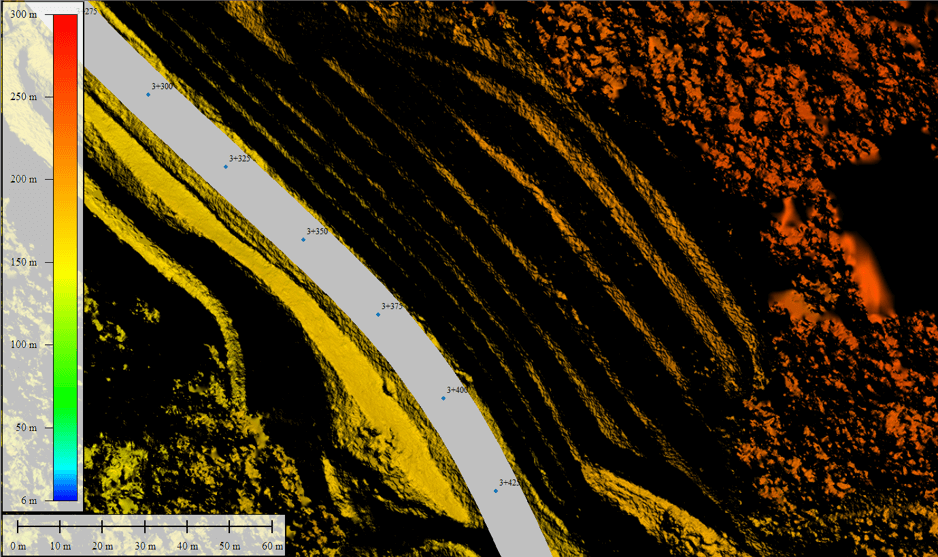
This integrated environment allows engineers to visualize how proposed road geometry interacts with slope conditions and hydrologic patterns. Both 2D and 3D views support clearer communication across design and construction teams.
By consolidating imagery, elevation data, watershed outputs, and project GIS layers in one platform, the workflow reduces fragmentation and improves decision-making efficiency.
Field Validation Confirms the Analysis
The photogrammetric and watershed analysis of the Jalan Kretek–Girijati corridor identified several areas with high potential for surface water accumulation.
Following a significant rainfall event, the team conducted ground observations. Water pooling occurred in the same locations predicted by the model.
With that validation, the project team implemented targeted drainage enhancements and slope stabilization measures. These preventative actions reduced the likelihood of landslides and flooding while helping protect nearby communities and sensitive environments.
A Repeatable Model for Resilient Infrastructure
The Jalan Kretek–Girijati project illustrates how drone-based photogrammetry and watershed modeling can support sustainable infrastructure development in complex terrain.
By combining aerial data collection, detailed terrain modeling, hydrologic analysis, and integrated GIS overlays, the workflow enables engineers to anticipate environmental challenges before they become construction delays or safety risks.
As Indonesia continues expanding its southern coastal corridor, this approach provides a repeatable framework for resilient road design. It also highlights the expanding role of drone data and geospatial analysis in large-scale infrastructure planning.
For more information on Global Mapper Pro® and how its integrated toolset supports workflows like this, visit Blue Marble Geographics.
Read more:

Miriam McNabb is the Editor-in-Chief of DRONELIFE and CEO of JobForDrones, a professional drone services marketplace, and a fascinated observer of the emerging drone industry and the regulatory environment for drones. Miriam has penned over 3,000 articles focused on the commercial drone space and is an international speaker and recognized figure in the industry. Miriam has a degree from the University of Chicago and over 20 years of experience in high tech sales and marketing for new technologies.
For drone industry consulting or writing, Email Miriam.
TWITTER:@spaldingbarker
Subscribe to DroneLife here.

