


Protein purification and complex assembly
Seven of the eight human CSN subunits, excluding CSN5, were overexpressed and purified from Escherichia coli (E. coli). Two trimeric subcomplexes, CSN1–2–3 and CSN4–6–7, were individually purified through co-expression. For the CSN1–2–3 subcomplex, CSN2 was subcloned into a modified pGEX4T1 vector (Amersham Biosciences) containing an N-terminal glutathione S-transferase (GST) tag followed by a tobacco etch virus (TEV) protease cleavage site. Truncated CSN3 (residues 1–409) and full-length CSN1 were individually subcloned into a modified pET15b vector (Novagen) containing an N-terminal His tag with a TEV protease cleavage site. The expression cassettes of CSN1 and CSN31–409—each driven by a T7 promoter and terminated by a T7 terminator—were subsequently inserted into the pGEX4T1-CSN2 plasmid. The resulting construct contained three independent expression cassettes for CSN2, CSN1 and CSN31–409, respectively. The CSN1–2–3 complex was co-expressed in E. coli BL21(DE3) cells (Novagen), purified by glutathione-affinity chromatography and subjected to TEV protease cleavage to remove the GST tag. The cleaved complex was further purified by anion-exchange (Source Q, Cytiva) and size-exclusion chromatography (Superdex 200, Cytiva). The CSN4–6–7 subcomplex was prepared using the same strategy. In this case, truncated CSN7b (residues 1–239) was subcloned into the modified pGEX4T1 vector, whereas full-length CSN4 and CSN6 were inserted into the modified pET15b vector. CSN8 was subcloned into a modified pET15b vector encoding an N-terminal maltose-binding protein (MBP) tag followed by a TEV protease cleavage site. The overexpressed MBP–CSN8 fusion protein was initially purified by MBP affinity chromatography, followed by on-column TEV protease cleavage to remove the MBP tag. The cleaved protein was then further purified by ion-exchange chromatography. The CSN-7mer complex—which comprises all subunits except CSN5—was reconstituted by incubating the CSN1–2–3, CSN4–6–7b and CSN8 a molar ratio of 1:1.5:2. The assembled complex was then purified by ion-exchange and size-exclusion chromatography.
The CSN5 subunit was prepared from insect cells using a Bac-to-Bac expression system. Wild-type and mutant CSN5 were subcloned into a modified GTE vector (Invitrogen) containing an N-terminal octa-histidine (8×His) tag, followed by a Venus fluorescent protein and a TEV protease cleavage site. High-titre baculovirus was generated using ExpiSF9 insect cells (Thermo Fisher Scientific) cultured at 27 °C. For large-scale protein production, ExpiSF9 cells at a density of 2 × 10⁶ cells per millilitre were infected with baculovirus and cultured at 27 °C for 68 h. Cells were harvested by centrifugation, resuspended in lysis buffer containing 20 mM Tris-HCl pH 8.0, 200 mM NaCl, 1 mM PMSF and Roche Complete Protease Inhibitor and lysed by sonication. The lysate was clarified by centrifugation and CSN5 was purified through a series of chromatography steps, including His-tag affinity, ion-exchange and size-exclusion chromatography. To obtain untagged CSN5, the Venus tag was removed by TEV protease digestion performed during dialysis following the initial His-affinity purification. The resulting mixture was then passed through a second Ni-NTA column to separate untagged CSN5 from the cleaved His–Venus tag. To assemble the complete CSN complex, purified CSN5 was incubated with tag-free CSN-7mer at a 2:1 molar ratio on ice for 30 min and then purified by size-exclusion chromatography (Superdex 200) using a buffer containing 20 mM HEPES (pH 7.5), 150 mM NaCl and 0.2 mM TCEP. The peak fractions containing CSN complex were pooled, concentrated, flash-frozen and stored at –80 °C.
Preparation of N8~CRL1 protein complexes
Two short unstructured segments in the N-terminus of CUL1 (residues 1–12 and 58–81) were removed from the full-length human CUL1, resulting in CUL1ΔN (referred to here as CUL1). Both CUL1 and RBX1 (residues 16–108) were fused with an N-terminal 6xHis tag followed by a TEV cleavage site and co-expressed in BL21(DE3). The complex was initially purified using Ni2+-Sepharose affinity chromatography. Following TEV cleavage to remove the His tag, the complex was further purified by cation-exchange and size-exclusion chromatography. The same strategy was used to prepare other CRL complexes, including CUL2-RBX1, CUL3-RBX1, CUL4A-RBX1 and CUL5-RBX2.
To prepare the heterodimeric N8-activating enzyme APPBP1–UBA3, APPBP1 was subcloned into the modified pGEX4T1 vector containing a GST tag followed by a TEV protease cleavage site, whereas UBA3 was subcloned into a modified pET15b vector containing a chloramphenicol resistance cassette. GST–APPBP1 and UBA3 were co-expressed in E. coli BL21(DE3) and purified by glutathione-affinity chromatography. After TEV cleavage, the APPBP1–UBA3 complex was further purified by anion-exchange and size-exclusion chromatography. The N8-conjugating enzyme UBC12 and N8 (wild-type and mutant forms) were subcloned into the same modified pGEX4T1 vector, expressed in E. coli BL21(DE3), and purified via glutathione-affinity and anion-exchange chromatography. A truncated form of N8 ending at glycine 76, representing the mature processed form, was used throughout this study. To generate the neddylated CRL1 complex (N8~CRL1), 10 μM of purified CRL1 was incubated with 10 μM GST–N8 in the presence of 0.2 μM APPBP1–UBA3 and 0.5 μM UBC12 at 4 °C for 1 h. The neddylation reaction was conducted in buffer containing 20 mM Tris-HCl pH 8.0, 200 mM NaCl, 0.4 mM TCEP, 2 mM ATP and 10 mM MgCl2. The resulting GST–N8~CRL1 was separated from unmodified CRL1 by glutathione-affinity chromatography. After on-column TEV cleavage, N8~CRL1 was eluted from the column and further purified by cation-exchange and gel-filtration chromatography.
To conveniently monitor the production of free N8 during CSN-mediated deneddylation, N8 was site-specifically labelled with the fluorescent dye Alexa Fluor 633 (Sigma) via a cysteine residue engineered in place of the native N-terminal methionine. Excess dye was removed by size-exclusion chromatography. The fluorescently labelled N8 was then conjugated to the CUL–RBX1 complex using the neddylation protocol described above. For BLI experiments measuring the binding of N8 to CSN, an AviTag followed by a biologically inert GB1 tag (the B1 domain of streptococcal protein G; 56 residues, ~7 kDa) was fused to the N-terminus of N8. The purified Avi–GB1–N8 fusion protein was efficiently biotinylated in vitro using E. coli biotin ligase (BirA). Excess free biotin was removed by size-exclusion chromatography on a Superdex 75 column, yielding monodisperse, biotinylated Avi–GB1–N8 suitable for immobilization on streptavidin biosensors.
Biolayer interferometry
The binding affinity between N8 and CSN or CSN5–CSN6 was measured using the Octet Red 96 system (Sartorius). Streptavidin (SA) biosensors (Sartorius) coated with streptavidin were loaded with 200 nM biotinylated N8 and then quenched with 200 nM biocytin before performing binding analyses. The reactions were conducted in black 96-well plates maintained at 30 °C. The binding buffer contained 20 mM HEPES pH 7.5, 150 mM NaCl, 0.2 mM TCEP, 0.1% Tween-20 and 0.1 mg ml–1 ovalbumin. CSN or CSN5–CSN6 were tested as analytes at threefold serially diluted concentrations in the absence or presence of 20 µM CSN5i-3 (MedChemExpress). To assess the binding affinity between CSNDM and N8~CRL1 containing wild-type or 3A and 3S mutant RBX1, biotinylated N8~CRL1 was initially loaded to streptavidin-coated biosensors. CSNDM was tested as analyte at threefold serially diluted concentrations. To measure the binding affinity of CSN5i-3 with CSN or CSN5–CSN6, biotinylated anti-Venus nanobody was initially bound to streptavidin-coated biosensors to convert the probes to Venus-nanobody biosensors. Venus-tagged CSN was then loaded through the interaction between Venus and the anti-Venus nanobody. To measure the binding of CSN5i-3 to CSN5–CSN6, biotinylated CSN5–CSN6 protein was loaded to streptavidin-coated biosensors. CSN5i-3 were measured as analyte at threefold serially diluted concentrations. Data analysis of all BLI experiments was performed using Octet data analysis software, and KD was determined from either kinetics or steady-state equilibrium measurements. All BLI experiments were performed a minimum of three times.
Isothermal titration calorimetry
Isothermal titration calorimetry (Marven) binding assays were performed at 25 °C using a MicroCal PEAQ-ITC system (Malvern). To measure the binding of CSN5i-3 or CSN5i-1a to CSN5–CSN6, 160 µM CSN5–CSN6 in the syringe was titrated into 10 µM CSN5i-3 or CSN5i-1a in the cell. The data were fitted to a one-site binding model to determine the KD, enthalpy (ΔH) and stoichiometry (N) using the MicroCal PEAQ-ITC Analysis Software.
Cryo-EM sample preparation and data collection
For grid preparation of all CSN complexes, holey gold grids (UltraAuFoil R1.2/1.3, 300 mesh) were pretreated with glow discharge. Fluorinated octyl maltoside (FOM) was added to all samples at a final concentration of 0.07% (w/v) before grid preparation. For CSN5i-3–CSN, CSN5i-3–CSN-N8, CSN5i-3–CSN–N8~CRL1, and CSN5i-1a-CSN complexes, 10 μM CSN was incubated first with 50 μM CSN5i-3 or CSN5i-1a and then with 30 μM N8 or N8~CRL1. Three microlitres of the sample were applied to grid. For the CSNDM–N8~CRL (CRL1, CRL2, CRL3, CRL4A and CRL5) complexes, N8~CRLs were mixed with CSNDM at a 3:1 ratio and incubated for 30 min on ice. The concentration was diluted to approximately 4.5 mg ml–1 for grid preparation. The grids were subsequently blotted for 6 s (blotting force = 0, temperature = 10 °C and relative humidity = 100%), plunged and flash frozen into liquid ethane using a Vitrobot Mark IV, and stored in liquid nitrogen for data collection.
Multiple complexes were imaged at different transmission electron microscopes at different Cryo-EM facilities. For the CSN, CSNDM–N8~CRL4, CSN5i-3–CSN-N8 and CSN5i-1a–CSN complexes, data collection was performed on a Titan Krios transmission electron microscope (Thermo Fisher Scientific) operated at 300 kV at the University of Washington. For the CSNDM–N8~CRL1, CSNDM–N8~CRL2 and CSN5i-3–CSN–N8~CRL1 complexes, data collection was performed on a Titan Krios transmission electron microscope operated at 300 kV at the HHMI Janelia Research Campus. For CSNDM–N8~CRL5 complex, data collection was performed on a Titan Krios transmission electron microscope operated at 300 kV at the National Cancer Institute. The automation scheme was implemented using the SerialEM software33,34 with beam-image shift strategy and active beam-tilt compensation at a nominal magnification of 105,000×, resulting in a physical pixel size of 0.840 Å, 0.827 Å, 0.835 Å, respectively. The zero-loss-energy images were acquired on a Gatan K3 direct detector operated in correlated double sampling mode with the slit width of post-column Gatan BioQuantum GIF energy filter set to be 20, 20, 10-eV, respectively. The dose rate was adjusted to 13.9, 10.1, 14.6 e− per Å2 per second, respectively, and a total dose of 60 e− per Å2 for each image fractionated into 60 frames. The images were recorded at a defocus range of −0.8 ~ 3.0 μm. For the CSNDM–N8~CRL3 and CSN5i-3–CSN complexes, data collection was carried out on a 200 kV Talos Glacios transmission electron microscope at University of Washington. The data collection performed with SerialEM automation scheme via beam-image shift strategy at a nominal magnification of 45,000x, resulting in a physical pixel size of 0.885 Å, using Gatan K3 direct detector operated in correlated double sampling mode. The dose rate was adjusted to 17.3 e− per Å2 per second, and a total dose of 50 e− per Å2 for each image fractionated into 100 frames. The images were recorded at a defocus range of –0.8–2.5 μm.
Cryo-EM data processing
All datasets were processed with cryoSPARC35. Beam-induced motion correction and contrast transfer function (CTF) estimation were conducted using cryoSPARC Live session with Patch Motion Correction and patch CTF estimation. The motion-corrected micrographs were filtered by defocus, CTF fit resolution (excluding >8 Å) and relative ice thickness. The curated micrographs were exported and subject to blob picking. After inspection of picked particles and removal of targets on ice or Au foil, the left particles were extracted with fourfold binning and subject to two-dimensional classification. The good particles were kept and subject to ab initio reconstruction with four classes. All particles were then subject to heterogeneous refinement with the four reconstructions generated from ab initio reconstruction as reference. Approximately 100,000 particles were randomly selected after heterogenous refinement. Particles of good reconstructions were used as template to train model for Topaz picking36. After picked by topaz, particles were extracted and cleaned with two-dimensional classification. Good particles were kept and filtered by centre-to-centre distance to remove duplicate particles.
For CSN5i-3–CSN–N8~CRL1, 229,370 good particles from 7,564 micrographs generated from sequential blob picking, two-dimensional classification were subjected to sequential ab initio reconstruction and heterogenous refinement. We used 149,404 particles from good reconstruction for topaz training; 1,174,702 particles were picked using topaz picking. After one round of two-dimensional classification and duplicates curation, 536,325 particles were kept and subjected to heterogeneous refinement using the four reconstructions generated from previous ab initio reconstruction as reference. We kept 370,244 particles and subjected them to sequential non-uniform refinement and CTF refinement. These particles yielded a 2.9 Å reconstruction. Three-dimensional classification was applied to further improve the density of CSN5–CSN6. We kept 174,577 particles and yielded a 3.0 Å reconstruction. The following local refinement with a binary mask focused on CSN5–CSN6–N8~CUL1–WHB domain yields a 3.3 Å reconstruction.
For CSNDM–N8~CRL1, 726,752 good particles from 10,052 micrographs were subjected to heterogenous refinement. We kept 434,896 particles from one good class at 5.2 Å for sequential particle extraction and non-uniform refinement37. After refinement, 433,043 particles yielded a nominal 3.3 Å reconstruction. The densities of CSN5–CSN6 and N8~CRL1 were less resolved than the C-terminal helical bundle of CSN. To further improve the density of the catalytic hemisphere, the particles were subject to three-dimensional variability analysis with a focused mask containing CSN5–CSN6 globular domain, N8, WHB and RBX1 globular domains implemented. After three-dimensional variability analysis38, we kept 177,066 particles of improved density covering CSN5–CSN6 and N8~CUL1–WHB, which yielded a 3.2 Å reconstruction. Sequential global CTF, local and non-uniform refinement yielded a 3.2 Å reconstruction. The CSN5–CSN6–N8 density was further polished using the same binary mask as the three-dimensional variability imposed for local refinement. The local refinement improved the CSN5–CSN6 density and allowed us to visualize the side-chain density of N8, CSN5–CSN6 and the CUL1WHB domain. Refer to Extended Data Figs. 1, 3 and 4, as well as Extended Data Tables 1 and 2, for further information.
Model building and refinement
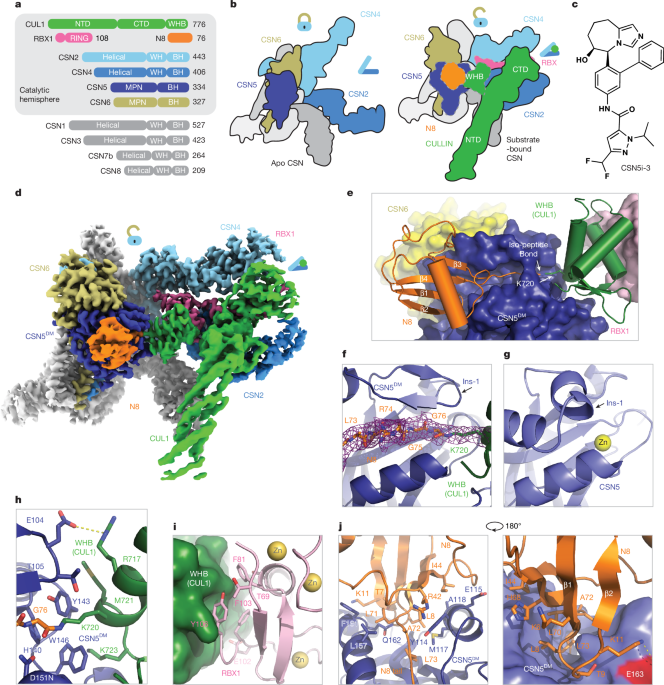
For the CSN5i-3–CSN structure, the PDB model 4D10 was fitted into the 3.3 Å CSN-CSN5i-3 electron microscopy map using Chimera39. The fitted model was used as the initial structure to rebuild the CSN complex. The CSN7a from 4D10 served as a template to trace the main chain, and the residue sequence was modified to match CSN7b in Coot40. For the flexible regions of CSN2 and CSN4, the PDB model was trimmed based on the density in Coot. The CSN5i-3 model from 5JOG was fitted into the 3.3 Å CSN5i-3–CSN EM map and refined using Phenix. For the CSN5i-1a-CSN structure, CSN5i-1b in PDB model 5JOH was modified on the basis of a CSN5i-1a SMILES file. The CSN model from CSN5i-3–CSN and CSN5i-1a was then fitted into the 3.0 Å CSN5i-1a-CSN electron microscopy map and refined with Phenix. For the CSN5i-3–CSN–N8~CRL1 model, the previous CSN-CSN5i-3 structure was used as the starting model. The CSN5–CSN6, CSN2 and CSN4 subunits undergo conformational changes upon binding to N8~CRL1. Their structural models were first split and then fitted into the 3.3 Å electron microscopy map. Residues were adjusted in Coot on the basis of sequence and side-chain density. The PDB model 1LDJ of CRL1 was fitted and manually adjusted in Coot. The iso-peptide bond was manually built in UCSF ChimeraX. For the CSN5i-3–CSN5–N8 structure, CSN5i-3–CSN and N8 from the PDB model 1XT9 were fitted into the EM maps and adjusted in Coot. The well-resolved density allowed us to model CSN5i-3 and the zinc ions. For the other CSNDM–N8~CRL complexes, the CSN5i-3–CSN–N8~CRL1 model was fitted into the electron microscopy map and adjusted in Coot. For the rest of the CRLs, the N8~CRL structures were automatically built using ModelAngelo41, combined with the docked CSNDM model then further refined manually in Coot. The final model was subjected to real space refinement in Phenix42. The iso-peptide bond between the N8 C-terminal glycine residue and the neddylation site lysine of CRLs was manually built and refined with Phenix. The structural figure panels were prepared with PyMol and UCSF ChimeraX.
DSSO cross-linking of the CSN–N8~CR1 complex
To assemble the CSN–N8~CRL1 complex in vitro for cross-linking, 7 µl of the purified CSN (6.8 μM) and 4.8 μl of N8~CRL1 (30 μM) complexes were mixed and incubated on ice for 10 s or 30 min. For the treated samples, CSN was first incubated with CSN5i-3 at a molar ratio of 1:10 for 30 min on ice before mixing with N8~CRL1. After incubation, the complexes were cross-linked with DSSO at a molar ratio of 1:100 (protein to linker) for 1 h at room temperature43. After quenching with 50 mM NH4HCO3 for 15 min, the cross-linked CSN–N8~CRL1 complexes were transferred onto a 30 kDa microcon and washed with 25 mM NH4HCO3. The proteins were reduced by 3.3 mM TCEP for 30 min and alkylated with 16.5 mM iodoacetamide for 30 min in dark. After washing with 25 mM NH4HCO3, proteins were reconstituted in 60 µl of 8 M urea in 25 mM NH4HCO3. Lys-C (enzyme to protein ratio of 1:100) was added to the solution and the mixture was incubated at 37 °C for 4 h. Urea was then reduced to 1.5 M for trypsin digestion (enzyme to protein ration of 1:50) at 37 °C overnight. The peptide digests were extracted, desalted by Sep-Pak C18 cartridge (Waters) and stored at –80 °C before TMT labelling.
TMT labelling and SEC-HpHt fractionation
Equal amounts of cross-linked peptides from each condition were labelled with 10-plex TMT reagents (Thermo Fisher Scientific) according to manufacturer’s protocol. Briefly, peptides (14.5 μg) were dissolved in 25 μl of 100 mM TEAB (pH 8.5). TMT reagents (0.8 mg) were dissolved in 41 μl of anhydrous acetonitrile (Sigma), and 3 μl of each TMT reagent was added to the corresponding aliquot of peptides together with 7 μl of anhydrous ACN. The reaction was incubated for 1 h with shaking and quenched with 5% hydroxylamine for 15 min at room temperature. The labelled peptides were pooled and dried using Speed-Vac. The dried samples were resuspended in 0.1% TFA buffer and desalted using Sep-Pak C18 cartridge and dried.
The TMT labelled peptides were dissolved in 30% ACN/0.1% TFA, mixed and fractionated on a Superdex 30 Increase 3.2/300 column with an Agilent 1260 Series HPLC. The two fractions containing inter-linked peptides (F23–25min, F25–27min) were collected for direct LC-MSn analysis or further HpHt separation44. For HpHt separation, each SEC fraction was dissolved in 160 µl of ammonia water (pH 10) and loaded onto a HpHt tip. Peptides were eluted with increasing percentage of ACN in ammonia water (6%, 9%, 12%, 15%, 18%, 21%, 25%, 30%, 35%, and 50%). The 25%, 30%, 35% and 50% fractions were combined to 6%, 9%, 12% and 21% fractions, respectively for LC MSn analysis.
LC MSn analysis
Cross-linked peptides were analysed by LC MSn using an UltiMate 3000 RSLC coupled with an Orbitrap Fusion Lumos mass spectrometer. Samples were loaded onto a 50 cm × 75 μm Acclaim PepMap C18 column and separated over a 180 min gradient of 4% to 25% acetonitrile at a flow rate of 300 nl min–1 (Jiao, 2022). Ions with charge of 4+ to 8+ in the MS1 scan were selected for MS2 analysis. The top 4 most abundant fragment ions in MS2 scan were selected for MS3 sequencing. The CID-MS2 normalized collision energy was 23%. For MS3 scans, CID was used with a collision energy of 35%. TMT quantitation on cross-linked peptides was accomplished using the Synchronous Precursor Selection MS3 method28.
Identification and quantitation of cross-linked peptides
MS3 spectra was extracted by PAVA (UCSF) and subjected to Protein Prospector (v.6.3.5) for database searching (using Batch-Tag against SwissProt human database, v.2024.08.05, 20,436 entries). The mass tolerances were set as ±20 ppm for parent ions and 0.6 Da for fragment ions. Trypsin was set as the enzyme with a maximum of three missed cleavages allowed. Cysteine carbamidomethylation and TMTplex at protein N-terminus were set as static modifications. A maximum of four variable modifications were also allowed: TMTplex at lysine, methionine oxidation, N-terminal acetylation and N-terminal conversion of glutamine to pyroglutamic acid. Three defined DSSO cross-linked modifications on uncleaved lysines—alkene (C3H2O, +54 Da), thiol (C3H2SO, +86 Da) and sulfenic acid (C3H4O2S, +104 Da)—were also selected as variable modifications. The in-house software XL-Tools was used to automatically identify, summarize and validate cross-linked peptides based on Protein Prospector database search results and MSn data43. Quantification values for cross-linked peptides were obtained from reporter ion intensities in Synchronous Precursor Selection MS3 scans28. These intensities were corrected for isotopic impurities of the different TMTplex reagents on the basis of the manufacturer’s specifications.
Affinity purification of CSN complexes
HEK293T cells expressing HBTH-tagged CSN2 and CSN6 were grown to about 90% confluence in DMEM medium containing 10% FBS and 1% Pen/strep32. The cells were treated with 1 μM CSN5i-3 or DMSO for 16 h. In-cell cross-linking was then performed using 0.025% formaldehyde for 10 min at 37 °C in PBS buffer31. The cells were then washed with PBS and lysed in a native lysis buffer containing 150 mM sodium chloride, 50 mM sodium phosphate, 10% glycerol, 1 mM ATP, 1 mM DTT, 5 mM MgCl2, 1X protease inhibiteo, 1X phosphatase inhibitor and 0.5% NP-40 at pH 7.5. The lysates were centrifuged at 13,000 r.p.m. for 15 min to remove cell debris, and the supernatant was incubated with streptavidin resin for 2 h at 4 °C. The bead-bound proteins were washed with 50 volumes of lysis buffer followed by 20 volumes of another buffer containing 150 mM NaCl, 25 mM Na2HPO4 and 5% glycerol, pH 7.6, and then cross-linked with 0.5 mM DSSO for 1 h at 37 °C. The cross-linked CSN complexes were reduced and alkylated then digested with LyC/Trypsin. The digested peptides were desalted with C18 tips before LC MS/MS.
Digestion of cell lysates
To examine protein abundance changes in cells during CSN5i-3 treatment, we digested 1 mg cell lysates from treated and untreated cells using a FASP protocol. Proteins were reduced, alkylated and digested on a 30 kDa microcon (Millipore). The digested peptides were desalted with Sep-Pak column before LC MS/MS.
LC MS/MS analysis for protein identification and label-free quantitation
For all LC-MS acquisitions, HPLC separation was performed on an UltiMate 3000 UHPLC (Thermo Fisher Scientific) using an EasySpray 50 cm × 75 μm I.D. Acclaim PepMap RSLC column heated at 45 °C and coupled on-line to an Orbitrap Fusion Lumos mass spectrometer (Thermo Fisher Scientific). Specifically, a 4–22% Buffer B gradient (Buffer A, 0.1% formic acid; Buffer B, 100% acetonitrile containing 0.1% formic acid) was run either over 57 min (1.5 h method) or 87 min (2 h method).
DDA-based analysis
The DDA-MS method for affinity-purified CSN complexes was 90 min and comprised an MS1 survey scan (375–1,800 m/z, 120,000 resolution at 200 m/z, automatic gain control (AGC) target = 4.0 × 10⁵, maximum injection time = 50 ms) followed by data-dependent MS/MS acquired in the linear ion trap with HCD NCE30 at top speed for 3 s. Target ions already selected for MS/MS were dynamically excluded for 30 s. MS2 scans were acquired in the linear ion trap using ‘Rapid’ mode with an AGC target of 2.0 × 10⁴ and a maximum injection time of 35 ms. Protein quantitation was performed using MaxQuant (v.2.0.3.0) against human proteome sequences from SwissProt database (20,418 entries; March 2025 version)45. The first search peptide tolerance was set to 15 ppm, with main search peptide tolerance set to 4.5 ppm. Both peptide spectrum match and protein false discovery rates were set at 1%, in razor peptide fashion. Trypsin was selected for the protease with up to one missed cleavage; no nonspecific cleavage was allowed. For protein quantitation, cysteine carbamidomethylation was set as a fixed modification, while methionine oxidation and N-terminal acetylation were selected for variable modifications, maximum of one per peptide. Intensities were determined as the full peak volume over the retention time profile. Intensities of different isotopic peaks in an isotope pattern were always summed up for further analysis. ‘Unique plus razor peptides’ was selected as the degree of uniqueness required for peptides to be included in quantification.
DIA-based analysis
The DIA-MS method for affinity-purified CSN complexes was 90 min and consisted of an MS1 survey scan followed by 33 MS2 scans using variable windows46. The MS1 scan range was set as 350–1,650 m/z with a resolution of 120,000 at 200 m/z. The AGC target value for the MS1 scan was set to 2.0 × 10⁶ with a maximum injection time of 50 ms. MS2 scans were acquired at a resolution of 30,000 (at 200 m/z), using HCD NCE30. DIA-NN (v.2.0.2) was used for all DIA analysis, including library generation, protein identification and quantitation47. The spectral library was generated using human proteome sequences from SwissProt database (20,418 entries; March 2025 version). Trypsin was set as the protease with one missed cleavage. N-term excision and cysteine carbamidomethylation were set as fixed modifications, whereas methionine oxidation was set as a variable modification with one max per peptide. The peptide length was set to 7–30 aa, with charge 2–4. The precursor false discovery rate was set to 1% for the output and proteins were quantified using the QuantUMS strategy48.
PRM-based targeted quantitative analysis
To generate the PRM target library for quantitation, peptide digests from affinity-purified CSN complexes were pooled and run using 2 h DIA-MS methods with the same settings as outlined above. The top 3 abundant peptide ions from the selected 126 proteins were chosen, with preference towards unmodified peptides and sequences identified without missed cleavages where possible. A total of 351 precursors from 126 proteins were selected and monitored across two 2 h acquisitions for cell lysate samples, with each peptide being scheduled within a 4 min window. The isolation window was set as 0.7 Da and Orbitrap resolution was 30,000 at 200 m/z. Transitions determined by DIA-MS analysis were quantified using Skyline (v.23.1.0.268)49. The peak areas of all transitions were summed for each peptide and then averaged to represent protein abundances. Final protein abundances were then averaged across biological replicates and compared between treated and control lysates. Two biological replicates were performed for each condition.
Validation of the selected CSN interactions by immunoblotting analysis
Affinity-purified human CSN complexes were separated by SDS−PAGE to validate the selected CSN interactions. Proteins were transferred to a PVDF membrane and analysed by immunoblotting. HBTH-CSN2 and HBTH-CSN6 were detected using a streptavidin−HRP conjugate (1:10,000), DDB2 was detected by using anti-DDB2 antibody (Thermo Fisher Scientific MA5-34832, 1:500 dilution), CUL4A was detected by using anti-CUL4A (Thermo Fisher Scientific PA5-14542, 1:1,000 dilution) and FBXO22 was detected by using anti-FBXO22 (Proteintech 13606-1-AP, 1:500 dilution).
Affinity pull-down analysis
Approximately 200 µg of purified CSN complex with His-Venus-tagged CSN5 was used as the bait. Venus-tagged N8 (wild-type and three mutants) were added at a 25:1 molar excess relative to CSN, either in the presence or absence of 10 µM CSN5i-3. The bait and binding partners were incubated together on ice at 4 °C for 2 h with gentle mixing. The reaction mixtures were then applied to 50 µl of Ni–NTA Sepharose resin and incubated with end-over-end rotation at 4 °C for 3 h. Beads were washed extensively with a binding buffer containing 20 mM Tris-HCl, pH 8.0, 150 mM NaCl and 10 mM imidazole. Bound complexes were eluted in 100 µl of an elution buffer containing 20 mM Tris-HCl, pH 8.0, 150 mM NaCl and 300 mM imidazole. Eluates were resolved by SDS–PAGE and the Venus signal was detected by in-gel fluorescence imaging.
Inhibition of iso-peptidase activity by CSN5i-3 and CSN5i-1a
The enzymatic activities of CSN and CSN5–CSN6 were determined by monitoring the amounts of the deneddylation product, N8 conjugated with the fluorescent dye CF633 and the reaction substrate, CF633–N8~CRL1. Twenty-microlitre reactions were performed in PCR tubes. Enzymes (recombinant CSN or CSN5–CSN6) were used at 2.0 nM (added at T = 0), and CF633–N8~CRL1 was used at 2 µM. CSN5i-3 was serially diluted threefold from 450 nM down to 0.062 nM. CSN5i-1a was serially diluted threefold from 100 µM down to 137 nM. Reactions at room temperature were stopped after 25 min by adding 8 µl of 4X SDS loading buffer containing Orange G, then heated for 5 min at 90 °C. Two tubes without inhibitor were designated as 100% activity, and one tube that contained SDS loading buffer before enzyme addition was considered 0% activity. The reaction products N8–CF633 and the CF633–N8~CRL1 substrate were separated on 4–15% mini-Protein gels (BioRad) at 250 V (67 mA) for 20–30 min. Fluorescence signals from CF633 were detected using an Odyssey CLX Imaging System (LICOR) in the 700 nm channel. All fluorescence signals were normalized to correct for loading variations. The Michaelis constant (Km) was determined for both CSN and CSN5–CSN6 with the CF633–N8~CRL1 substrate under the same buffer and reaction conditions. The substrate was serially diluted threefold from 1 µM to 0.021 nM. Fluorescence signals from CF633 were detected using the Odyssey CLX Imaging System (LICOR) in the 700 nm channel, and the enzyme rate versus substrate concentration was analysed using an enzymatic kinetic model in Prism (GraphPad).
Reporting summary
Further information on research design is available in the Nature Portfolio Reporting Summary linked to this article.

