


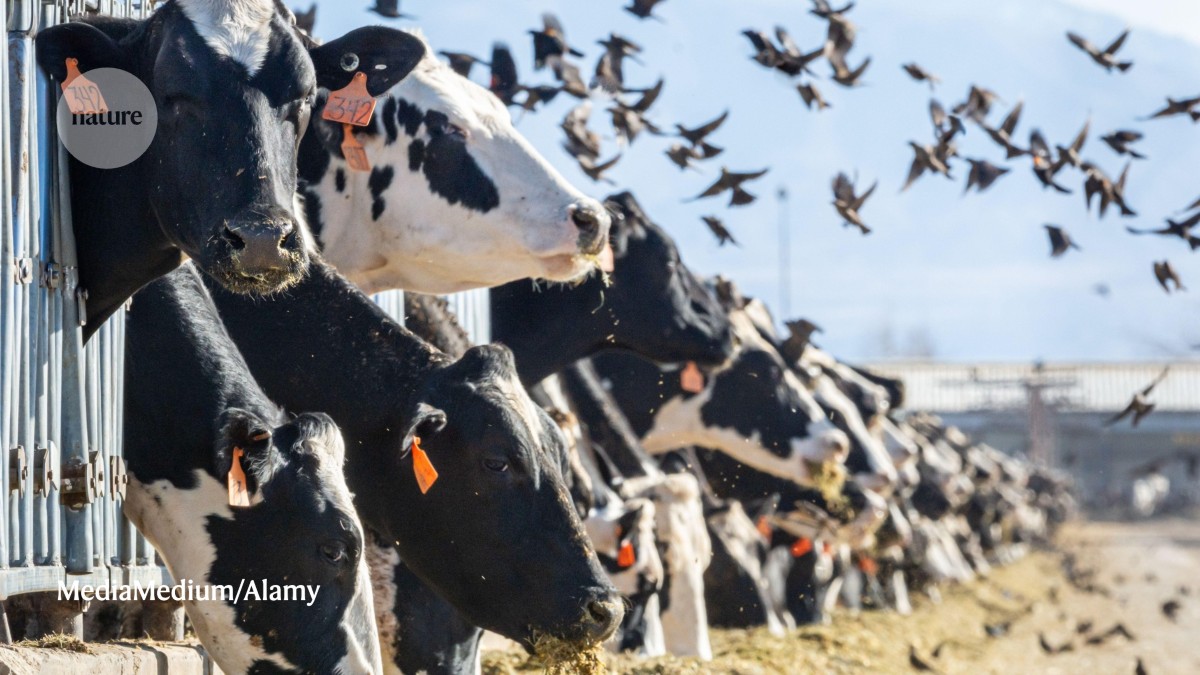

Dairy cattle throughout the United States have been infected with the H5N1 virus.Credit: MediaMedium/Alamy
In the southwestern United States in the early weeks of 2024, a large-animal veterinarian pulled up to a dairy farm on his usual rounds and was greeted by an odd absence. The barn cats who normally came trotting out to meet his truck were nowhere in sight.
Over the next few weeks, at dairies across Texas and New Mexico, cows started to get sick. They were losing their appetites and producing less milk than usual — and what little they did produce was thick and gluey. Deaths of birds such as crows and pigeons were also being reported. And then there were the barn cats. They were disappearing or dying suddenly, after becoming blind or unable to walk (see ‘Is a lack of curiosity killing the cats?’).
The bird and cat deaths were consistent with influenza — specifically, a type of highly pathogenic avian influenza (HPAI) known as H5N1 that had been circulating among wild birds and causing outbreaks on poultry farms across the country since early 2022. But H5N1 had never been known to infect cattle.

Nature Spotlight: Influenza
As the weeks went on, dairy veterinarians across the region compared notes, messaging back and forth and organizing conference calls. Affected cows were tested for dozens of likely diseases, but to no avail.
In late March 2024, milk samples from sick cows and tissue samples from barn cats that had died at a dairy in northern Texas were tested for avian influenza at the National Veterinary Diagnostic Laboratory in Ames, Iowa. The test was more to rule out the virus than anything else. “Nothing else was coming up positive,” says Meghan Davis, a veterinary epidemiologist at the Johns Hopkins Bloomberg School of Public Health in Baltimore, Maryland. But both species were positive for H5N1.
The results unmasked an outbreak of H5N1 in US dairy cattle that, by September 2025, had affected more than 1,000 herds across 18 states. That birds and cats played a part in the outbreak’s detection highlights the common vulnerabilities and intertwined fates of livestock, companion animals and wildlife species. In fact, the US dairy outbreak is only one element of a global H5N1 outbreak that has caused mass deaths among dozens of wildlife species and killed tens of millions of domestic poultry in the past several years.
Human deaths from H5N1 have been much rarer — the virus killed 12 people, globally, between January and August 2025. But there are fears that further evolution of the virus could spark a human pandemic. Arresting that possibility requires a public-health approach that recognizes the interdependency of human, animal and ecosystem health, known as the One Health perspective. But surveillance often fails to cover a broad enough variety of species in sufficient detail to keep tabs on the virus, researchers say.
Flu on the wing
For at least the past 20 years, scientists have known that influenza surveillance in birds is key to monitoring pandemic risk. Wild birds harbour just about every one of the almost 150 possible subtypes of influenza A, the form of the virus that causes human pandemics.

Large numbers of terns were found dead on beaches in South America.Credit: Marcela Uhart, University of California, Davis
Influenza has a segmented genome, making it easy for new strains to emerge when birds congregate in large numbers. “Everybody has their different viruses with all their pieces that can swap around like Lego bricks,” says Wendy Puryear, a virologist at Tufts University School of Veterinary Medicine in North Grafton, Massachusetts. This is especially true for breeding grounds at high latitudes, where birds’ migratory ‘flyways’ converge.
Influenza can spill over from wild birds to domestic flocks. The bigger the global poultry industry gets, the more often this happens — and the more likely it is that the virus will evolve into HPAI, which refers specifically to the impact on domestic poultry. (Whether HPAI viruses cause severe illness in other species, including humans, is unclear.) More than 50 HPAI strains have emerged since the first such virus was isolated in Scotland in 1959. Most have been stamped out quickly by mass culling of infected poultry flocks.
The H5N1 lineage that led to the current global outbreak is an exception. It emerged among domestic geese in Guangdong, China, in 1996. The following year, six people died from the virus after visiting live poultry markets in Hong Kong — the first avian influenza fatalities reported in humans. For about a decade, the virus was mostly confined to eastern China, where it was passed back and forth between wild and domestic waterfowl that mingled in the same ponds. Then, in 2005, it killed around 1,500 wild birds near Qinghai Lake in western China. Over the next few months, migratory flyways brought it to Russia, Europe, the Middle East, Africa and India.
These events triggered a focus on influenza surveillance in wild birds globally, says Thijs Kuiken, a veterinary pathologist at Erasmus University in Rotterdam, the Netherlands. “People realized that now, wild animals were carrying the virus to new places, so they need to be studied.” Initially, the goal was to protect the poultry industry and to prevent occasional human infections, Kuiken says. But in the early 2020s, the rapid global spread of a new form of the virus, known as clade 2.3.4.4b, laid bare the need for a much more comprehensive approach.
This virus caused mass deaths among European seabirds in 2020. It then jumped to North America in late 2021. By late 2022 it had reached South America; in early 2024, it landed in mainland Antarctica.
H5N1 is “going into a much broader range of wild birds than other forms of influenza have in the past”, Puryear says. Previously, the virus mostly affected waterfowl and seabirds. But now it has been reported in more than 500 species of wild birds across a variety of taxonomic groups, from songbirds to raptors.
It has also infected at least 80 species of mammals, producing sustained mammal-to-mammal transmission in several instances, including among mink (Neovison vison) at a fur farm in Spain, southern elephant seals (Mirounga leonina) in South America, and dairy cattle in the United States. “There are multiple alarm bells going off,” says Martha Nelson, a computational biologist at the US National Center for Biotechnology Information in Bethesda, Maryland, who works with influenza genome sequences.
Cattle contagion
Alarm bells also rang for Maggie Baldwin, the Colorado Department of Agriculture’s state veterinarian, one day in July 2024. The state’s poultry industry had been hit hard over the previous two years by H5N1, and the dairy outbreak had arrived in Colorado herds in late April. On that July day, she got word that the virus had spilled over from a dairy facility to a poultry operation in the state for the third time.

Barn cats have been affected by the H5N1 outbreak.Credit: DS70/Getty
H5N1 is disruptive to dairy operations, but most infected cattle recover after a few weeks. For poultry farmers, however, the virus is ruinous. It is so swiftly lethal to domestic flocks that all birds on site must be culled when the virus is detected. In Colorado, dairy-to-poultry spillovers resulted in the culling of 3.2 million birds in July 2024.
“I said, ‘We need to make a change — we really need to have a better handle on where the virus is,’” Baldwin recalls. She implemented a strategy that several states had been discussing: weekly testing of samples from bulk milk tanks.
The approach builds on existing procedures to test milk for antibiotics and bacterial contamination. It enables detection of infected herds before cows start to show symptoms, giving farmers more time to implement quarantine and other measures to make sure that the virus does not spread from the farm.
About a dozen infected herds were discovered in the weeks after bulk-tank testing began, but no new infections have emerged since mid-August 2024. As of late July 2025, Colorado’s dairy herds remain free from H5N1. Davis calls bulk-tank testing “one of the best success stories” of H5N1 surveillance. Indeed, the US Department of Agriculture began requiring it nationally in early December 2024 — and by August 2025, through this and other measures, the number of affected states had contracted to six.
But on-farm surveillance alone cannot eradicate the virus from agricultural operations. In early 2025, two fresh spillovers from wild birds into dairy cattle were identified in Nevada and Arizona. H5N1 also continues to periodically pass from wild birds into poultry in the United States and elsewhere.
Wild-bird surveillance has so far provided much of the information about H5N1 risk for agricultural operations. If officials know that a virus-carrying flock of migratory waterfowl is moving through an area, for example, “then you can put out an alert to producers that this is a high-risk period”, says David Swayne, a poultry veterinarian in Watkinsville, Georgia, and former head of HPAI research at the US Department of Agriculture.
But these efforts leave many questions unanswered about how H5N1 gets onto farms in the first place and to what extent vectors other than birds are responsible. Researchers have suggested that rodents, flies and even gusts of wind could also be spreading viral outbreaks.

