


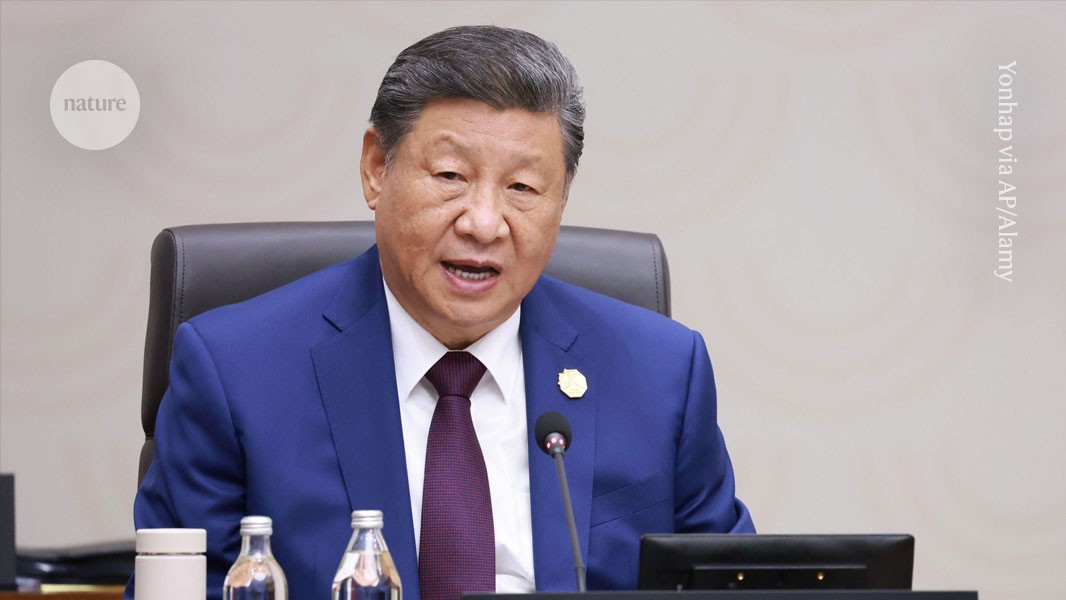

Chinese president Xi Jinping speaking at the 2025 Asia-Pacific Economic Cooperation meeting in Gyeongju, South Korea.Credit: Yonhap via AP/Alamy
Despite risks ranging from exacerbating inequality to causing existential catastrophe, the world has yet to agree on regulations to govern artificial intelligence. Although a patchwork of national and regional regulations exists, for many countries binding rules are still being fleshed out.
In October, at a meeting of the Asia-Pacific Economic Cooperation forum, Chinese President Xi Jinping reiterated his country’s proposal to create a body known as the World Artificial Intelligence Cooperation Organization (WAICO), which would bring nations together as a step towards creating a global governance system for AI.

China seeks self-reliance in science in next five-year plan
The proposal is part of a wider drive to be at the helm of efforts to govern AI, in contrast to a US approach that is focused on deregulation. When it comes to transparency and AI policy, “China is the good guy at the moment,” Wendy Hall, a computer scientist at the University of Southampton, UK, told reporters at an event in London in October.
Many hurdles lie in the way to creating a binding intergovernmental agreement on AI, but some advocates say it is possible, comparing the technology to other risky but useful endeavours for which agreements exist, such as nuclear power and aviation. Nature looks at China’s approach, what a global AI governance body might look like and its chance of success.
How does the Chinese AI ecosystem differ from those of other countries?
Encouraged by the government, Chinese firms tend to release models as open weight, meaning that they can be downloaded and built on. And compared with Western nations, China has less of a focus on making machines that could outsmart humans — often referred to as artificial general intelligence — and is instead concentrating on a race to use AI to drive economic growth. This is exemplified by a policy introduced in August called AI+, says Kwan Yee Ng, who leads international AI governance at Concordia AI, a Beijing-based consultancy that focuses on AI safety.
How does China approach AI regulation?
China was among the first nations to introduce AI-specific regulations, beginning in 2022, and has wide-ranging rules on harmful content, privacy and data security, for example. Developers of public-facing AI-powered services must let Chinese regulators test their systems ahead of deployment, says Ng. The result is that models such as those developed by the Hangzhou-based company DeepSeek, which found world fame with its R1 model earlier this year, are among “the most regulated in the world”, says Joanna Bryson, a computer scientist and researcher in AI ethics at the Hertie School in Berlin. Despite this, the authorities often take a soft approach to enforcing that regulation, says Angela Zhang, a law researcher and specialist in AI regulation at the University of Southern California in Los Angeles.
By contrast, the United States has no comprehensive legislation on AI at the federal level, and in January President Donald Trump revoked an executive order aimed at ensuring AI safety. He has positioned his administration as pro-industry, last month suggesting in a social-media post that it would add a clause to a federal bill to prevent states from regulating AI. The European Union approach has been to classify AI systems by risk level, with different rules relating to transparency and oversight at each tier, and obligations that came into force in August, aimed at the most powerful AI systems. The UK government, meanwhile, has shelved plans to introduce comprehensive AI legislation until next year, at the earliest.
What international legislation exists to govern AI?
Very little. The only legally binding international regulation comes from the Council of Europe, an international organization of European member states, separate from the European Union, which established its Framework Convention on AI in May 2024. The treaty y commits any signatory country to implementing its broad obligations — such as ensuring that AI activities align with human rights — through their national laws. But there are no sanctions or a supranational enforcement body, says Lucia Velasco, an economist and researcher at the Oxford Martin School’s AI Governance Initiative, who is based in New York.
Companies and nations have also signed various non-binding agreements, such as the UNESCO Recommendation on the Ethics of Artificial Intelligence, the OECD AI Principles and the Bletchley Declaration, an international agreement signed by 28 countries at the UK AI Safety Summit in 2023. Several expert groups have produced documents outlining the risks, one of the most prominent being the International AI Safety Report. The United Nations (UN) is running a ‘dialogue’ process and has created a scientific panel to guide countries’ regulatory efforts.
What has China proposed?
WAICO would be a way for countries to coordinate AI governance rules while “fully respecting the differences in national policies and practices” and championing the global south, Chinese officials have said. China has proposed that the body’s headquarters be in Shanghai, but other details remain uncertain.
WAICO looks unlikely to govern AI directly in any enforceable way (and China has said it backs a UN approach to governing global AI) but it could be a route for countries to gradually coalesce around a framework.
Xi’s call to create WAICO was at least the fourth such push from a Chinese official in four months, suggesting the idea is important to the government, says Ng. One reason is commercial, says Zhang. “The fact that China is able to set standards helps China’s product diffusion all over the world,” she says.
The move also gives China some diplomatic cachet. “China is trying to be like [an older] brother to the global south, arguing ‘we also need to have our voice in the governance of AI and not be dictated to’,” says Zhang.

