


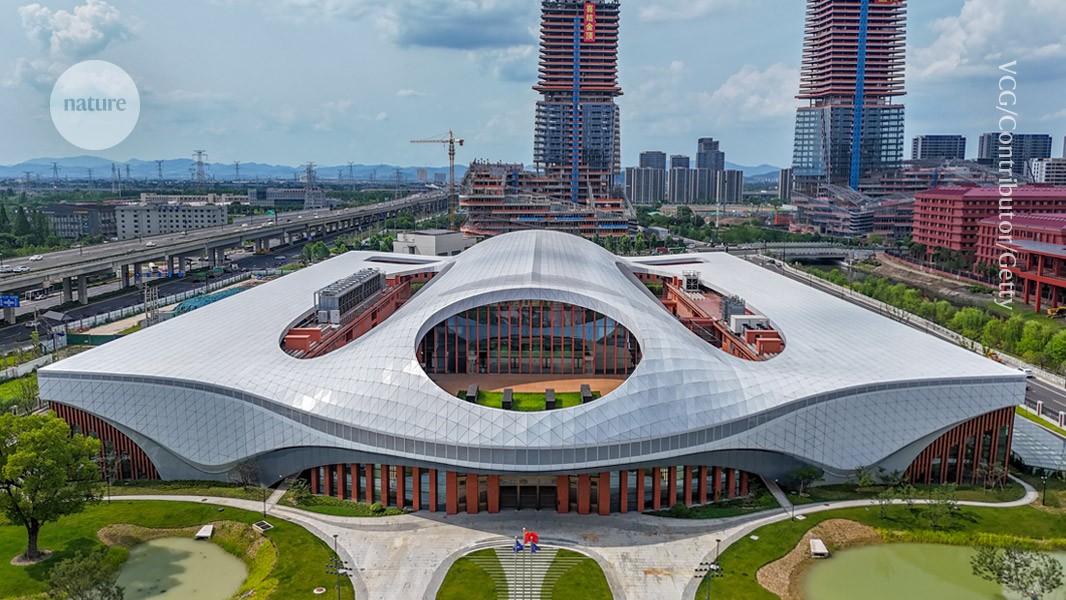

The Centrifugal Hyper-gravity and Interdisciplinary Experiment Facility in Hangzhou is one of several major science infrastructure projects to be funded by China’s national government.Credit: VCG via Getty
China is on the cusp of becoming the world’s biggest public funder of research, according to a forecast by US academics, as stalled growth in government investment in the United States coincides with consistent rises in spending by the Chinese authorities.
The analysis — produced exclusively for Nature Index — was the work of researchers from Frontiers in Science and Innovation Policy (FSIP), a programme at the University of California, San Diego, that studies the US research and development (R&D) system and examines the extent to which public and private funding boost technological development.
Government spending on R&D in China increased by 90% to US$133 billion in the decade leading up to 2023, according to the most recent purchasing-power-adjusted data from the Organisation for Economic Co-operation and Development (OECD). By contrast, in the United States, spending rose by just 12%, to $155 billion.
According to the FSIP’s forecast, China’s public spending on research is likely to overtake that of the United States in the next two to three years.
“I think the earliest likely is 2028, plus [or] minus one year,” says Robert Conn, a specialist in research policy and science philanthropy, who co-leads the FSIP. “It could be next year, could be 2029.”
The United States has been the global leader in R&D investment since the end of the Second World War. China taking the lead in public research spending would therefore be a watershed moment. It would set the scene for the emergence of a new “hegemon” in science, says Meghan Ostertag, who studies economic policy at the Information Technology and Innovation Foundation, a think tank in Washington DC.
In the past few years, China has already pulled ahead of the United States on various measures of research performance. In the 145 natural-science and health-science journals tracked by Nature Index, for instance, its contribution is on track to be double that of the United States by the end of 2026.
The FSIP projection is, in some ways, conservative. It predicts that US research spending will remain flat, despite efforts by the administration of President Donald Trump to cut research budgets. At the same time, it incorporates a slowdown in Chinese research spending earlier in this decade, explains Christopher Martin, president of the non-profit organization Explorative Science Foundation in Christchurch, New Zealand, who worked on the analysis for the FSIP.
Martin looked at the growth trajectory in spending from 2020 to 2023 and used that to extrapolate forwards. The annual growth rate of China’s government spending was between 1% and 5% after 2020, compared with an average of 11% between 2005 and 2020.
“My best guess is that the 2020 pandemic made policymakers more conservative,” he explains, “which was then exacerbated by the Chinese property-sector crisis beginning in 2021.” If he had gone back further, China’s upward trajectory “might have been a little more steep” (see ‘Crossover point’).
Earlier this month, the Chinese government announced proposals for the country’s total annual research spending, from all sources, to increase by at least 7% per year for the coming five-year period from 2026 to 2030.
Yutao Sun, a specialist in innovation policy at Dalian University of Technology in China, thinks that the government’s research spending might increase even more, which would bring the crossover point with the United States even closer.
Fundamental research
In terms of spending on fundamental research, China still has a long way to go. Its overall 2023 expenditure in this area, from both private and public sources, was $53 billion — less than half that of the United States, which stood at $120 billion, according to the most recent purchasing-power-adjusted data from the OECD.
Yet Chinese government spending on fundamental research more than tripled between 2013 and 2023, whereas it increased by just over half in the United States, when comparing data on central and regional government expenditure from the Chinese Ministry of Finance and the US National Center for Science and Engineering Statistics.
In the United States, the FSIP expects overall funding for fundamental research agencies, such as the National Science Foundation and the National Institutes of Health, to be broadly flat this year as the US Senate pushes back on cuts requested by the Trump administration.
However, over the coming years, the FSIP team thinks that government spending on fundamental research in the United States is likely to decline in real terms, and that Congress will be unable to fully push back against cuts requested by the White House. This puts China on track to surpass the United States in this area “within a decade”, according to Conn.
Because fundamental research sits at the beginning of the development process, it represents the “seed corn that will provide the innovations and discoveries a decade from now”, explains Conn. “That’s where we’re really going to falter, and that’s where the biggest changes tend to occur.” (See ‘Fundamental gap’.)
Broader goals
China’s increased focus on fundamental and applied research is part of a “grander strategy” by the Chinese government to be a world leader economically and politically, says Ostertag. “I think years and years ago they saw that technology and science was the way to do that, and I think the rest of the world is realizing that now.”
Sun cautions that the FSIP analysis is based on OECD data adjusted by purchasing power, which takes into account the fact that goods and services in China are cheaper than they are in the United States, meaning that money goes further. Sun says that the analysis might be overstating Chinese research spending as a result, because items such as scientific equipment and journal access are often purchased on the international markets.
But if there is any slowdown in government spending on research in the United States, it might have long-term implications for business growth. A 2024 analysis by the Federal Reserve Bank of Dallas in Texas estimates that public funding has accounted for one-fifth of the growth in US business-sector productivity since the Second World War, because it spurs private research spending and increases innovation.

