


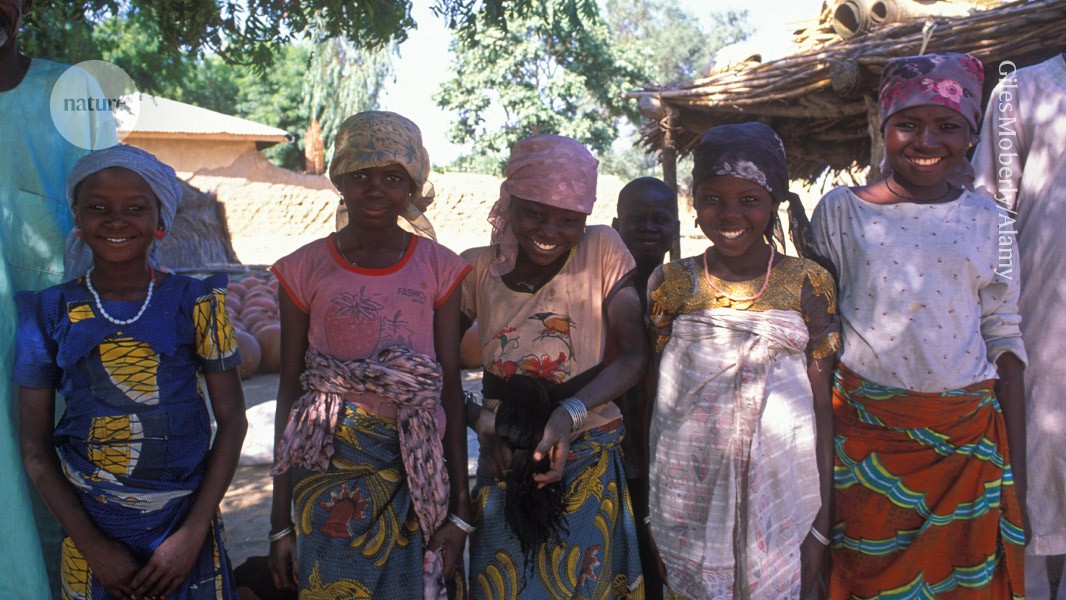

Credit: Giles Moberly/Alamy
An educational programme for young girls in northern Nigeria that involved local religious leaders massively reduced the number of child marriages, a study reported in Nature today has found1.
Nearly 80% of girls in northern Nigeria get married before they turn 18. Most of those who get married are already out of school or stop attending after marriage.
A project developed by Daniel Perlman, a medical anthropologist at the University of California, Berkeley, and implemented by the Centre for Girls Education (CGE), in Abuja, is working with community leaders to encourage girls to stay in school and, as a consequence, to delay marriage. Now, a study involving more than 1,000 girls by Perlman and his colleagues suggests that the strategy is working.
Co-author Maryam Abubakar at CGE says that the success of the programme, which is called Pathways to Choice, had a lot do to with the involvement of local religious leaders. “We had meetings with them, we introduced the project and we were lucky that they accepted it,” she says. “They were involved in the programme from the beginning.”
‘Widespread and severe’
Some 41% of women under the age of 35 in northwestern and northeastern states have ever attended school. Reasons why families might not enrol their daughters in school and instead opt for early marriage include scepticism about education quality and fear of violence. Nearly 1,700 schoolchildren have been kidnapped in Nigeria since 2014.
“There’s a lot of insurgents, bandits and terrorists, and sometimes they capture single girls,” says Olubukola Omobowale, a community physician and global mental-health specialist at the University of Ibadan in Nigeria. “Families believe that, if the girl gets married early, then the husband can protect her.”
Ending child marriage — defined as formal marriages or informal unions involving a child under the age of 18 — is one of the United Nations Sustainable Development Goals. It is illegal in Nigeria according to the country’s Child Rights Act. But several states, all in northern Nigeria, have not adopted the act. These states use the Islamic legal system, or Sharia, for both civil and criminal law. In those states, many people aren’t even aware of the law, says Omobowale.
The rates of child marriage in northern Nigeria, where 48% of girls are married before the age of 15, are much higher than in the rest of the country. “Child marriage in this setting is what I would call both widespread and severe,” says co-author Isabelle Cohen, an economist at the University of Washington in Seattle.
In the first year of the programme, out-of-school girls were offered accelerated learning in reading, mathematics, life skills and business skills in ‘safe spaces’ dedicated to them. In the second year, the emphasis was on ensuring that the girls return to school. Parents were helped with the costs of school fees and uniforms, and girls continued to have access to tutoring and mentoring in the safe spaces, which were like after-school clubs. Those who did not return to school were offered vocational training to work in local shops.
Back to school
What is new about this approach is that the researchers tested its effectiveness in a randomized control trial. The researchers enrolled 1,181 adolescent girls from 18 communities in the states of Borno, Kaduna and Kano who were both out of school and unmarried at the start of the programme. The communities were divided into nine pairs: one community of each pair participated in the programme while the other did not. The involvement of local leaders helped the programme to recruit almost all of the girls that met the inclusion criteria in each community, Abubakar says.

A classroom at Kuriga school in Kaduna state, pictured on 8 March 2024, a day after 250 pupils were kidnapped by gunmen.Credit: Haidar Umar/AFP via Getty
The trial took place between 2018 and 2020, and participants were surveyed at the beginning and at the end of the programme. By the final survey, 79% of the girls participating in the programme were still unmarried, versus about 14% in the group that did not participate. This corresponds to an 80% decrease in the likelihood of marriage during the study period, the researchers say.

