


You have full access to this article via your institution.
Hello Nature readers, would you like to get this Briefing in your inbox free every day? Sign up here.

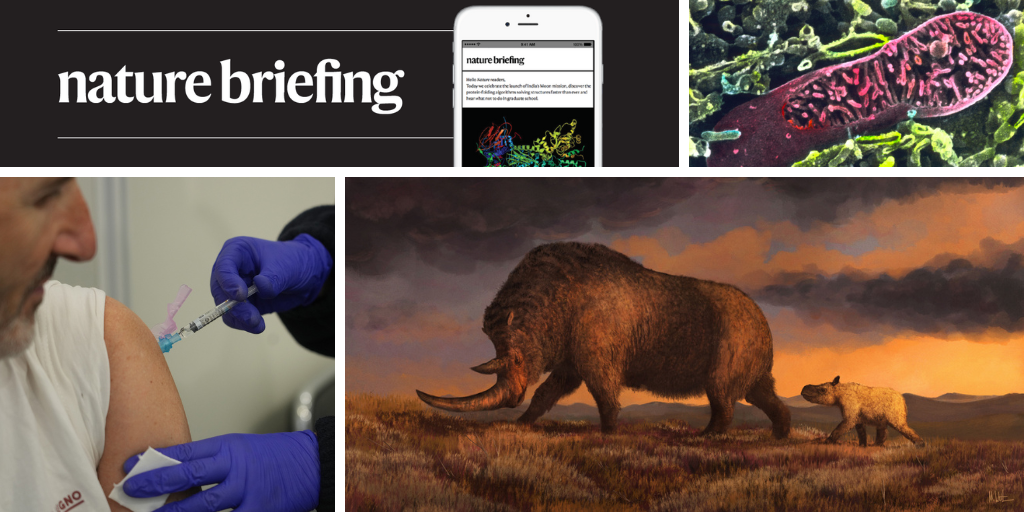
Mitochondria — tiny cellular energy factories — can move from one cell to another in a process called mitochondrial transfer. (Professors P. Motta & T. Naguro/Science Photo Library)
Cancer cells use mitochondria stolen from immune cells to escape detection and spread. Researchers found that when cancer cells take on these mitochondria in mice, it both weakens the immune cells and triggers a molecular pathway in the cancer cells that help them fly under the immune system’s radar and invade lymph nodes. This beneficial molecular pathway was activated even when researchers disrupted the mitochondria’s ability to produce the energy-carrying molecule ATP. The findings could explain how cancer cells survive in lymph nodes, which are packed with immune cells that should be able to kill them.
Reference: Cell Metabolism paper
A genomic analysis of around 14,400-year-old woolly rhino (Coelodonta antiquitatis) tissue — recovered from the stomach of an ice age wolf (Canis lupis) — has revealed clues as to the cause of the species’ rapid extinction around 14,000 years ago. Researchers compared the animal’s genetic diversity to genomes belonging to older woolly rhino samples and found no evidence of inbreeding, which suggests the species’ downfall was not a long, gradual process. The team instead proposes that a warming climate destroyed the rhinos’ habitat, which caused a swift population collapse.
Reference: Genome Biology and Evolution paper
In many parts of the world, the 2025–26 flu season started earlier and has accelerated faster than in previous years. Scientists suspect that a newly dominant strain of the influenza virus, H3N2, is behind this surge in cases. This strain has several key mutations that differentiate it from the strain used in this year’s vaccine, which might make it easier for the virus to shrug off the immune protection the jab confers. Population immunity to this strain was relatively low when this flu season began because H3 flu viruses haven’t circulated much in the last few seasons.
Genes that protect the body against infection during youth can do harm in old age, according to a study in mice. Researchers found that a gene called Foxo1 helped to protect heart tissue from damage during sepsis — a condition in which the immune system overreacts to an infection — but only in young mice. In old mice, the same gene caused the tissue to atrophy and die in response to bacteria-induced sepsis. The study shows that “the mechanisms that are protective to organs really can differ dramatically” with age, says immunologist Andrew Wang.
Climate change
Last year has been confirmed as the third-warmest year on record by the European Union’s Copernicus Climate Change Service and US research organization Berkeley Earth — despite the return of cooling La Niña weather phenomenon. “The warming spike observed in 2023 to 2025 has been extreme, and suggests an acceleration in the rate of the Earth’s warming,” said Berkeley Earth in its report. Burning fossil fuels remains the main cause, but the situation is probably being made worse by hot seas and changes in cloud patterns caused by warming, and (ironically) the cleaning up of sun-shading air pollution.
And the global average temperature over the past three years has surpassed 1.5 ℃ above pre-industrial levels — an increase that nations pledged in the 2015 Paris Agreement to prevent. It is “hard to describe just how serious the risks to humanity are, as we rapidly take ourselves out of the climate our entire agriculturally based civilization is based on,” says atmospheric scientist John Marsham.
France 24 | 4 min read & Financial Times | 4 min read (free registration required)
Reference: Copernicus Climate Change Service report & Berkeley Earth report

Features & opinion
Journal clubs, in which early-career scientists gather to get to grips with the literature in their field, can easily get caught up in ripping papers to shreds with criticism, writes evolutionary ecologist and entomologist Stephen Heard. As he recalls, “by the time we’d done we’d completely dismembered the paper; nobody thought it had any scientific value; and the smell of our smug satisfaction tinged the air six labs down the hall. Looking back, I’m thoroughly embarrassed.” He offers advice on how to avoid making the same mistake by focusing on a paper’s value and the lessons it offers.
Scientist Sees Squirrel personal blog | 9 min read
Three writing instructors share their top tips to help graduate students make the process of writing papers easier and overcome the ‘fear of the blank page’:
• Set concrete goals, broken down into smaller, tangible steps, to map out what the full writing process entails.
• Draw up a realistic writing schedule and commit to it as you would other professional obligations.
• Celebrate successes, large or small, to make writing enjoyable.
• Write as you go through a project to chip away at it in smaller chunks.
Today I’m hoping I haven’t stopped growing. I’m an average-ish height, but I can’t help but feel a couple of extra inches wouldn’t go amiss. My hope is renewed now that I know Tyrannosaurus rex didn’t reach its full size until around 40 years old — 15 years later than scientists previously thought.
I still have a few years before I reach 40, so here’s hoping I’m on the same growing schedule as the T. rex.
Help this newsletter grow by sending your thoughts and feedback to [email protected].
Thanks for reading,
Jacob Smith, associate editor, Nature Briefing
With contributions by Flora Graham
• Nature Briefing: Careers — insights, advice and award-winning journalism to help you optimize your working life
• Nature Briefing: Microbiology — the most abundant living entities on our planet — microorganisms — and the role they play in health, the environment and food systems
• Nature Briefing: Anthropocene — climate change, biodiversity, sustainability and geoengineering
• Nature Briefing: AI & Robotics — 100% written by humans, of course
• Nature Briefing: Cancer — a weekly newsletter written with cancer researchers in mind
• Nature Briefing: Translational Research — covers biotechnology, drug discovery and pharma

