


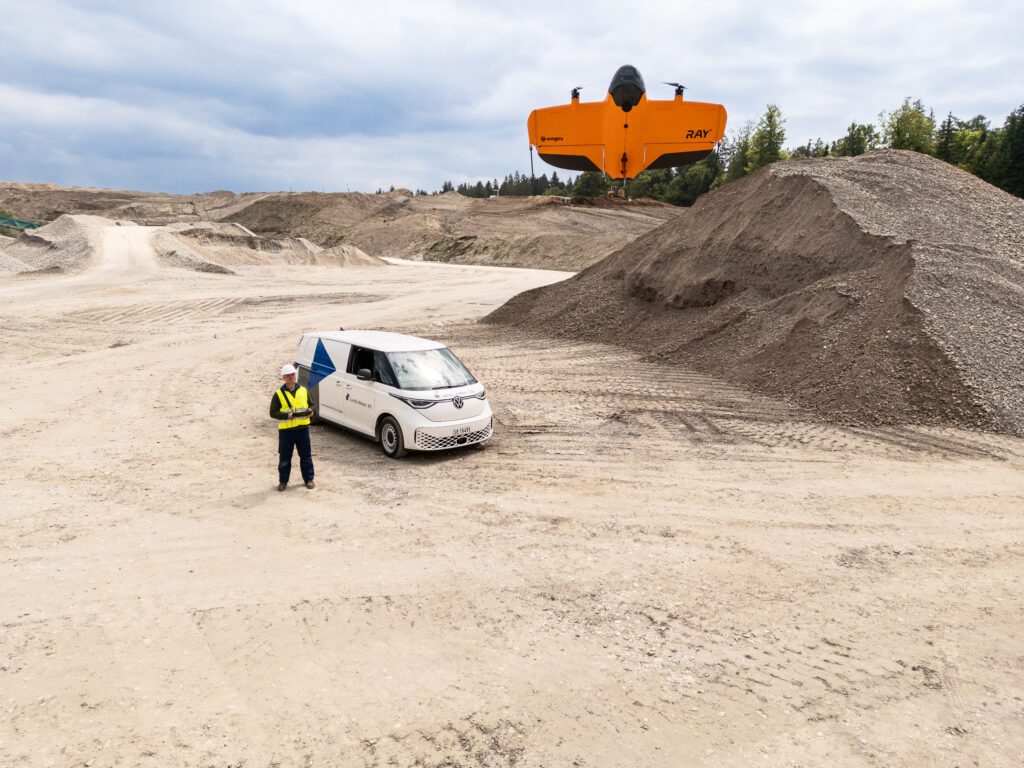
New Study Explores When Drone Mapping Can Reduce Ground Setup
A new white paper from Swiss drone manufacturer Wingtra takes on a long-standing question in drone surveying: is it possible to achieve survey-grade accuracy without ground control points (GCPs)?
The report, Repeat Accuracy Verification, presents results from 102 drone flights designed to test both accuracy and repeatability using checkpoints alone.
The findings suggest that, under the right conditions, drone workflows may be able to reduce reliance on GCPs—without sacrificing accuracy.
Sub-3 cm Accuracy Without GCPs
Across five test sites in Switzerland, the study recorded mean horizontal accuracy of under 1 cm and vertical accuracy around 1.4 cm. In 95% of cases, results stayed within a 2-sigma range below 3 cm.
Notably, these results were achieved without using GCPs to adjust the data. Instead, checkpoints were used solely to verify accuracy.
The study also found that repeat flights produced consistent results. Comparisons between digital surface models showed differences below 3 cm across stable terrain, supporting use cases like earthworks tracking and change detection.
Accuracy Still Depends on Workflow
The white paper makes clear that reducing ground points does not mean eliminating rigor.
One key factor is GNSS correction quality. The distance between the drone and its correction source can directly impact accuracy, with an additional 1–2 cm of error introduced for every 10 km of baseline distance.
In practice, this means reliable correction data, such as a nearby base station, remains essential.
The report also outlines when different approaches make sense:
- Checkpoints only: repeat surveys, volumetrics, and monitoring workflows
- Mixed GCP and checkpoint workflows: complex terrain or strict accuracy requirements
- No ground points: lower-accuracy or time-sensitive missions
A More Flexible Approach to Ground Control
Rather than replacing GCPs entirely, the study points toward a shift in how they are used.
For many applications, especially repeat surveys, reducing ground setup could improve efficiency and safety. At the same time, more complex projects will still require traditional control methods.
The full white paper provides detailed methodology, site-level results, and best practices for implementing these workflows in the field.
For surveyors and drone professionals, it offers a deeper look at how advances in GNSS and payload design are changing expectations around accuracy: and where ground control still plays a critical role.

Miriam McNabb is the Editor-in-Chief of DRONELIFE and CEO of JobForDrones, a professional drone services marketplace, and a fascinated observer of the emerging drone industry and the regulatory environment for drones. Miriam has penned over 3,000 articles focused on the commercial drone space and is an international speaker and recognized figure in the industry. Miriam has a degree from the University of Chicago and over 20 years of experience in high tech sales and marketing for new technologies.
For drone industry consulting or writing, Email Miriam.
TWITTER:@spaldingbarker
Subscribe to DroneLife here.

