


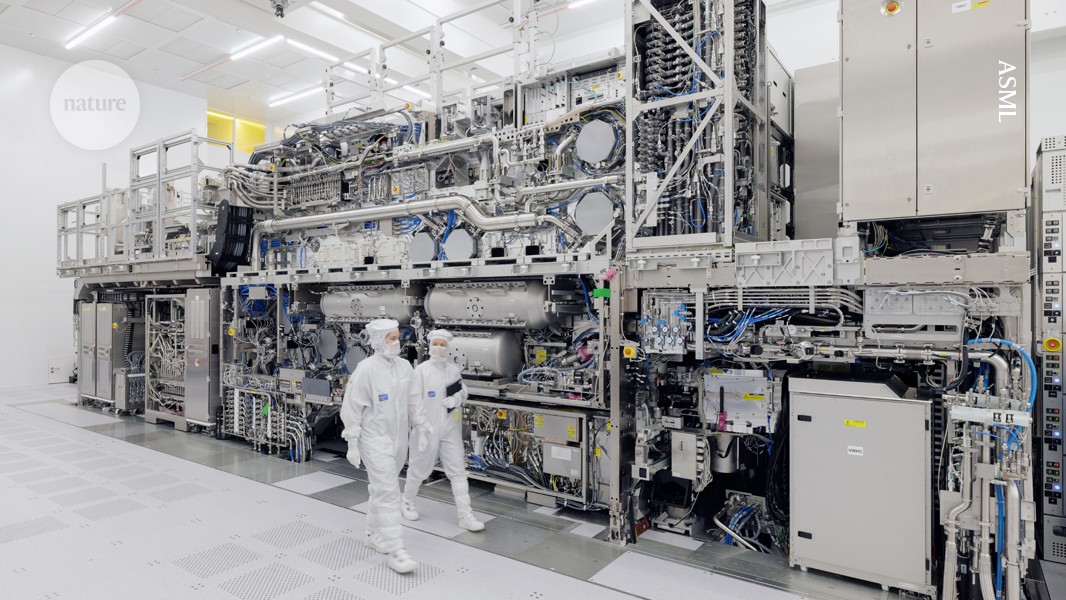

This chip-patterning system uses extreme ultraviolet light to ‘paint’ patterns on silicon wafers.Credit: ASML
A powerful light source bigger than a London double-decker bus has set a record: it can create structures on a silicon wafer that are just 8 nanometres (nm) wide. Those are thought to be the smallest ever made in a single step by a commericial chip-patterning system. According to the system’s manufacturer, it could be used to make computer chips patterned with 2.9 times more transistors than chips produced with the previous generation of the light sources used for this purpose.
The device projects extreme ultraviolet (EUV) light through a patterned ‘mask’ onto the surfaces of silicon wafers coated with light-sensitive chemicals. In response to the light, the chemicals harden in the same pattern. The wafer is then chemically etched, and the process repeated, to produce all of the electric components of the chip, including tiny switches called transistors and the extremely fine wiring that connects them.

How cutting-edge computer chips are speeding up the AI revolution
This process, called EUV lithography, is not new. But the record-setting model has extra-powerful optics that can make smaller transistors. Cramming ever-more and tinier transistors into a chip of a given area enables progress in computing. Chips with more transistors could also help artificial-intelligence data centres to run more computations without using more electricity.
The unprecedented system was described at the SPIE Advanced Lithography + Patterning conference in San Jose, California, in February1. The advances were presented by a representative of the system’s manufacturer, ASML, which is headquartered in Veldhoven, the Netherlands.
The company has sent about ten of these EUV devices, which cost about US$400 million, to its customers, including chipmakers Intel and SK hynix. These companies will use the machines to create their next generation of chips, says Maarten Voncken, head of research metrology at ASML. Thanks to the AI boom, says Voncken, “the demands we see are monumental in the number of chips that are needed and the scaling that is needed”.
Pushing Moore’s law
The high-performance computer chips used in mobile phones and the data centres powering the AI boom have features crafted with nearly atomic-scale precision. A guiding principle of the chip industry called Moore’s Law dictates that the number of transistors on a chip should double roughly every two years. It’s not a law of nature, but it has held true thanks to the tremendous efforts of engineers and physicists. But it’s getting harder to keep up with Moore’s law, even as AI creates a demand for ever-faster chips.
Improvements in lithography systems can help. The shorter the wavelength of light, the smaller the features that can be etched onto a wafer. The properties of the light-handling systems are also important. Systems with higher values of a unitless property called numerical aperture can emit light over a broader range of angles. This results in better image contrast and therefore higher resolution, meaning chipmakers can use these systesm to pack higher densities of transistors onto chips.
From lunatic fringe to data centres
The lithography tools used in the 1990s and into the 2000s used deep ultraviolet light with a wavelength of 193 nm, the shortest wavelength that can be directed using the types of lens found in eyeglasses and binoculars.

Nanomaterials pave the way for the next computing generation

