


You have full access to this article via your institution.
Hello Nature readers, would you like to get this Briefing in your inbox free every day? Sign up here.

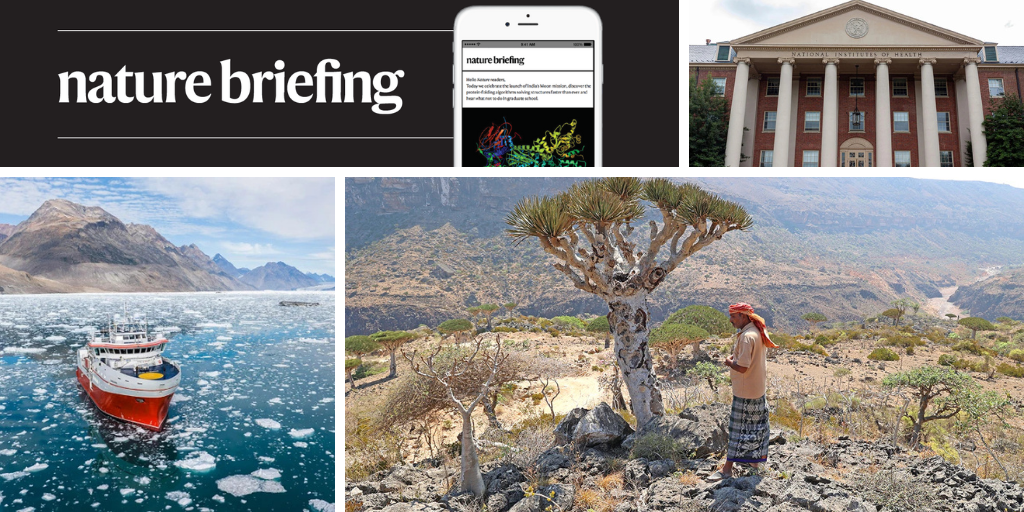
The research vessel Tarajoq is the biggest research investment by Greenland’s government to date.Credit: Alex Rivest
In November, the theme of Greenland Science Week was ‘All Eyes on Greenland’ — a particularly resonant title in the wake of threats by US President Donald Trump to somehow acquire the island, which is also known as Kalaallit Nunaat. The event highlighted that the autonomous territory is a hotbed of globally important scientific research. It is a centre for climate-change studies, a hub of geological and minerals research and a unique place for genetic and biomedical research.
Larvae of the European blister beetle (Meloe proscarabaeus) mimic the scent of flowers to find a ride to their next meal. The larvae produce floral-smelling compounds to lure bees, then hitchhike back to the bees’ nest and eat the eggs they find there. This trickery is the first known example of an animal imitating the scent of a flower. “This was totally unexpected for us,” says biochemist and study co-author Tobias Köllner. “We saw the chromatogram and thought, ‘This is a flower, not an insect.’”
Reference: bioRxiv preprint (not peer reviewed)
The amount of microplastic particles in the atmosphere might be lower than some studies have suggested, possibly even by several orders of magnitude. Researchers fed estimated global microplastics emissions into a computer simulation of how the atmosphere transports pollutants. They found that the predicted amounts didn’t match those reported in studies that directly measured microplastics concentrations in 283 locations worldwide. The findings shouldn’t be used to dismiss the problem of atmospheric microplastics, says environmental scientist and study co-author Ioanna Evangelou. But they do suggest a need to standardize the measurements of microplastics globally, she says.
The US National Institutes of Health (NIH) has announced that it will no longer support studies that use human fetal tissue derived from elective abortions. The move doesn’t mark the end of all such research — some scientists will turn to a much smaller pool of private funding in lieu of government grants. But researchers say the restrictions will make it more difficult to study fetal development and stem cell biology, and will slow the hunt for new medical treatments, say researchers. Other sources of fetal tissue are miscarriages and stillbirths, but they are of limited use.
Crucial grant-review panels for more than half of the institutes that make up the US National Institutes of Health (NIH) are on track to lose all their voting members as their terms expire within the year and because replacements are not being appointed. The law requires these panels to review applications for all but the smallest grants before funding can be awarded. If the advisory councils go dormant, “this could lead to some very big problems for the agency”, says Michael Lauer, who previously ran the NIH’s ‘extramural’ arm, which funds researchers at institutions across the United States. “No grants can get funded without approval from council.”
Features and Opinion
A group of researchers circumvented safeguards on the personal data of more than 20,000 children taking part in the US Adolescent Brain Cognitive Development Study (ABCD) and used it to produce papers arguing for racist theories, reports The New York Times. “It’s evil,” says neuropsychologist Terry L. Jernigan, a co-director of the ABCD Study. “It’s not just that the science is faulty, but it’s being used to advance an unethical agenda.” The situation has raised questions about the ability of the NIH to keep people’s data safe. And some scientists are worried that the door to harmful use of such data is widening, after moves by the administration of US President Donald Trump that could undermine the NIH’s restrictions on research that stigmatizes people.
The New York Times | 19 min read
By any measure, it looks certain that the Earth’s average temperature will surpass 1.5 ℃ above pre-industrial levels — an increase that nations pledged in the 2015 Paris Agreement to prevent. “Continuing to emphasize a failed temperature target might produce more harm than good,” argue climate-policy experts Kwesi Quagraine, Mark Lynas and Erle Ellis. Instead, they suggest a new north star for climate progress: ‘clean-energy shift’. “For example, if clean-energy grows by 6% each year and total energy demand grows by 3%, the clean-energy shift is +3%, meaning that clean energy is displacing fossil energy as a share of total energy generation,” they write. “The bigger the number, the faster the exit from fossil fuels.”
Despite plenty of evidence that it’s key to good health, fibre is not considered to be an ‘essential nutrient’ like vitamins and amino acids — meaning it loses out when nutrition is being prioritized and communicated. Four health researchers argue for giving fibre its due by setting out how it fulfills key requirements of an essential nutrient, including establishing a benchmark for fibre deficiency: a dysfunctional gut microbiome.
Where I work

Mohammed Amar is the Indigenous on-site manager of the Socotra endangered-tree project, mainly funded by the Franklinia Foundation in Geneva, Switzerland.Credit: Rachel Nuwer for Nature
Mohammed Amar is the on-site manager of a project to protect the endangered plant species in his native Socotra, a Yemenii island. He works as a link between scientists, Indigenous communities and local authorities to identify areas for habitat restoration and find strategies that suit conservation and people’s needs. “After seeing the results, local people are becoming more interested in the work. I hope our people retain enough knowledge to care for nature; nature is the source of life,” he says. (Nature | 3 min read)
On Friday, Leif Penguinson was hiding among the lovely llamas in Bolivia’s Sajama National Park, home to the stunning chullpas (burial towers) left by the ancient Aymara people. Did you find the penguin? When you’re ready, here’s the answer.
Thanks for reading,
Flora Graham, senior editor, Nature Briefing
With contributions by Jacob Smith
• Nature Briefing: Careers — insights, advice and award-winning journalism to help you optimize your working life
• Nature Briefing: Microbiology — the most abundant living entities on our planet — microorganisms — and the role they play in health, the environment and food systems
• Nature Briefing: Anthropocene — climate change, biodiversity, sustainability and geoengineering
• Nature Briefing: AI & Robotics — 100% written by humans, of course
• Nature Briefing: Cancer — a weekly newsletter written with cancer researchers in mind
• Nature Briefing: Translational Research — covers biotechnology, drug discovery and pharma


